
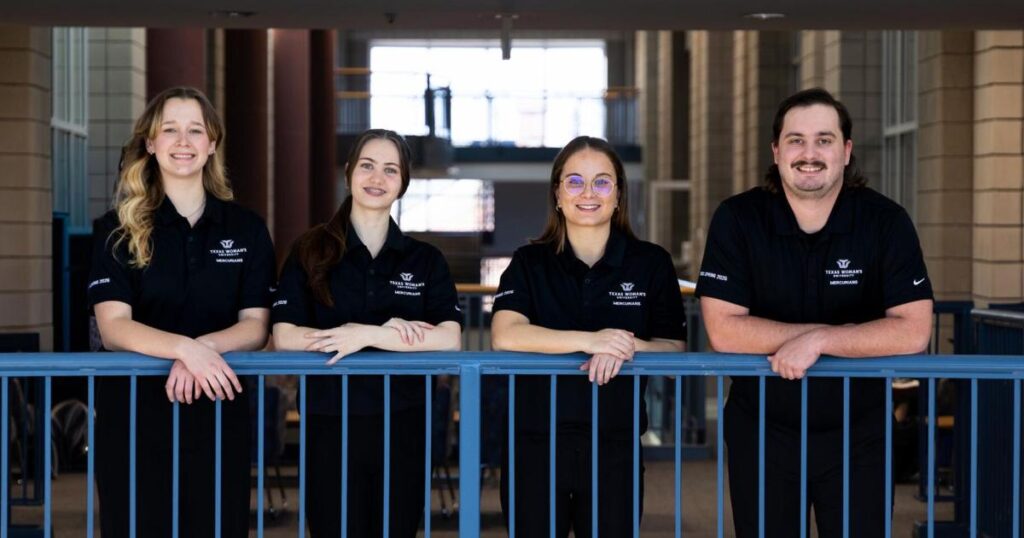
A group of four Texas Woman’s University kinesiology students, as part of Team Mercurians, won the Texas Space Grant Consortium Design Challenge with a boot designed to combat muscle atrophy in space through compressed air pistons.
The competition’s judges, who hold positions at NASA, evaluate student projects for potential and provide feedback and guidance for further development. Each member of Team Mercurians received a $1,000 scholarship award for their overall win.
“You pick a topic and address that issue with some kind of solution or countermeasure,” said Gabriella Powell, TWU kinesiology junior and team leader. “It’s primarily engineering, but we are kinesiology students, so we kind of bring a physiology side to it.”
The Texas Space Grant Consortium has administered the annual competition and showcase every year since 2002, where teams from different schools select NASA-related challenges involving spaceflight, astronauts and mission operations.
The TWU team’s project, called Biomechanical Oscillation and Overcoming Tissue atrophy, or BOOT, went up against nearly 20 schools to win first place.
Powell said BOOT was built upon a project the TWU team created last year, aimed to reduce muscle atrophy, the loss or thinning of muscle mass that commonly occurs in space due to a lack of gravity. The technology works by simulating walking in microgravity, a state of minimal gravity where astronauts do not experience normal weight-bearing, through airbags.
“By creating this device, they were trying to inflate the airbags in a cyclical pattern then mimic a walking pattern,” Powell said. “Targeting receptors at the bottom of the foot and by applying pressure to those, you’re activating musculature in the lower legs.”
The team said they wanted to build on the earlier project and improve its design with TWU kinesiology senior Austin Travis serving as the team’s design lead.
Powell said the group modified the device by replacing the airbags with mechanical components and pneumatic pistons. She said they focused on applying a comfortable amount of pressure at the bottom of the foot to activate lower leg muscles while maintaining safety and comfort.
“We did a lot of background research and then with that research, we tried to target that amount of force and pressure with our device,” Powell said.
With four students with backgrounds primarily in kinesiology, the study of human motion and health, and the BOOT requiring engineering skills, TWU kinesiology senior Candela Fidalgo said the team initially lacked the necessary knowledge.
Fidalgo served as the team’s lead researcher and said she used her skills in research to better understand the project.
“It was quite hard at the beginning because I don’t really know anything about engineering, I know a lot about research,” Fidalgo said. “I read a lot of articles about pneumatic systems and how they worked.”
TWU kinesiology senior Natalie Vogel served as the team’s coder, handling the programming, circuitry and pneumatic system, a role she previously did not have much experience in.
“Before this, I had never done any coding apart from once in middle school,” Vogel said.
“I would watch a lot of YouTube videos and work on it on my own time.”
To overcome learning lots of new skills and other obstacles, Powell said teamwork played a critical role in the group’s overall success. She said she felt proud of all the work the team put in when presenting their finalized device at the showcase held on April 14.
“There wasn’t a single time when I felt like I was struggling and I was on my own, I couldn’t have done it without these guys,” Powell said. “[…] This semester wouldn’t have gone as well as it did without collaborating […] there were certain struggles that we faced throughout the semester and lots of doubts on whether we would place at all, it just felt really rewarding in the end.”