

Something is missing from the universe. Not misplaced, but structurally absent. About 85 percent of all matter in existence cannot be seen, touched, or detected by any instrument humans have built. It bends light. It shapes galaxies. And for decades, no one has been able to say what it actually is. Now a team of theoretical physicists thinks a single undiscovered particle might answer that question, and that the particle lives in a dimension beyond anything human senses can reach.
A study published in The European Physical Journal C proposes a particle that would connect ordinary matter to the invisible dark matter that outweighs it by a ratio of five to one. The researchers, Adrián Carmona of the University of Granada, and Javier Castellano Ruiz and Matthias Neubert of the PRISMA+ Cluster of Excellence at Johannes Gutenberg University Mainz, call it “a possible new messenger to the dark sector.” Their model places it in a warped fifth dimension, just beyond the four that humans experience as space and time.
The Puzzle That Pointed Elsewhere
The research did not start as a hunt for extra dimensions. It started with a narrower irritant: why do the fundamental particles of matter weigh what they weigh?
Fermions (electrons, quarks, neutrinos) are the basic constituents of all physical matter. Their masses span twelve orders of magnitude across three distinct families, a range so extreme that the Standard Model, physics’ most successful framework, offers no satisfying account of it. “We knew that the masses of these constituents had some special features, which were crying out for an explanation,” the team said.
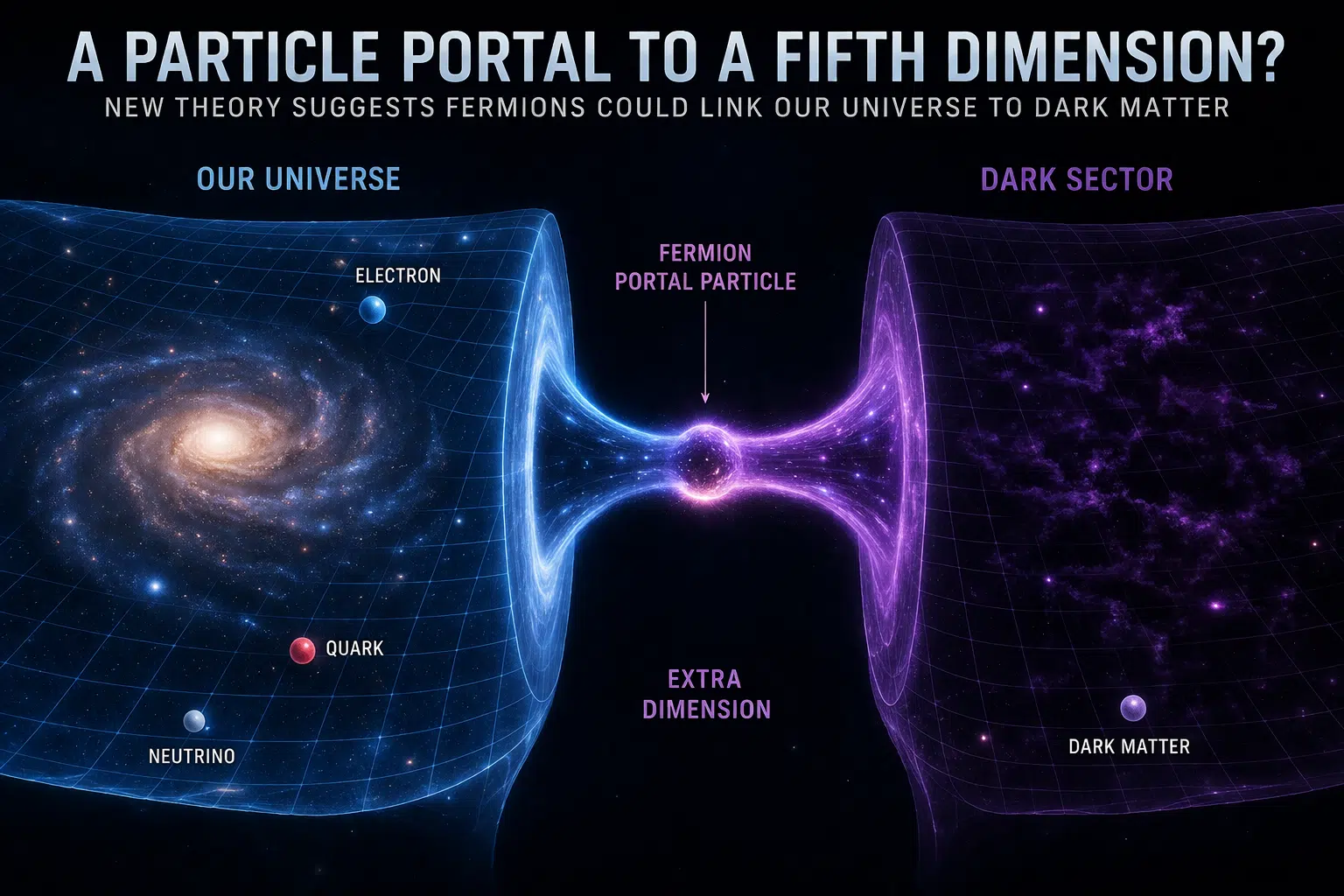 Fermion masses follow patterns so extreme that even physics’ most successful framework cannot explain them. Image credit: A.Arezki/DG
Working through equations that describe what a hidden fifth dimension would do to physical reality, the researchers kept finding the same thing: a new field in the mathematics, tied to a particle nobody had proposed before.
A Bridge Between Two Kinds of Matter
The particle resembles the Higgs boson closely enough in its quantum properties that the two would mix, forming a channel between visible matter and whatever occupies the fifth dimension. That channel is what pulls dark matter into the picture.
“If this heavy particle exists, it would necessarily connect the visible matter that we know and that we have studied in detail with the constituents of dark matter,” the researchers told VICE, “assuming that dark matter is composed out of fundamental fermions, which live in the extra dimension.” The models they built around the particle held up against existing observational data on how dark matter is distributed across the cosmos, a baseline test any credible dark matter hypothesis must clear.
 A single particle mixing with the Higgs boson could form the first real bridge between visible and dark matter. Image credit: Shutterstock
If the particle were ever confirmed, it could reveal the mass range of dark matter and how it interacts with ordinary matter, two of the most wanted numbers in modern physics.
Why No Machine Built Today Can Find It
The Higgs boson was predicted in 1964 and not confirmed until 2012, after the Large Hadron Collider at CERN was built specifically to reach it. The particle the Mainz and Granada team proposes would be heavier still, beyond what the LHC can produce under any conditions currently planned.
Proposed next-generation machines, among them the International Linear Collider and the Future Circular Collider, could eventually approach the required energies. But even at 100 teraelectronvolts, roughly seven times the LHC’s design energy, a direct detection would be “very challenging,” the researchers wrote. That is not a dismissal. It is a timeline.
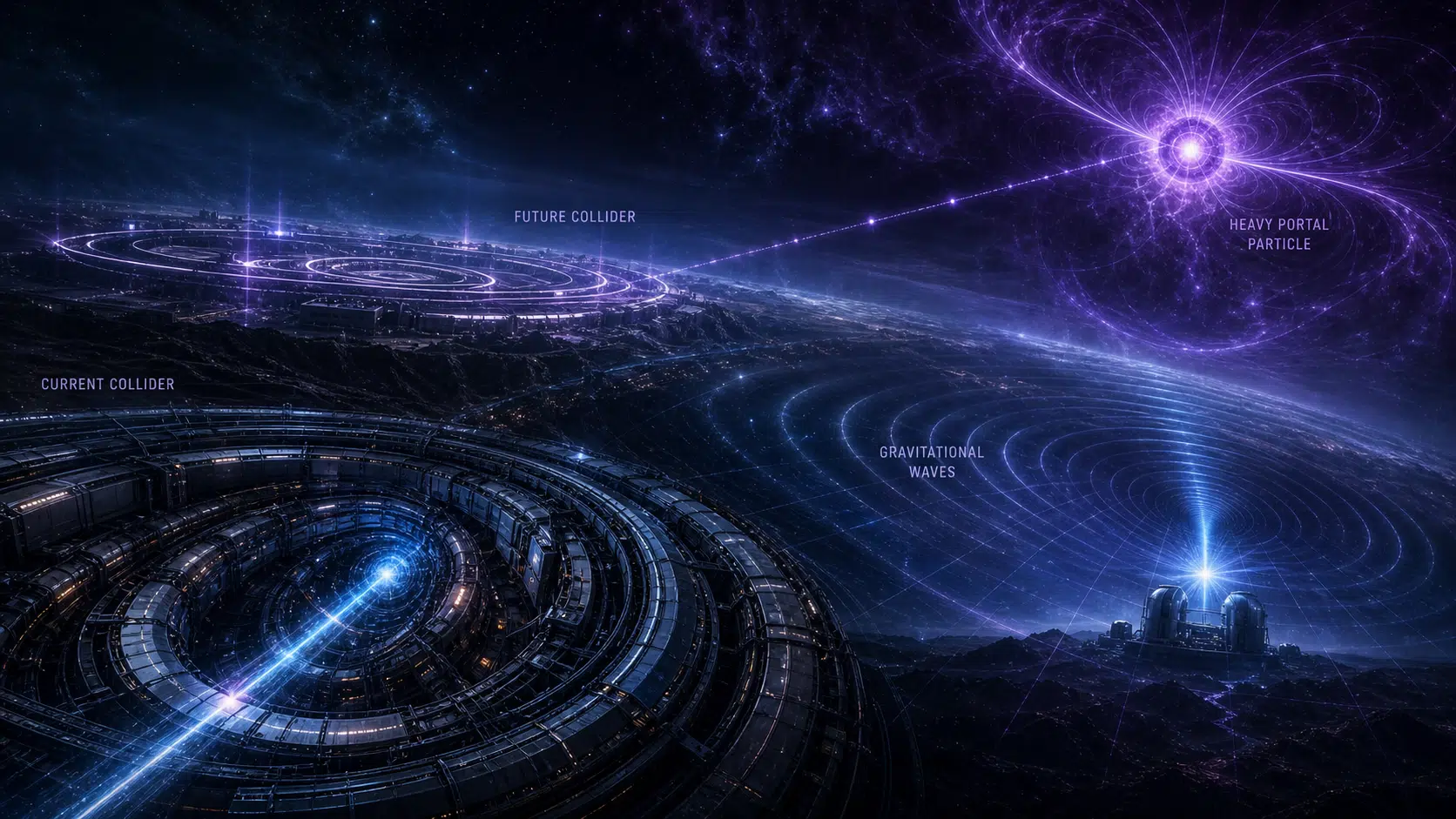 The particle is too heavy for any collider on Earth. The search now depends on ripples left over from the Big Bang. Image credit: A.Arezki/DG
The more practical near-term path runs through gravitational waves. Ripples in spacetime from violent events in the early universe can persist billions of years and arrive at detectors today. The researchers believe the new particle may have shaped that early cosmological history, leaving a signal that future observatories could pick up without a collider capable of producing the particle directly.
One Particle, Several Loose Threads
Dark matter is not the only problem the proposed particle touches. The same mathematical framework raises the possibility of addressing two other long-standing puzzles: the flavor puzzle, which asks why fermion families exist at all in their current configuration, and the hierarchy problem, which concerns why gravity is so vastly weaker than every other fundamental force.
The researchers also identified a related question they have not yet pursued: whether the new particle helped stabilize the fifth dimension itself during the early universe. If it did, that process may have generated gravitational wave signatures detectable by future observatories, independent of any collider result.
The full study is available in The European Physical Journal C. The team has said follow-up work will examine the particle’s potential cosmological signatures and whether future hadron colliders could detect any indirect trace of it.