
Donald Trump talks the language of hyperbole. He’s a salesman at heart, whether it’s in real estate or politics or anything else, and he has the showman’s instinct for performance.
It’s certainly served him well. Who can argue the results? Billions in wealth and the White House. Twice.
But there are times when this Trumpian skill, honed but untamed, becomes a burden. It’s a risk Trump should have learned by now. But there’s a danger he’s walking into again, and it is coming so soon after the last time.
Things You Wouldn’t Believe
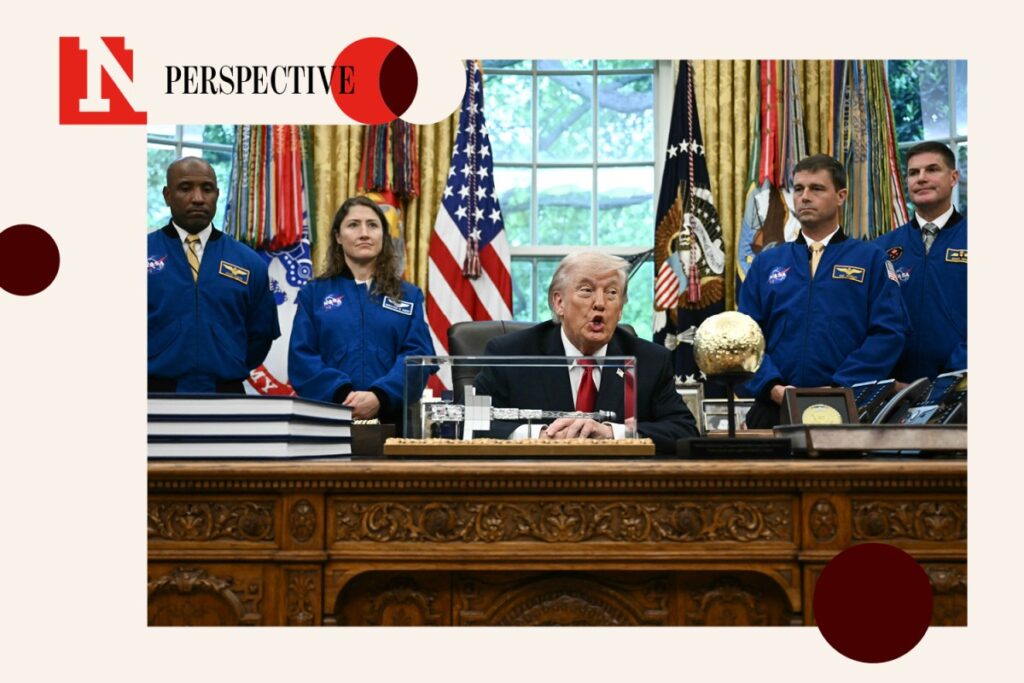
The big orange man is talking about little green men. At a White House appearance with NASA’s Artemis II crew, the president said he had interviewed pilots who “saw things that you wouldn’t believe”.
We’ll know more with the imminent files release. Trump said the review he ordered of the government’s UFO files had found “many very interesting documents” and that the first releases would begin “very, very soon.”
It’s a message his MAGA supporters in Congress are running with, dancing around the tantalizing proposition of wonder, pilots, secrecy, and an imminent payoff.
The House Oversight task force led by Representative Anna Paulina Luna, a Florida Republican, charged with pushing the federal government to be more open about its secrets, went even further than Trump.
“I have seen evidence in a SCIF [Sensitive Compartmented Information Facility] that leads me to believe there are things we cannot explain,” Luna said on the Pod Force One podcast. “I have observed things that are of nonhuman origin and creation. That’s my opinion.”
Her opinion cuts against what the Pentagon’s own UFO office (AARO) has said: It found “no evidence” of extraterrestrial beings, activity, or technology.
The risk here is similar to the aftermath of the Jeffrey Epstein files saga: Trump is making the same mistake again in overselling what his administration can actually deliver to an increasingly disillusioned MAGA base.
The Epstein files were late, released in bits, sloppily redacted, had key pieces missing, and left MAGA with even more questions than they started with about the sex offending financier.
It didn’t help that, having persistently sold MAGA a giant establishment cover-up, Trump’s officials concluded the same as its predecessors: Epstein killed himself in jail and didn’t have an elite client list that he blackmailed.
What the People Want
Still, despite the Epstein letdown, the public is ready to hear what it suspects about UFOs, not merely what analysts or intelligence officials can prove, as recent YouGov polling makes clear.
When Trump said there are things “you wouldn’t believe,” he was wrong. People already believe.
A November YouGov survey found that 56 percent of Americans believe aliens definitely or probably exist, 47 percent believe aliens have visited Earth, and 73 percent think the U.S. government would hide UFO evidence from the public.
That’s fertile ground for declassification, but it is also a trap, because a public primed to expect proof may treat ordinary ambiguity as deliberate concealment.
The Epstein files are not a perfect parallel, because those records concern real victims and a convicted sex offender rather than unresolved aerial sightings.
But they demonstrate how Trump-world transparency can backfire when insinuation outruns the document trail, as the DOJ memo showed.
Politically, it told a MAGA movement trained to expect a hidden list that the list was not there, and the administration’s handling angered both Republicans and Democrats.
The aftermath was not closure but escalation.
A bipartisan Epstein Files Transparency Act that legally forced their disclosure by a short deadline. And now, the Justice Department’s watchdog is reviewing how the DOJ handled the mandated release and redactions.
That is the Epstein error in a nutshell: treat disclosure as a promised climax, deliver a messy record, and watch the audience call the mess a continuation of the cover-up.
We Need to See the Files
The best argument for releasing UAP material is not that the truth about aliens are waiting in a file cabinet, it’s that pilots, sensors and restricted airspace deserve a serious accounting, as House Oversight has argued.
AARO’s annual report said some cases remained unresolved, identified two military-aircrew reports involving flight-safety concerns, and described three reports in which pilots said they were trailed or shadowed by UAP.
The same report said a commercial crew reported a possible near miss with a cylindrical object off the coast of New York and that AARO was continuing to analyze the case.
It also recorded 18 reports from nuclear-security and regulatory officials about incidents near nuclear infrastructure, weapons and launch sites, all categorized as unmanned aircraft systems.
All of that is troubling enough to justify oversight and greater transparency without promising through implication a trove of earth-shattering secret intelligence about alien spacecraft.
Luna’s September hearing on the issue framed UAP disclosure as “national security, government accountability, and the American people’s right to the truth,” which is a defensible brief when government reporting channels and military witnesses are involved.
But the serious version of that case is dry, technical and likely full of balloons, drones, sensor limits and classification fights, as AARO history suggests.
AARO’s historical review said most sightings were ordinary objects or phenomena and that many unresolved cases lacked good data, not that every unexplained dot was a spaceship.
Historic Disclosure
Representative Thomas Massie, a Republican who helped force the Epstein vote, had called Trump’s UFO move the “ultimate weapon of mass distraction” and warned that “the Epstein files aren’t going away… even for aliens.”
This sharp criticism identifies the weakness in Trump’s current play.
A president cannot keep converting distrust of government into suspense without eventually producing evidence that changes minds, especially when 73 percent of Americans already think the government would hide UFO evidence.
Trump’s defenders would say he is doing what many voters say they want, because the House task force was built to examine secrets of public interest, and Luna explicitly included UAPs, Epstein, COVID-19 origins, and 9/11 files in its transparency agenda.
But “release the files” is a slogan, while declassification is a grind of exemptions, redactions, privacy rules, victim protection, intelligence equities and dull explanations, as the Epstein release problems showed.
The Epstein release became chaotic partly because disclosure was treated as proof that politics had suppressed the obvious truth, one that many people believed before seeing the evidence, and not as a legal process with limits.
If the UFO files contain unmistakable evidence of nonhuman technology, Trump will own a historic disclosure with implications that are quite literally out of this world, despite AARO’s prior “no evidence” findings.
But if they merely contain intriguing clips, ambiguous sensor returns, and more unresolved cases, he will own the expectation gap he created, because the AARO report already shows how often mystery survives without becoming revelation.
The first outcome would be extraordinary; the second is how conspiracy politics usually loses customers, one anticlimax at a time.
Hey gang, Carlo Versano here. I hope you enjoyed this article. As Newsweek’s Director of Politics and Culture and editor of the 1600 newsletter, I’m keen to hear what you think. Now, Newsweek is offering a new service to allow you to communicate directly with me in the form of a text message chat. You can sign up and get a direct line to me, as well as the reporters who work for me. You can shape our coverage.
As a Newsweek member, we’re offering this service to you for free. You can sign up below, or read more about how it works here. Let’s talk!