
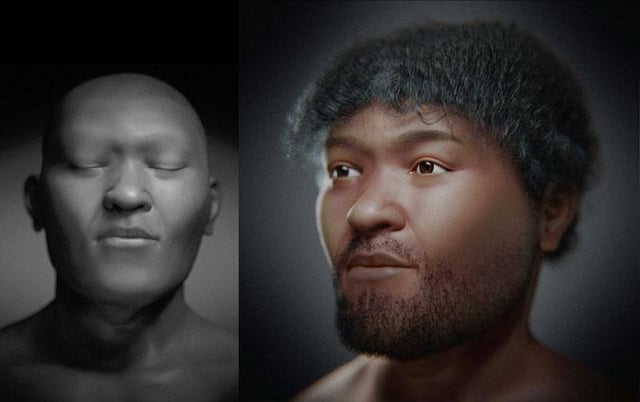
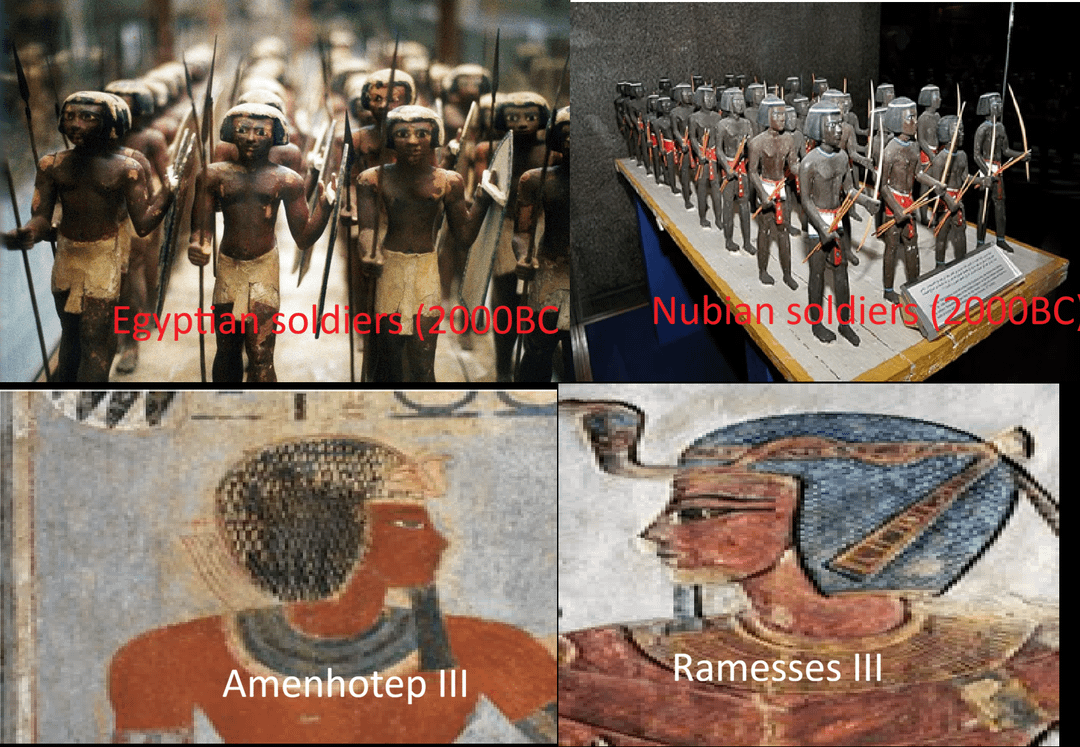
When we look at the depictions of ancient Egyptians, one thing is clear. Their hair, their skin, and their facial features make it obvious that they have significant Sub-Saharan ancestry (see the 1st and 2nd picture added to this post). When we read all the descriptions written by ancient Greeks, it is notable that also they describe the ancient Egyptians as similar to Sub-Saharan populations.
Now, why does it seem like the media tries to gaslight us in regard to denying significant Sub-Saharan ancestry?
The first example is a genetic research in regards to the whole genome of an ancient Egyptian individual, this case from the site called Nuwayrat, with the study called "Whole-genome ancestry of an Old Kingdom Egyptian".
In the study, it is stated that "if tracing the ancestry of many present-day Egyptians in our study to the Bronze Age, much of it would be found in groups related to Nuwayrat or alternatively to sources best represented by Middle Neolithic Morocco from which approximately 80% of Nuwayrat’s ancestry derives."
What the study fails to explain, is that Middle Neolithic Moroccans still carry around ~20–30% of deep-rooted Sub-Saharan ancestry. This means that this individual still is about a quarter Sub-Saharan. According to the research; "the Nuwayrat individual is predicted to have had brown eyes, brown hair and skin pigmentation ranging from dark to black skin." The first image added to this post shows how the individual most likely must have looked like. As one can see, a very Sub-Saharan African looking man.
Furthermore, if the North African Neolithic source ultimately derives partly from earlier North African groups such as so-called "Iberomaurusians", then some older African ancestry may be hidden inside the “North African” label rather than counted separately as “Sub-Saharan.” With other words, the Sub-Saharan ancestry could be much higher than ~20–30%.
Also, the study reportedly excluded substantial ancestry related to Mota Cave Ethiopia, central Africa, eastern Africa, or southern Africa in this individual. However, The study’s rejection of Mota-like or central/southern African ancestry does not necessarily mean it fully tested for ancient Nubian or Upper Nile-related ancestry. Nubian ancestry is not identical to West African, central African, or Ethiopian Mota-like ancestry. Why is this ancestry not included, given that this Sub-Saharan ancestry is the most likely candidate?
The second example could be seen as a clearer example of blatant gaslighting, which comprises a genetic research in regards to an ancient Egyptian individual from Abusir-el Meleq, called: "Ancient Egyptian mummy genomes suggest an increase of Sub-Saharan African ancestry in post-Roman periods".
However, what this research completely fails to inform us about, is that Abusir-el Meleq should be interpreted with enormous doubt due to several limitations. The site itself, Abusir el-Meleq, was used over a long period and became increasingly cosmopolitan, especially during the Ptolemaic and Roman eras, when individuals of Greek, Roman, and other foreign backgrounds settled in the region and integrated into local society.
The research only goes back to the late New Kingdom. As a result, the sampled individuals reflect a mixed or regionally specific population rather than a broadly representative cross-section of ancient Egyptians. If we want to research the general genetic ancestry of all Americans, we don't dig up the remains from Chinatown to determine the overall ancestry, just to give an example.
In addition, the study relies on modern reference populations to model ancestry, particularly for identifying “Sub-Saharan” components. These proxies are imperfect and do not represent the genetic ancestry of ancient African populations, such as those from Nubia. Because ancient Nubian genomes were not systematically included as a distinct reference, certain forms of African ancestry, especially those related to the Upper Nile, may be completely underrepresented or mischaracterized in the results. This is especially true, since the site Abusir el-Meleq had Nubians being buried there according to Nubian traditions with Nubian Products like black rimmed clay bowls and an alabaster vanity panel.
Taken together, these factors suggest that the Abusir el-Meleq data does only provide valuable insights into one regional population, it should not be generalized to all of ancient Egypt without considering its specific archaeological context and the limitations of current genetic modeling. Furthermore, also in this research, the most-likely candidate, Nubian, is completely ignored.
Unsurprisingly, there are at least 6 researches (Jean Gourdine et al. (2018), S.O.Y. Keita (2022), Danielle Candelora (2022), Nancy Stiebling & Laura Helft (2023), Christopher Ehret (2023), Augustin Holl & Jean Gourdine (2023)) heavily criticizing the aforementioned research that concludes that ancient Egyptians had "less Sub-Saharan ancestry than modern Egyptians", a completely incorrect title that seems to only have been used to gaslight readers into making them believe ancient Egyptians were less related to Sub-Saharan African populations, which can absolutely not be inferred from the aforementioned research.
Why does a study uses this disingenuous title, if not only to gaslight us in regards to the supposed (lack of) Sub-Saharan ancestry of ancient Egyptians, in combination with presenting conclusions that do not tell the picture of the Sub-Saharan ancestry of all ancient Egyptians, but pretends that it is in regards to a population which can not even be regarded as representative of all ancient Egyptians?
Are we being gaslighted in regards to the Sub-Saharan ancestry of ancient Egyptians?
by DvaravatiSpirit
3 Comments
You are picking a few random examples here to show that they were sub Saharan when you might as well just pick others that support the opposite claims.
The media is not gaslighting you. Netflix even made Cleopatra black which she definitely was not.
Look into who carries on all the Egyptian traditions, dress, literally the priesthood entrusted with the Sigui ceremony(Egypts Henti). But this doesn’t really matter, because Old Egypt the land to the West is where everything we read about happened.
Definitely.