
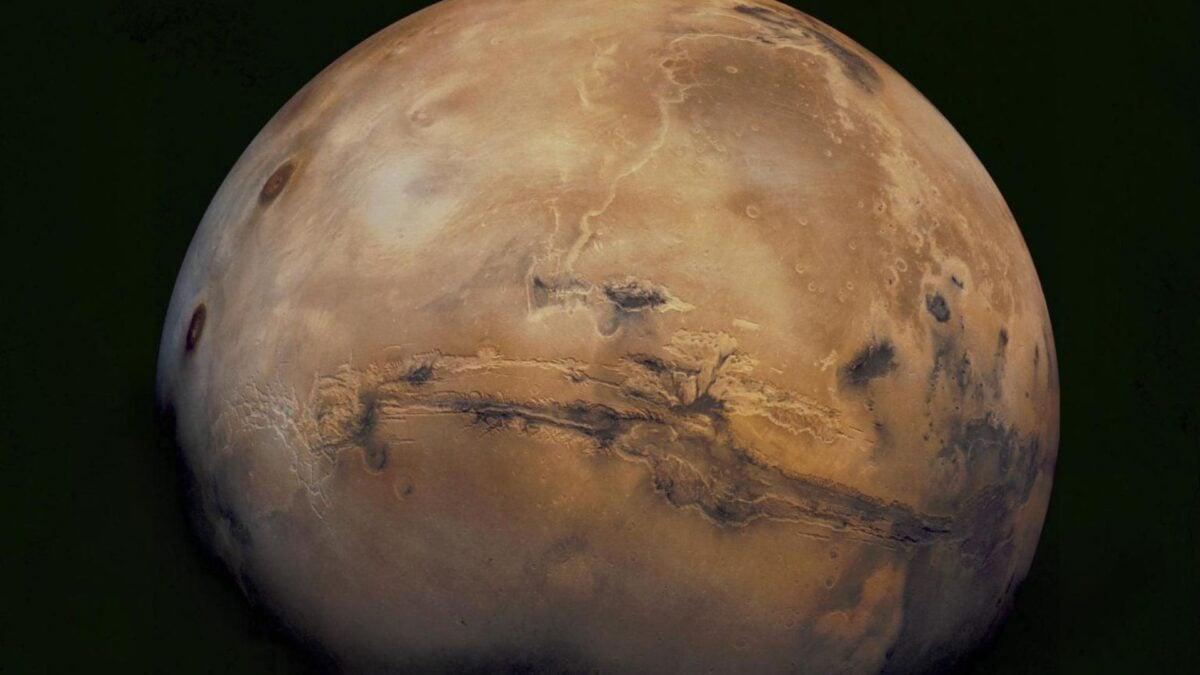
Astronomer Finds a Shortcut to Mars by Following an Asteroid’s Journey Through Space | Orbital data from asteroid 2001 CA21 points to a potential 153-day round-trip journey to Mars.
by Clear_Polish23
Astronomer Finds a Shortcut to Mars by Following an Asteroid’s Journey Through Space | Orbital data from asteroid 2001 CA21 points to a potential 153-day round-trip journey to Mars.
by Clear_Polish23
7 Comments
That one cool trick that NASA doesn’t want you to know!
The article didn’t do anything to make this less click- baity.
A one-way trip to Mars takes somewhere between seven and 10 months, following a fairly direct route between Earth and our neighboring planet. But what if we could cut that journey by more than half, reaching the Red Planet and returning back to Earth in less than a year?
Using the early orbital data of asteroids, an astronomer may have found the ultimate spacecraft shortcut through the solar system. In a new [study](https://www.sciencedirect.com/science/article/pii/S0094576526002456), Marcelo de Oliveira Souza of the State University of Northern Rio de Janeiro followed the predicted route of asteroid 2001 CA21 to look for a new path to reach Mars. The results, published in the journal Acta Astronautica, identify a course that would take approximately 153 days for a round trip to the Red Planet and back.
**Earth to Mars**
To set a course for Mars, scientists behind interplanetary missions calculate precise data based on the planets’ movements through space. The distance between Earth and Mars is in constant flux due to their orbits. The two planets are closest together when they’re both on the same side of the Sun and are farthest apart when they are on opposite sides of the host star.
Every 26 months, Earth passes directly between the Sun and Mars. This alignment, known as the Mars opposition, is when spacecraft set a course for the Red Planet. The astronomer behind the recent study, however, wondered whether there could be hidden shortcuts en route to Mars during the planet’s closest approach to Earth.
To find said shortcut, Souza followed the early predicted path of a near-Earth asteroid that crossed the orbit of both Earth and Mars.
I don’t understand what the “trick” is here, and the gizmodo author probably doesn’t either.
Like, this literally sounds like technobabble:
*The asteroid’s early orbital predictions describe a highly eccentric trajectory with a well-defined sub-ecliptic orbital plane, or the plane that contains Earth’s orbit around the Sun.*
This straight up doesn’t make sense:
*The researcher looked for a route to Mars that stayed within five degrees of the asteroid’s tilt, which would allow a spacecraft to take a more direct flight to the Red Planet.*
But regardless, this makes the results extremely limited in scope:
*the researcher found that 2031 was the only year in which the Earth-Mars geometry aligned favorably with the asteroid’s orbital plane*
Again though, I am not sure what the main takeaway of this is.
You can get to mars in a month if you want. All you need is more fuel. Thanks again for attending my ted talk.
[Here is a link](https://phys.org/news/2026-04-interplanetary-shortcut-mars.html) to what I assume is the source article, without all the ad cancer.
I have to admit I don’t really understand how this is possible. The shortest possible flight path between two relatively near celestial bodies *seems* to a non-astrophysicist (me) like it should be reasonably easy to work out. [Here’s the paper.](https://www.sciencedirect.com/science/article/pii/S0094576526002456) Maybe someone who does this for a living can eli5 it for us?
My one wish in life is that I was smart enough to understand orbital mechanics. The mathematicians to do orbital mechanics are truly amazing.
Some sort of Rich Purnell maneuver