
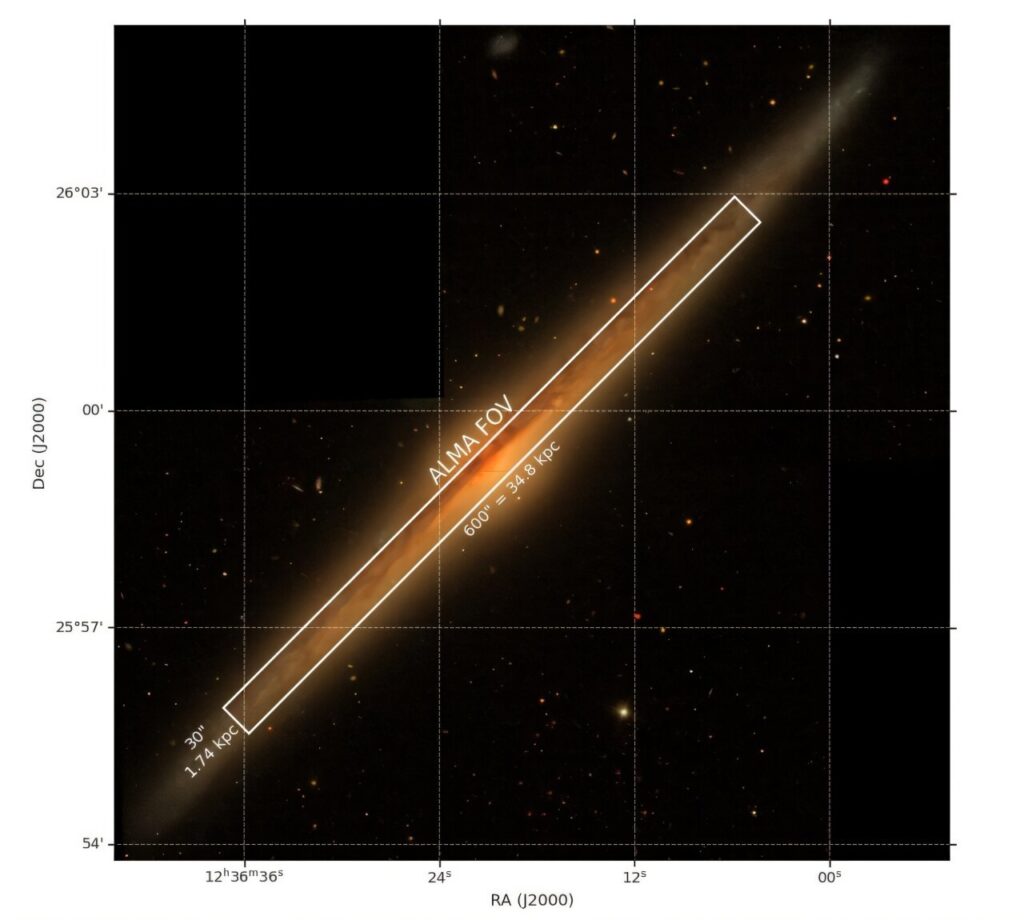
The American Atacama Large Millimeter/submillimeter Array (ALMA) has been studying the galaxy NGC 4565, nicknamed “Needle” because of its shape, for some time. The study made it possible to observe large molecular clouds containing carbon dioxide.
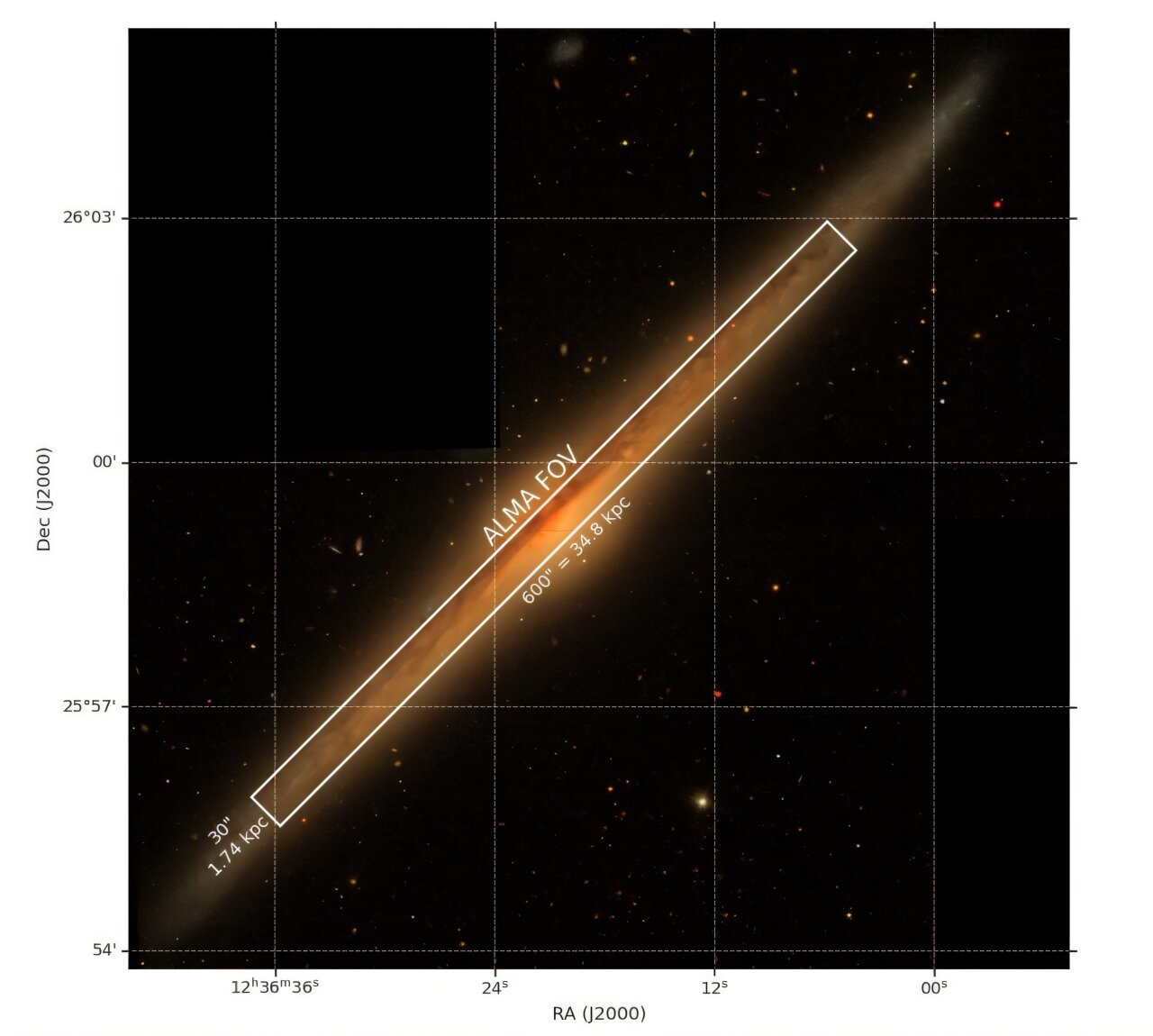 The Needle Galaxy. Source: phys.org
Interesting places in the Needle galaxy
NGC 4565, known as the “Needle galaxy” due to its narrow profile, is a striking example of a spiral galaxy viewed edge-on. The galaxy has a diameter of about 176,000 light-years and a mass of 80 billion solar masses. The distance to NGC 4565 is estimated to be approximately 39 million light-years.
The Needle galaxy is considered to be analogous to the Milky Way and also shares many similarities with the Andromeda galaxy. That is why a team of astronomers led by Grace Krahm of Ohio State University decided to study this galaxy in greater detail using ALMA, focusing on the molecular gas in its interstellar medium (ISM). Such research could be extremely important for studying the processes that control star formation, galactic evolution, and gas cycles between different phases of the interstellar medium.
Research using ALMA radio telescopes
Scientists conducted high-resolution ALMA observations in the 12CO(2-1) and 13CO(2-1) bands, which provide a detailed view of the molecular gas in NGC 4565 at a large angle of inclination.
The ALMA observations allowed Krahm’s team to identify giant structures on the scale of molecular clouds throughout the molecular disk of the Needle galaxy, including the outer, low-density regions where atomic gas makes up the bulk of the interstellar medium. This helped them investigate how the properties of molecular clouds and the vertical structure of the interstellar medium vary with galactocentric radius and local environment.
Comparison of galaxy NGC 4565 with other galaxies
In particular, observations have revealed that the Needle galaxy contains very little molecular gas within its ring. Next comes a disk dominated by molecular hydrogen, followed by an outer disk composed of hydrogen iodide. With regard to the radial profiles, the data obtained indicate a certain similarity to the Andromeda Galaxy and the spiral galaxy NGC 2775.
The collected data indicate that the radial profiles of NGC 4565 in the optical and mid-infrared wavelengths extend far outward over large scales, reflecting the galaxy’s high mass and substantial size. It has been determined that the 13CO/12CO ratio is approximately constant within a radius of 16,300–42,400 light-years, which corresponds to a uniform optical depth and isotopic composition throughout the galactic disk.
The study showed that the molecular disk of the Needle galaxy is thin, with its vertical extent decreasing as the radius increases. As for giant molecular clouds (GMCs), it turns out that they are predominantly aligned with the galaxy’s major axis, with a moderate axis ratio of about 1.5.
In general, the molecular clouds in the Needle galaxy have sizes, velocity dispersions, surface densities, and virial parameters that, on the whole, correspond to the distribution of physical properties in galaxies with lower inclination.
Observations have also revealed a prominent star-forming region in the ring of the Needle galaxy, corresponding to a high density of molecular gas. The authors of the article named this complex the “East Ring Pileup.” The images obtained suggest that the “East Ring Pileup” contains a compact region dubbed the “Jewel,” which is bright across many wavelengths and comparable in density to starburst regions in the Local Group, such as 30 Doradus.
According to phys.org