
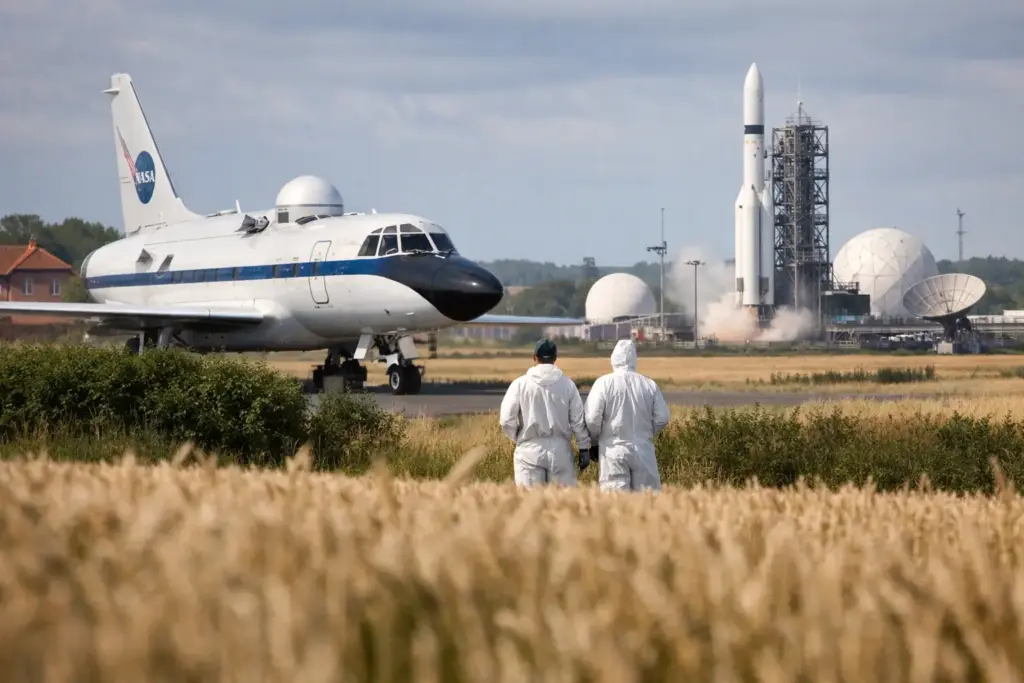
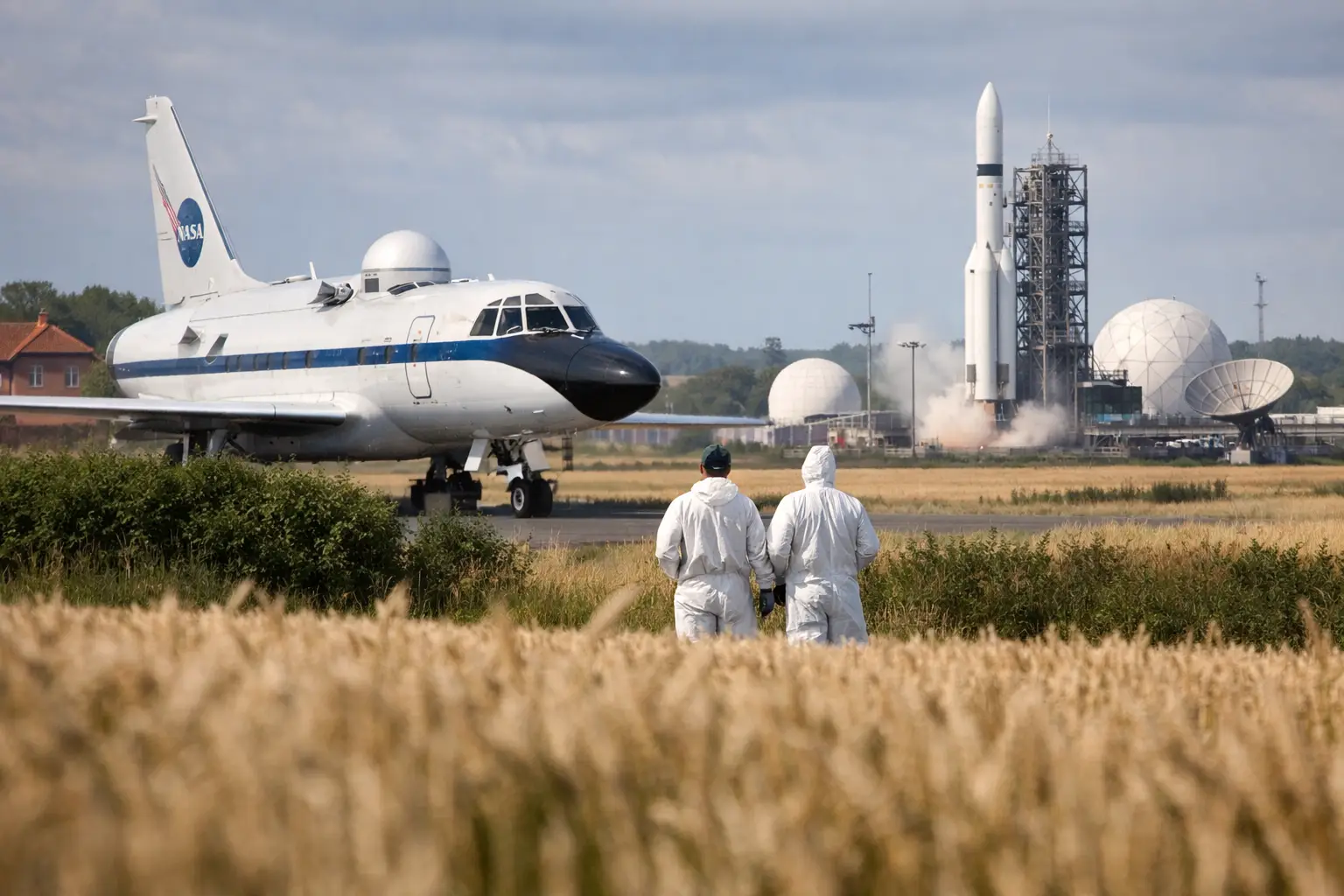
A small lay-by outside Stowmarket has been cordoned off after what officials are calling a major breakthrough in NASA research, though locals maintain it is still, at heart, just a muddy bit near some bins.
By Our Norfolk Reporter: Ian Bred
The announcement came after three people in hi-vis, one man with a clipboard and a woman from Bury St Edmunds who once did a Level 3 in Applied Science were seen staring into the middle distance and saying the word “trajectory” with grave conviction. By teatime, rumours had spread that Suffolk had become the latest frontier in international space science, narrowly beating Swindon and a retail park outside Crewe.
Why NASA research has set its sights on Suffolk
According to sources speaking with the confidence usually reserved for parish councils objecting to a cycle lane, NASA research teams became interested in Suffolk after satellite images detected several phenomena too baffling to ignore. Among them were the enduring mystery of a traffic queue forming for no reason on the A14, the unexplained vanishing of all decent mobile signal near Framlingham, and a bright orange glow over Ipswich later confirmed to be a Toby Carvery sign in fog.
A mock-serious briefing held in a village hall described the county as “an ideal live test environment for observing resilience, strange weather and men who insist shorts are appropriate in February”. Researchers are also said to be fascinated by local gravitational anomalies, particularly the force that pulls every conversation in a pub towards planning permission, potholes or someone who used to know Ed Sheeran’s cousin.
The early findings are said to be promising. One working paper, seen briefly before being used to steady a wobbly trestle table, claims Suffolk offers “conditions analogous to deep space”, including silence, uncertainty, weak public transport links and the sensation that one is very far from central government.
The key areas of NASA research now under review
The programme is broad, which is the sort of thing officials say when nobody is fully sure what anyone is doing. Still, several strands of NASA research have emerged as priorities.
Tractors as lunar transport
Engineers are reportedly studying whether a slightly elderly tractor from near Diss could outperform modern lunar rovers, mainly because it already knows how to handle ruts, stubborn terrain and an operator giving contradictory instructions. One prototype mission involved a Massey Ferguson carrying a flask, three cables and a man called Keith across a beet field while observers nodded and took notes.
The trade-off, naturally, is speed. The tractor may be reliable, but its top pace remains “steady” in the same way a village fête is lively. On the other hand, it can be repaired with a hammer, mild swearing and a biscuit tin of miscellaneous bolts, which gives it a clear advantage over most government procurement.
Pub acoustics and extra-terrestrial communication
Scientists have long searched for intelligent life elsewhere in the universe. Suffolk has offered a more immediate challenge by asking whether two men at opposite ends of a crowded pub can exchange a coherent message about darts without either party mentioning Nigel Farage, a caravan or inflation.
Initial results suggest alien communication may prove easier. A simulated contact exercise in Woodbridge broke down after six minutes when one participant began explaining how pubs used to be better before everyone had opinions. Researchers nevertheless believe the county’s public houses remain useful testing grounds because they combine noise, folklore and inexplicable stickiness in a single enclosed habitat.
The atmospheric mystery of seaside chips
One of the more ambitious branches of NASA research concerns the question of why chips bought by the sea are either the finest thing a person has ever eaten or a gull-mediated financial error. Teams in Lowestoft are said to be measuring salt density, wind behaviour and the confidence levels of teenagers working the fryer on Bank Holiday weekends.
This has led to some disagreement. Purists argue the science is compromised by vinegar. Others insist vinegar is the science. It depends, as ever, on whether one approaches the issue as an academic or as a person standing on a promenade trying not to lose a sausage to a bird the size of a terrier.
Local reaction to the Suffolk space project
Public enthusiasm has been mixed but lively. Some residents are thrilled that the county is finally receiving international recognition beyond being described by weather presenters as “the dry bit”. Others have questioned whether NASA research funds should be spent here at all when the village hall roof still leaks and the bus timetable appears to have been designed by a hostile philosopher.
In Kesgrave, one retired engineer said the whole thing made perfect sense because “if you can land a machine on Mars, you should be able to sort the roundabout by Tesco”. This has not yet been adopted as official policy, though insiders say it has been added to a whiteboard under the heading Strategic Opportunities.
Elsewhere, farmers have responded with measured scepticism. Several noted that if American scientists wish to understand dust, machinery failure, long hours and being ignored by Westminster, they could simply spend ten minutes near a grain store in August. One, speaking while leaning on a gate in the approved national style, said he welcomed the attention but hoped nobody would try rebranding slurry as bio-astro matter.
What NASA research says about British expertise
For all the silliness, there is something oddly plausible about the idea that major scientific work ends up in provincial Britain wearing borrowed wellies. The country has always excelled at making world-changing discoveries in underheated rooms with poor biscuits and one extension lead that looks legally troubling.
That is where the story gains traction. NASA research has the glamour of rockets and cosmic ambition, but much of real science is patient, fussy and surprisingly close to a car park. It involves collecting data, arguing over definitions and pretending a laminated badge makes everyone feel more in charge than they are. On that basis, Suffolk may indeed be the ideal partner.
The bureaucracy problem, now in orbit
No British project is complete without paperwork developing its own weather system. Sources say the local liaison team has already produced fourteen forms, three risk assessments and a consultation on whether the phrase “mission control” might unfairly raise expectations at Mid Suffolk District Council.
This may be the true meeting point between space agencies and local governance. Both are capable of extraordinary complexity. Both use acronyms as if vowels were a weakness. And both eventually arrive at the same practical question, namely who has got the key to the storage cupboard.
Can Suffolk genuinely help NASA research?
In strict scientific terms, probably not in the way the posters suggest. Suffolk is not Cape Canaveral, unless one has had four pints and is looking at Felixstowe Docks through optimistic eyes. There are limits. A scarecrow is not a humanoid test unit, even if it has excellent posture. A combine harvester is not a launch platform, despite repeated lobbying from men who enjoy saying otherwise.
Yet there are useful lessons here. Places like Suffolk are full of practical intelligence, improvised problem-solving and a national talent for carrying on under conditions no brochure would ever advertise. If a machine can survive a British lane in January, there is at least a case for trialling it somewhere unpleasant in the solar system.
It also helps that local people are unusually calm in the face of absurd developments. Tell a Suffolk resident that a multinational agency wants to measure cosmic dust in a beet field and, after a brief pause, they will usually ask whether it affects parking. That level-headedness could be invaluable if civilisation is ever represented by a man in a gilet saying, “Fair enough,” to an alien.
By last night, the cordon around the Stowmarket lay-by had been reduced, with officials confirming the suspected meteorological anomaly was “mostly a puddle”. Even so, the broader work continues. Samples are being gathered, clipboards are being flourished and at least one consultant remains convinced that Bungay offers conditions similar to the outer rim of Saturn, if only spiritually.
If NASA research has truly arrived in Suffolk, the county will do what it always does when something improbable turns up – squint at it, put the kettle on and see whether it can be useful before the rain starts.