
By John Stonestreet and Andrew Carico, Op-ed contributor Wednesday, April 22, 2026 Getty Images/Mark Stevenson
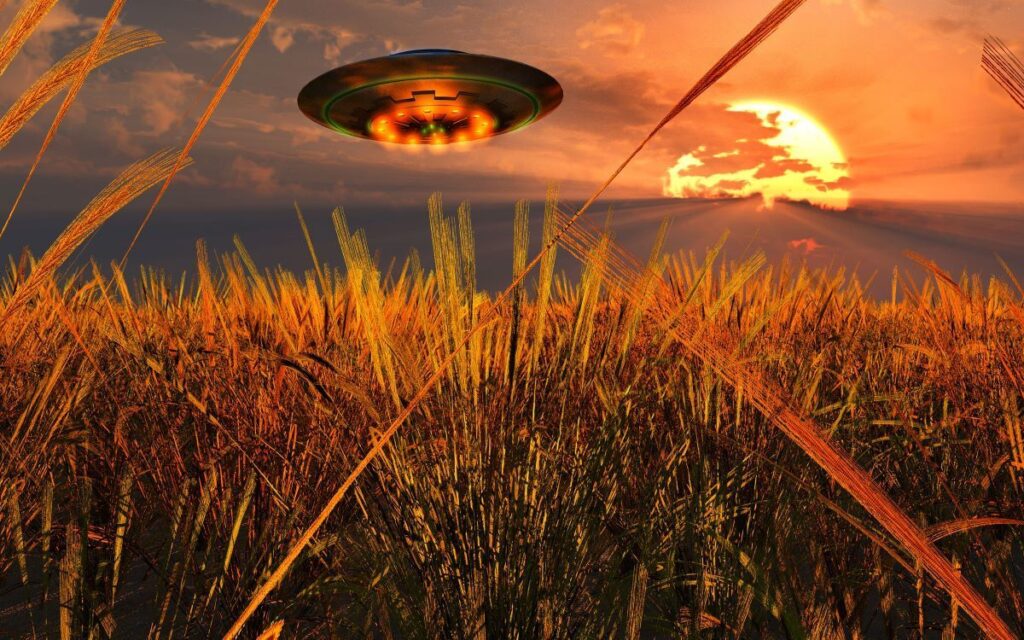
Recently, Vice President JD Vance admitted that he is “obsessed” with UFOs and extraterrestrial visitors. He then suggested that what are often identified as aliens could be masquerading demons. As Vance puts it, “I think one of the devil’s great tricks is to convince people he never existed.”
Vice President Vance is in a growing company of those, including many Christians, who are fascinated with aliens. And especially for Christians, right thinking about ET begins with getting our worldview right on the existence of the natural and supernatural.
In fact, the rise of vague spiritualities not firmly rooted in Christian doctrine has fostered many modern beliefs about aliens. Decades ago, C.S. Lewis rightly stated why we often prefer vague spirituality over encountering the real God:
“An ‘impersonal God’—well and good. A subjective God of beauty, truth and goodness, inside our own heads—better still. A formless life-force surging through us, a vast power which we can tap—best of all. But God Himself, alive, pulling at the other end of the cord, perhaps approaching at an infinite speed, the hunter, king, husband—that is quite another matter.”
Recently, CBN News produced a documentary that explored aliens in terms of the supernatural. In an interview, well-known astrophysicist Dr. Hugh Ross claimed that the strongest evidence for demons is asserted encounters with UFOs, and that, statistically, there is a high correlation between those who claim encounters with UFOs and those who have dabbled in the occult or who have had close relatives tied to the occult. It is not surprising, then, that scholars such as Diana Pasulka have identified what some call “UFOology” as a kind of religion, filling a void that Christians know can only be filled by God alone.
It’s also not a coincidence that the rising interest in aliens and UFOs is happening at the same time as an increasing concern over AI. After all, some claim that trans-dimensional, non-human intelligences can use technology to communicate with humans. Between AI and alien life, conversations about demonic activity are more mainstream than they were just 100 years ago.
In a couple of his books, the late historian Rodney Stark observed that early Christians condemned a fear of supernatural beings. Rather, they believed that Satan’s defeat by Christ was definitive, and that Christ’s resurrection had enthroned Him above any and all other powers throughout the entire universe. That is, of course, what Scripture proclaims, which makes it an important starting point for Christians thinking about things like UFOs, aliens, and AI demons. In short, Christians are to be people of hope.
Another factor in making sense of the contemporary fascination with aliens is that a naturalistic worldview, even secular humanism in which man is considered the measure of all things, has brought the world to the ironic place of devaluing humanity. There must be other beings in the universe, or else we are the best there is? This drives, at least to some degree, the incessant search for other life forms.
While there is much we do not know about aliens, UFOs, and unknown life “out there,” much of the unexplained activity could be explicable by other, simple means: drones, weather balloons, and government operations. And we must not rule out the very demonic activity described clearly in Holy Scripture, such as in Ephesians. Scripture is plain that there is a God, that humans are made in his image, and that demons (who do exist) are jealous of that.
Ephesians also teaches that we do not just wrestle against flesh and blood but against the spiritual forces of evil and their use of cosmic powers. Scripture also makes plain that through His work on the Cross, Christ disarmed all such authorities, put them to shame, and triumphed over them.
In his book Not the Way It’s Supposed to Be: A Breviary of Sin, philosopher Neal Plantinga explained that Christians must talk about evil as if it is a real foe, because it is. We also, he said, should talk about evil as if it is a defeated foe, because Christ is risen. Thus, we should see even the unexplainable with this certainty; that the Christ, who has risen, is the Lord, who is eternally triumphant over all that is seen and unseen.
Originally published at BreakPoint.
John Stonestreet serves as president of the Colson Center, equipping Christians to live with clarity, confidence, and courage in today’s cultural moment. A sought-after speaker and author on faith, culture, theology, worldview, education, and apologetics, he has co-authored five books, including A Practical Guide to Culture, A Student’s Guide to Culture, and Restoring All Things. John hosts Breakpoint, the nationally syndicated commentary founded by Chuck Colson, and The Point, a daily one-minute feature on worldview and cultural issues. Previously, he held leadership roles at Summit Ministries and taught biblical studies at Bryan College (TN). He lives in Colorado Springs, Colorado, with his wife, Sarah, and their four children.
Andrew Carcio serves as an administrator at a classical school in California. He earned his Ph.D. in Political Science from Claremont Graduate University, and he has also written for Public Discourse, Law & Liberty, the Claremont Review of Books, RealClear Education, WORLD Opinions, The American Mind, and Starting Points Journal, amongst others.