
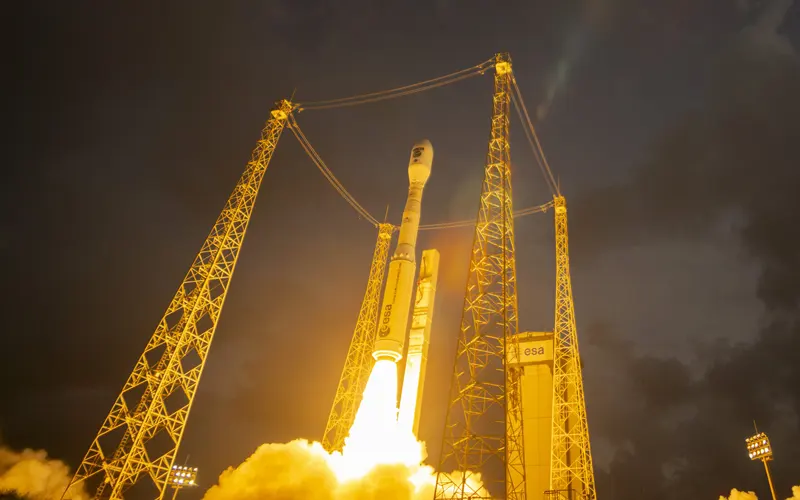
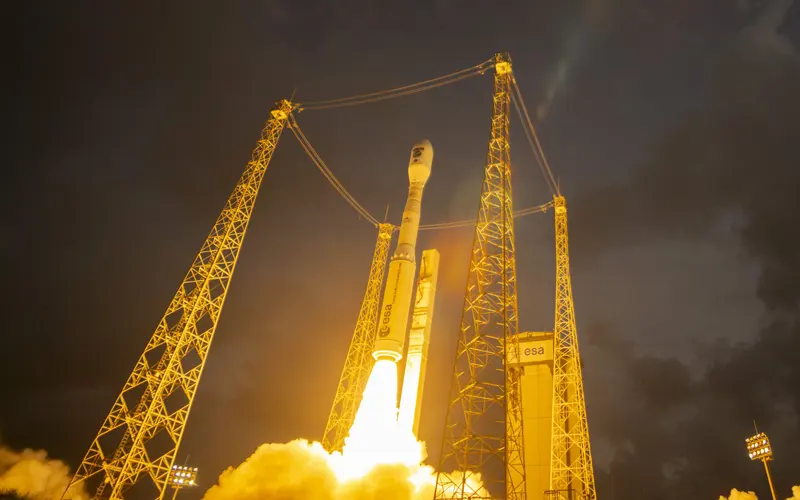
 Credit: ESA / S. Corvaja
European Space Agency disclosures show that the agency paid more than €51 million to launch the European Commission’s Sentinel-1C Earth observation satellite aboard a Vega C rocket on 5 December 2024. The flight marked the rocket’s return to flight after being grounded for nearly two years following a December 2022 failure.
While the European Union is responsible for the overall management of the Copernicus Earth observation satellite constellation, ESA is tasked with managing contracts with European industry for its development, launch, and operation. As part of this responsibility, the agency publishes an annual list of all contracts awarded with a value exceeding €15,000.
On 8 April 2022, ESA announced that it had awarded Arianespace the contract to launch the Sentinel-1C satellite aboard a Vega C rocket. While the contract value wasn’t included in the announcement, the agency’s EU contract disclosures for that year show it was €48.62 million. However, ESA-contracted work for the mission’s launch began several years earlier.
A €1.28 million contract awarded to Arianespace is listed in the agency’s 2019 disclosures, with the description “Vega C launcher compatibility study for the Sentinel-1C mission.” This was followed by a €1.23 million contract in 2021 for a second launch compatibility study.
In 2024, the year the satellite was launched, there was a €25,000 charge, and in 2025, the year after it was launched, there was another €500,000 charge. The disclosures do not provide any details about what these additional charges covered, with both simply listed as “Copernicus Sentinel-1C Launch Service.” With both included, the total cost climbs to €51.65 million.
In response to a request to confirm the accuracy of this summary, the European Commission stated that “the figures mentioned are indicatively correct.” The Commission’s spokesperson did, however, add that “to provide a complete and accurate vision of the situation, further strategic, technical and financial details would be required.”
ESA’s disclosures do, however, provide another point of reference. On 29 November 2022, Arianespace announced that it had been awarded contracts to launch five Sentinel satellites aboard Vega C rockets for the European Union’s Copernicus programme. In the agency’s 2022 contracts disclosure, the value of that five-launch bundle is €232 million, which, if split equally over the five missions, is €46.4 million per flight.
The clearest price comparison for a Vega-C launch is India’s PSLV rocket, which has a comparable payload capacity to low Earth orbit. The rocket also features a similar configuration to Vega, with solid-fuel boosters and a liquid fuel upper stage. PSLV does, however, stand ten metres taller than its Italian counterpart.
In 2018, the Indian government agreed to fund a series of 30 PSLV launches at a cost of Rs 6,131 crore, or around €18.6 million per flight. According to the announcement, this figure includes “Programme Management and Launch Campaign” costs. This figure is supported by disclosures from a senior official at the Vikram Sarabhai Space Centre in 2019, who explained that a fully integrated PSLV launch vehicle costs around Rs 200 crore, or approximately €18.1 million. This, however, appears to reflect the internal production cost of the vehicle and would likely exclude any profit margins, meaning the price charged to commercial customers is likely higher. The figure is, however, less than half the stated sticker price of a Vega C flight.
Another point of reference for price comparisons is found in another ESA EU contract disclosure. In 2014, ESA awarded a €26.9 million contract to Eurockot Launch Services to launch the Sentinel-5P satellite. The satellite was successfully launched aboard a Rokot rocket from the Plesetsk Cosmodrome on 13 October 2017. A similar launch for ESA three years earlier, which deployed the agency’s Swarm mission aboard a Rokot rocket, had a contract value of €27.1 million. Rokot was, however, notably less capable than Vega C, with a payload capacity of just 1,900 kilograms to low Earth orbit, compared to 3,300 kilograms for Vega C.
Both the PSLV and Rokot data points were between five and eight years old when the Sentinel-1C contract was awarded. The Rokot launch system has also since been retired. As a result, a direct comparison of launch costs isn’t straightforward. That said, it does appear that Vega C is priced at a premium.
With Avio now managing the full gamut of Vega-C’s development and operations following its separation from Arianespace, it remains to be seen whether that consolidation translates into more competitive pricing on future flights. While the cost of Vega C may not be competitive in all commercial contexts, both ESA and the European Commission have repeatedly emphasised the need for sovereign access to space. This ensures demand for European-made launch vehicles even if lower-cost international alternatives exist.
Keep European Spaceflight Independent
Your donation will help European Spaceflight to continue digging into the stories others miss. Every euro keeps our reporting alive.