
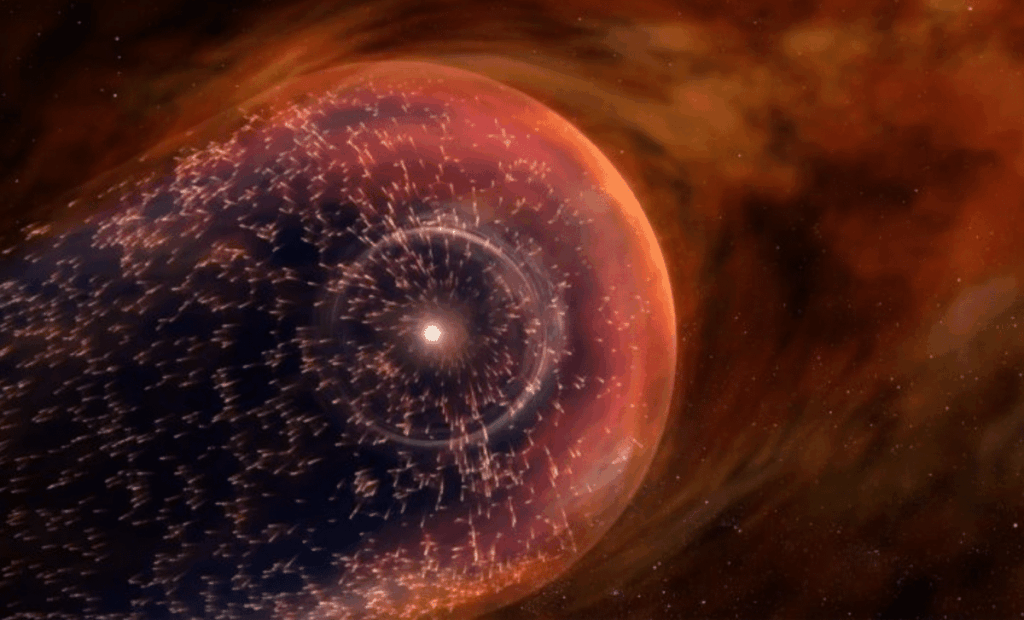
For decades, physicists have believed they had identified the fundamental forces shaping the universe, gravity, electromagnetism, and the strong and weak nuclear forces. Yet, subtle anomalies in observations have continued to resist clear explanation, hinting that something may still be missing from this picture. Now, a new study published in Physical Review D points to a faint but persistent phenomenon that could signal the presence of an additional, previously overlooked influence embedded within the fabric of reality itself.
The Great Disconnect Between Cosmic And Local Physics
For decades, astronomers have faced a puzzling contradiction. On the largest scales, the Universe behaves in ways that standard physics cannot fully explain. Galaxies rotate too quickly, cosmic expansion accelerates, and vast structures evolve under influences that appear to go beyond Einstein’s general relativity. These observations point toward the existence of dark matter and dark energy, mysterious components that dominate the cosmos.
Yet inside our solar system, everything appears remarkably predictable. Planetary orbits align with precise calculations. Spacecraft trajectories match expectations down to astonishing levels of accuracy. Signals traveling near the Sun confirm the curvature of spacetime exactly as Einstein described. There is no measurable deviation, no anomaly, no hint of hidden forces.
According to Universe Today, this contradiction is what scientists now call the Great Disconnect. If unknown physics governs the Universe at large, why does it vanish entirely in our local environment? The absence of detectable effects nearby is not a minor inconvenience, it is one of the biggest obstacles to understanding the true nature of reality. The new work led by Slava Turyshev at NASA’s Jet Propulsion Laboratory reframes this problem, arguing that the answer may lie not in the absence of a new force, but in how cleverly it hides.
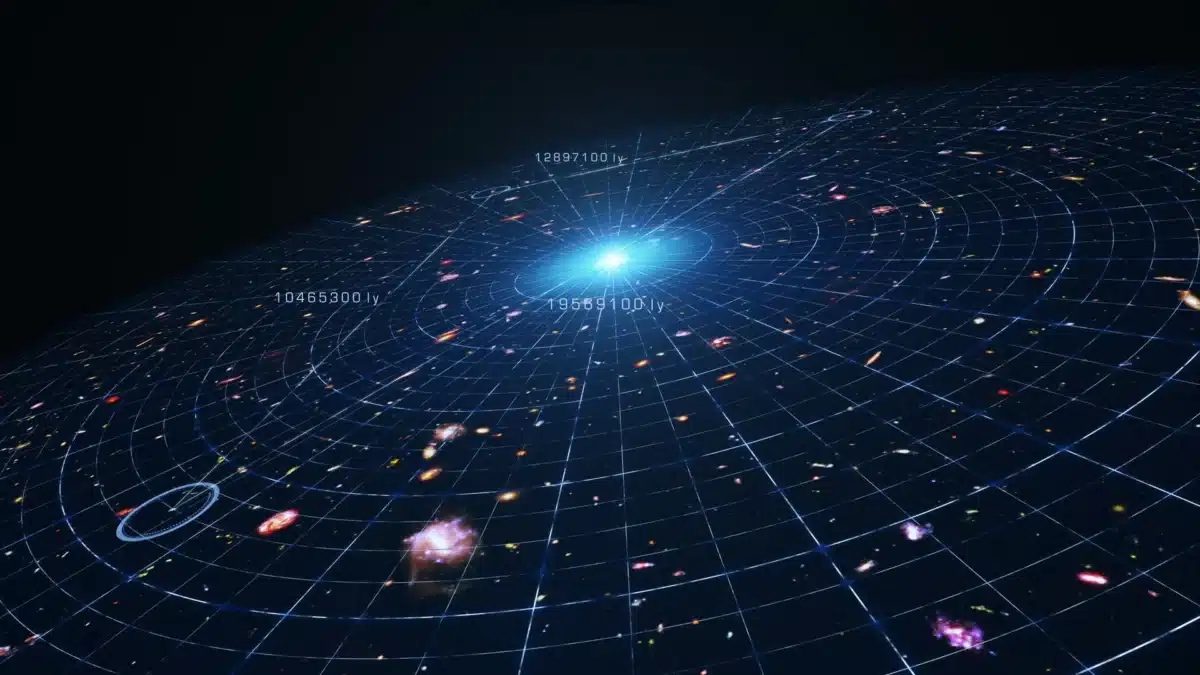 Scale of dark energy effecting surrounding stars.
Credit – NASA’s Goddard Space Flight Center Conceptual Image Lab / Michael Lentz
A Fifth Force That Adapts To Its Environment
The study, discussed in Physical Review D, explores the idea that a previously unknown interaction, a fifth force beyond gravity, electromagnetism, and the nuclear forces, could behave differently depending on its surroundings. This concept is known as screening, and it offers a compelling explanation for why such a force would dominate cosmic scales while remaining undetectable near Earth.
One leading model is the chameleon mechanism. In this framework, the strength of the fifth force depends on local matter density. In empty regions of space, where matter is sparse, the force becomes strong and influences cosmic expansion in ways associated with dark energy. In dense environments like the solar system, it weakens dramatically, effectively blending into the background of known physics.
This does not mean the force disappears entirely. Instead, it may persist in extremely subtle forms. Around massive bodies like the Sun, it could exist only in thin outer regions, making detection extraordinarily difficult. Current instruments lack the sensitivity to isolate such faint signals, which explains why decades of precise measurements have revealed nothing unusual.
The implication is striking: the laws of physics may not be fixed in strength, but adaptive, shaped by the very environment they operate within.
Vainshtein Screening And The Suppression Of Forces
A second model, known as Vainshtein screening, takes a different approach. Rather than changing the strength of the fifth force itself, this mechanism suggests that strong gravitational fields suppress its observable effects. In this scenario, the force remains constant, but its influence is effectively masked near massive objects.
Central to this idea is the concept of a Vainshtein radius, a boundary beyond which the hidden force can operate freely. For the Sun, this radius may extend as far as 400 light-years, encompassing not just the solar system but a vast region of the surrounding galaxy. Within this enormous zone, the fifth force would remain suppressed, explaining why local experiments consistently confirm general relativity.
This model has profound implications. It suggests that even if a new fundamental force exists, humanity may be located deep inside a “shielded” region where its effects are nearly impossible to detect. Only by observing phenomena far beyond this boundary, or by designing experiments capable of piercing this suppression, could scientists hope to reveal its presence.
Why Detecting It Requires A New Generation Of Missions
Turyshev’s work makes one point clear: current experimental approaches may not be enough. Missions designed to test general relativity within the solar system have achieved extraordinary precision, yet they were never intended to detect ultra-subtle deviations predicted by screening models.
Future progress will depend on designing targeted experiments guided by precise theoretical predictions. Without clear expectations of what to measure, even the most advanced instruments risk producing inconclusive results. This is why large-scale surveys like Euclid and the Dark Energy Spectroscopic Instrument (DESI) are so important. They provide data that can help refine models and generate testable hypotheses.
The next step would involve dedicated missions capable of detecting minute anomalies in gravitational behavior. These could include spacecraft placed in carefully chosen trajectories, instruments optimized for extreme sensitivity, or entirely new measurement techniques. Each incremental improvement brings scientists closer to the threshold where hidden physics might finally become visible.
The challenge is immense, but the potential reward is transformative. Detecting a fifth force would not just add a new entry to the list of fundamental interactions, it would redefine our understanding of gravity, dark energy, and the structure of the Universe itself.