
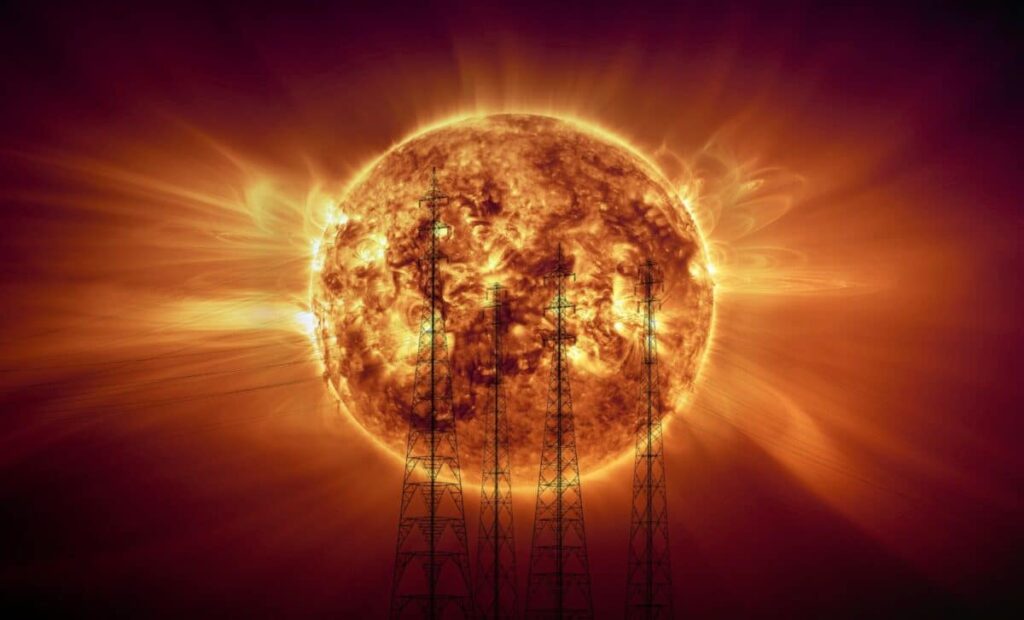
Scientists have found a way to identify magnetic fields on the far side of the sun, a region that cannot be seen from Earth. By studying sound waves moving through the star, they can now detect not just where activity is forming, but how it is structured. This finding could help researchers better anticipate solar eruptions before they rotate into view.
From Earth, we only ever see one half of the sun. The other side remains hidden, yet it can host active regions that later turn toward us and sometimes trigger solar flares affecting satellites and communications.
For years, helioseismology has been the main tool to probe this unseen hemisphere. According to research published in Scientific Reports, scientists use sound waves traveling through the solar interior to spot large active regions days in advance.
Decoding Magnetic Polarity Through Solar Waves
The new step forward is about magnetic polarity. Before this, scientists could detect active regions but had no way to tell how their magnetic fields were oriented. As explained by Dr. Amr Hamada of the NSF National Solar Observatory, the team managed to extract that missing information by looking at tiny shifts in the wave signals.
“Helioseismology has allowed us to detect where active regions exist on the far side of the sun. However, until recently we could not determine one of their most important properties: the magnetic polarity.”
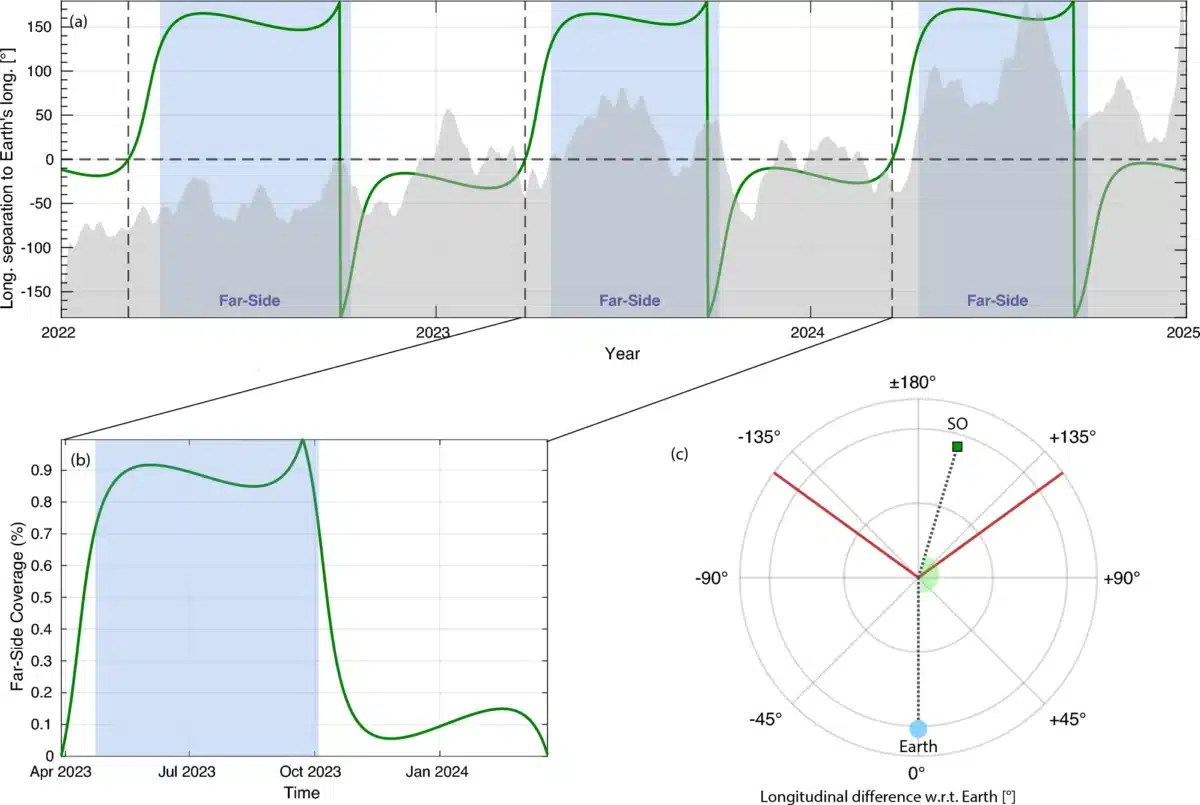 The far-side dataset coverage and viewing geometry provided by Solar Orbiter. Credit: Scientific Reports
These shifts reveal whether magnetic fields point outward or inward, which directly influences how powerful an eruption might become. The study also relied on known physical rules, such as the Hale polarity law, to interpret these signals. This allowed them to build detailed magnetic maps of regions that are still out of sight.
A Global Network Listening To The Sun
The work is based on observations from the NSF-NOAA Global Oscillation Network Group (GONG). This network of robotic telescopes operates around the world and continuously records the sun’s surface oscillations. Dr. Alexei Pevtsov noted that these oscillations have long been used to identify far-side activity.
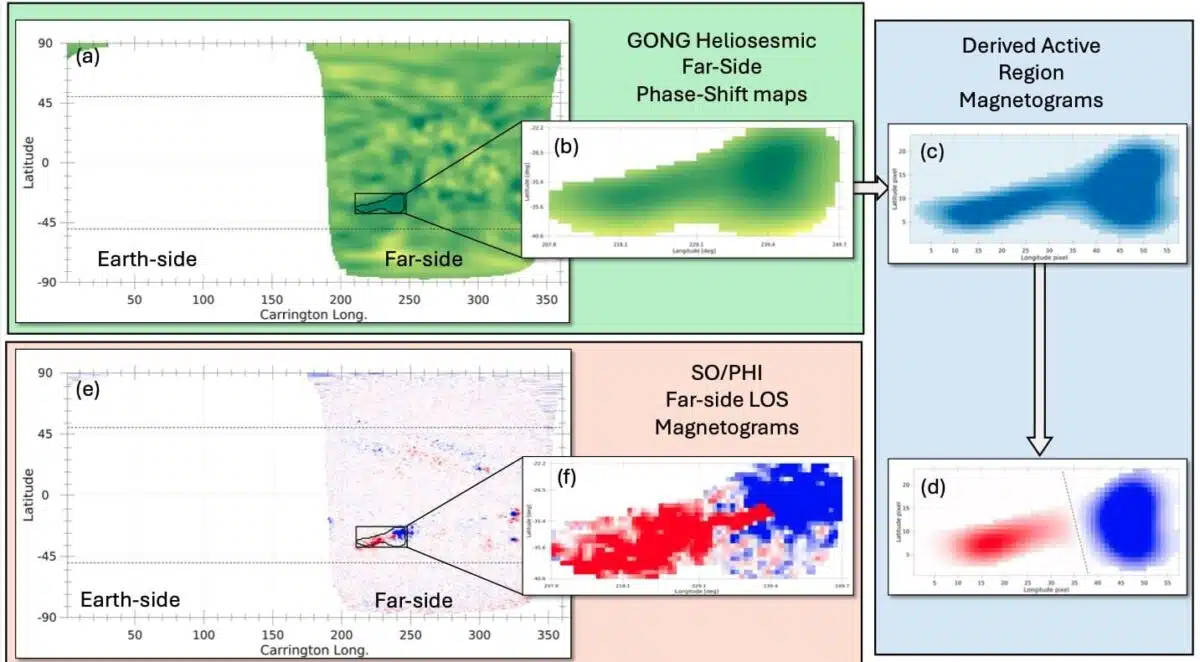 Polarity‑resolved far‑side magnetic fields from helioseismic detection. Credit: Scientific Reports
What stands out now is that the data holds more subtle information than previously thought, including clues about magnetic structure.
“The sun is constantly ringing with sound waves,” Dr. Hamada explained. “One idea that captures people’s imagination is that we can ‘see’ the far side of the sun using sound waves,” he adds.By tracking how those waves move and change, scientists can gather information about both the sun’s interior and its hidden side.
Why Far-Side Magnetism Matters For Earth
Magnetic structure is a key factor in space weather. Strong magnetic regions are often behind solar eruptions that can interfere with satellites, navigation systems, and power infrastructure.
As the researchers, current magnetic maps only cover the side of the sun facing Earth. Since the sun rotates in about 27 days, active regions can become important for Earth before their magnetic properties are directly measured. Adding far-side magnetic data to existing models could improve early warnings. It would give scientists more time to assess potential impacts and better understand how solar activity develops.