
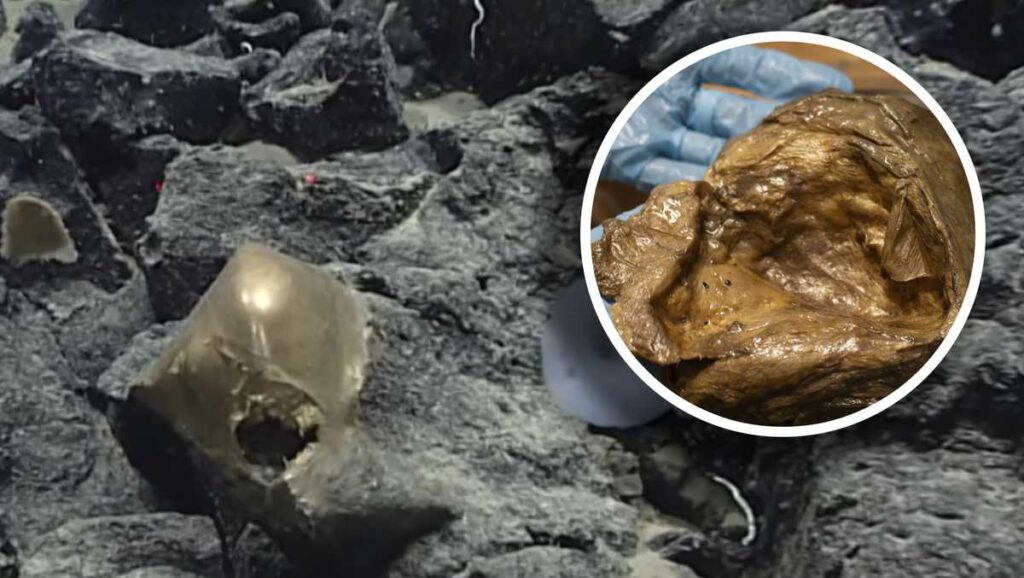
Scientists identify mysterious ‘golden orb’ found on ocean floor – and it’s not an alien egg
Not, we’ll have to slurp up. It does look like it’s been torn by something hydraulics coming up. I just hope when we poke it something doesn’t decide to come out. It’s like the beginning of *** horror movie. Pretty sure this is how the first episode of The X-Files started. Can you go partial zoom on HD1, please? I’ll just go out and tickle it, um. Touch the rock. Yeah, let’s give it *** little tickle. Oh, soft, softer malar, OK. I’m not sure if it’ll just fall apart if I try to grab it. It seems like it. It seems pretty delicate. It could maybe break pieces off and slurp it up. It may just pulverize. I don’t know. Yeah, why don’t we try, I think, uh, scraping it to the best of your ability with the manipulator and then suctioning what’s what we get. Let’s see what we could scrape it with the suction nozzle as well to try to just grab gently and see if I can scoop up *** nice big chunk of it, maybe, or, or just go layers of old for the slurp nozzle. What do you guys, what’s maybe *** scrape with the slurp nozzle. It’s very, yeah, it’s pretty can we get the drawer out here? I don’t know. Let’s, I can’t see. Let me look down *** little bit. I could give you *** little bit, but probably not full extension. OK, stand by. I can come out slow too if you want. Yeah, real slow. I think the starboard toe might push *** little bit too big to sample. Maybe just gently push out real gently. I think we’ll attempt *** suction. Easing into it. So folks tuning in haven’t seen this kind of sample collection before. We have *** suction sampler attached to this ROV camera. It’s *** long hose that flushes water through to create suction, and we can change the level of strength that we use. So we can gently suction at least *** piece of this. We can’t get any morphological information. Um, we might be able to get some. DNA results that could indicate even *** broad group. That this may belong to, it’s got us all stumped. Maybe when we take *** closer look under the microscope later, something will come to light. Yeah, so if it’s *** sponge, I’d expect to see some of those spicules, um, even very small ones. Although not all sponges have spicules, much to my dismay, that would be too easy. Yeah, that too. Sorry about that. My favorite one has no spicules and it encrusts on other sponges coming back. So it makes my life really difficult, but it’s very cool. I’m holding there. OK, standby for grip forces going up to 5. I think it’s always worth *** collection when uh our collective knowledge can’t identify it. That means it’s something weird or even have, I think we have *** lot of good guesses, but none of them very firm. Mhm. OK, draw her in, please, drawing in. OK, you’re ready on, uh, slurp. Nolan Barrett’s coming in with *** similar suggestion. If um we want to look at for something like spicules or sclerites, we can dissolve *** little bit of tissue in bleach. We just use household bleach, and it will dissolve any of the living tissue and the skeletal elements behind so we could maybe see. We don’t have *** compound scope, um, as far as I know. Yeah, there you go. That’s might be able to tell the dissection for partial zoom. I usually travel with one. This is very unlike me. I’d be very interested to see what your checked bag looks like. You got 360 RPMs on it. As long as it’s sterile, usually get away with it if it’s in, uh, was in *** small amount of ethanol. I need to turn it off, off, yeah, stand by. I’m gonna push forward *** little bit. Roger that. OK, we’re gonna try to move *** little bit closer to see if we can reach this *** bit better. It does kind of look to me like there’s *** couple different layers of it too, for sure. It’s like *** smoother layer on top, and then it looks to be more textured inside, yeah, but not like any. Sponge that I can think of, but yeah, really thin dermal layer makes me think egg case even more. but
Scientists identify mysterious ‘golden orb’ found on ocean floor – and it’s not an alien egg

Updated: 11:31 AM CDT Apr 24, 2026
A two-and-a-half-year-old mystery of a “golden orb” found on the ocean floor has finally been solved.It all started when scientists discovered a mysterious golden mass during a 2023 NOAA expedition at a depth of 3,250 meters (over 2 miles) in the Gulf of Alaska.A remotely operated vehicle encountered a golden mound-shaped object with a hole in it, stuck to a rock.Above video: Watch the moment the expedition discovers the ‘golden orb,’ baffling scientistsScientists admitted they had no idea what they were looking at.The unidentified object captured significant public interest, rumored to be everything from an alien egg to an unknown species.But the truth is much more mundane.According to new research findings released Wednesday by the NOAA, the mysterious golden orb is “a remnant of the dead cells that formed at the base of a giant deep-sea anemone, Relicanthus daphneae. It was the part of the anemone that attached to the rock substrate.” Identifying the golden orb was a multi-year, complex effort, NOAA officials said.“We work on hundreds of different samples and I suspected that our routine processes would clarify the mystery,” said Allen Collins, Ph.D., zoologist and director of NOAA Fisheries’ National Systematics Laboratory. “But this turned into a special case that required focused efforts and expertise of several different individuals. This was a complex mystery that required morphological, genetic, deep-sea and bioinformatics expertise to solve.”So the golden orb is not an egg, a sponge, or remnants of a space alien, but a relic of a deep-sea anemone.While this discovery confirms the identity of the previously unknown specimen, the Earth’s deep ocean still holds many secrets.“This is why we keep exploring,” said William Mowitt, acting director of NOAA Ocean Exploration, “to unlock the secrets of the deep and better understand how the ocean and its resources can drive economic growth, strengthen our national security, and sustain our planet.”
ANCHORAGE, Alaska —
A two-and-a-half-year-old mystery of a “golden orb” found on the ocean floor has finally been solved.
It all started when scientists discovered a mysterious golden mass during a 2023 NOAA expedition at a depth of 3,250 meters (over 2 miles) in the Gulf of Alaska.
A remotely operated vehicle encountered a golden mound-shaped object with a hole in it, stuck to a rock.
Above video: Watch the moment the expedition discovers the ‘golden orb,’ baffling scientists
Scientists admitted they had no idea what they were looking at.
The unidentified object captured significant public interest, rumored to be everything from an alien egg to an unknown species.
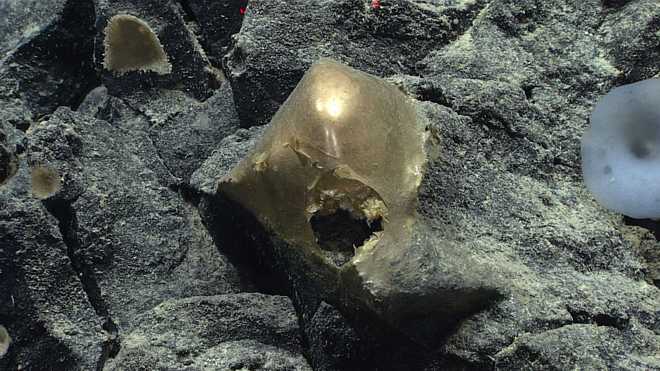
NOAA Ocean Exploration
This unidentified specimen, seen in situ on a rocky outcropping at a depth of about 3,300 meters (2 miles)
But the truth is much more mundane.
According to new research findings released Wednesday by the NOAA, the mysterious golden orb is “a remnant of the dead cells that formed at the base of a giant deep-sea anemone, Relicanthus daphneae. It was the part of the anemone that attached to the rock substrate.”
Identifying the golden orb was a multi-year, complex effort, NOAA officials said.
“We work on hundreds of different samples and I suspected that our routine processes would clarify the mystery,” said Allen Collins, Ph.D., zoologist and director of NOAA Fisheries’ National Systematics Laboratory. “But this turned into a special case that required focused efforts and expertise of several different individuals. This was a complex mystery that required morphological, genetic, deep-sea and bioinformatics expertise to solve.”
So the golden orb is not an egg, a sponge, or remnants of a space alien, but a relic of a deep-sea anemone.
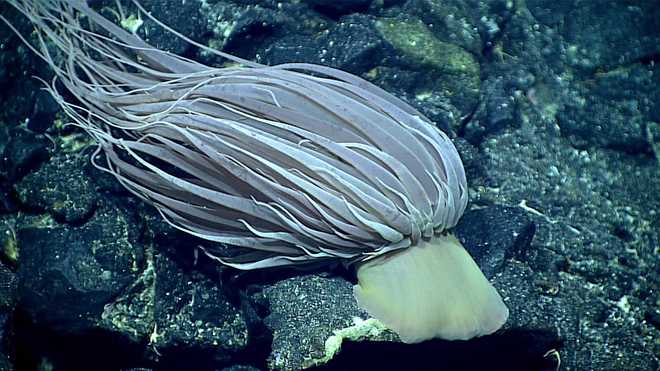
Hearst OwnedNOAA
A deep-sea anemone, Relicanthus daphneae.
While this discovery confirms the identity of the previously unknown specimen, the Earth’s deep ocean still holds many secrets.
“This is why we keep exploring,” said William Mowitt, acting director of NOAA Ocean Exploration, “to unlock the secrets of the deep and better understand how the ocean and its resources can drive economic growth, strengthen our national security, and sustain our planet.”