
noirlab2612 — Photo Release

Dark Energy Camera spies the faint glowing features of Messier 104, known as the Sombrero Galaxy
24 April 2026
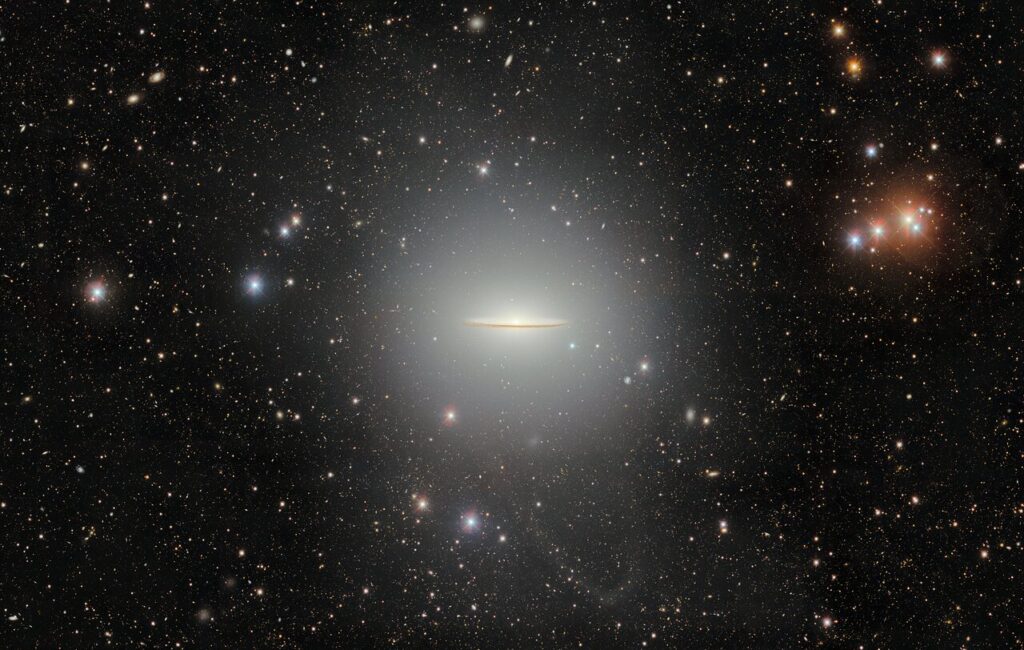
Messier 104, nicknamed the Sombrero Galaxy, is a popular target for amateur observing and astronomical research. Its recognizable extended halo, as well as a faint stellar stream, are captured in exquisite detail in this image from the Department of Energy-fabricated Dark Energy Camera, mounted on the U.S. National Science Foundation Víctor M. Blanco 4-meter Telescope at Cerro Tololo Inter-American Observatory in Chile, a Program of NSF NOIRLab.
The Sombrero galaxy (Messier 104) is a galactic masterpiece that captivates scientists and astronomy enthusiasts alike. Its intricate system of globular star clusters lends insight into stellar populations, and astronomers are intrigued by the supermassive black hole at its center. Its distinctive visual features and relative brightness make it a favorite among amateur astronomers. The fascinating story of its discovery, involving three esteemed astronomers, has earned it a spot on one of the most important lists of deep sky objects. Today, it stands as one of the most iconic galaxies in the night sky.
Messier 104 resides approximately 30 million light-years from Earth in the constellation Virgo (see finder chart). Spanning an impressive 50,000 light-years across, it is among the largest objects of the Virgo Galaxy Cluster. Despite its grandeur, it appears relatively dim in the night sky — just below the threshold of naked-eye visibility, though it can be observed with a small telescope or binoculars.
This image was captured with the 570-megapixel Department of Energy-fabricated Dark Energy Camera (DECam) mounted on the U.S. National Science Foundation Víctor M. Blanco 4-meter Telescope at Cerro Tololo Inter-American Observatory (CTIO) in Chile, a Program of NSF NOIRLab.
The incredible resolution of DECam reveals the Sombrero Galaxy’s striking features. At its core is an intensely bright nucleus, which is surrounded by a swarm of around 2000 globular star clusters. A thin, dark band of cold dust and hydrogen gas traces the perimeter of the disk, where most of the galaxy’s star formation takes place. The moniker “Sombrero Galaxy” comes from its striking resemblance to a sombrero, with its pronounced central bulge and dark dust trail that resemble the lofty crown and expansive brim of the traditional Mexican hat.
Also visible in this image is the galaxy’s enormous glowing halo, which appears to stretch over three times the width of the Sombrero itself. This may be the first time the halo has been captured with this level of detail and at this large a scale. DECam’s incredible sensitivity also captured a sweeping stellar stream extending from the south side of the galaxy. The halo and the stellar stream are populated with stars that have been torn from their home galaxies, hinting at a past galactic merger between the Sombrero and a smaller satellite galaxy.
The story of Messier 104’s discovery is intertwined with the endeavors of several prominent astronomers. It was initially spotted by the French astronomer and comet hunter Pierre Méchain in 1781 when he was an associate of the renowned comet hunter Charles Messier. At that time, Messier was compiling a list of non-cometary celestial objects, now famously known as the Messier Catalogue, to aid other astronomers in distinguishing these objects from passing comets.
Interestingly, Messier 104 did not find its place in the original publication of Messier’s list. However, it was later discovered that Messier added it by hand to his personal copy. Independently, in 1784, the well-known astronomer William Herschel also stumbled upon this remarkable galaxy and designated it as H I.43.
It wasn’t until French astronomer Camille Flammarion’s subsequent confirmation that these two independent discoveries were the same object that Messier 104 officially earned its place in the Messier Catalogue in 1921. Thus, through the collaborative efforts of these astronomers across different eras, the Sombrero Galaxy has become a celebrated addition to our knowledge of deep sky objects.
Its alluring visual characteristics, coupled with its accessibility to amateur equipment, contribute to Messier 104’s popularity among stargazers. Amateur astronomers often enjoy observing and photographing the Sombrero Galaxy, making it a prime target for citizen science projects and public outreach efforts. It is an excellent subject for sharing the wonders of the Universe with the public and fostering engagement with astronomy and science.
More information
The Dark Energy Camera (DECam) was designed specifically for the Dark Energy Survey (DES). It was funded by the U.S. Department of Energy (DOE) and was built and tested at DOE’s Fermilab. To provide new insights into the accelerating expansion of our Universe, the DECam records the motions and distances of galaxies in the distant past. While the full DES study ended in 2019, the camera continues to provide new insights to astronomers and astrophysicists.
NSF NOIRLab, the U.S. National Science Foundation center for ground-based optical-infrared astronomy, operates the International Gemini Observatory (a facility of NSF, NRC–Canada, ANID–Chile, MCTIC–Brazil, MINCyT–Argentina, and KASI–Republic of Korea), NSF Kitt Peak National Observatory (KPNO), NSF Cerro Tololo Inter-American Observatory (CTIO), the Community Science and Data Center (CSDC), and NSF–DOE Vera C. Rubin Observatory (in cooperation with DOE’s SLAC National Accelerator Laboratory). It is managed by the Association of Universities for Research in Astronomy (AURA) under a cooperative agreement with NSF and is headquartered in Tucson, Arizona.
The scientific community is honored to have the opportunity to conduct astronomical research on I’oligam Du’ag (Kitt Peak) in Arizona, on Maunakea in Hawai‘i, and on Cerro Tololo and Cerro Pachón in Chile. We recognize and acknowledge the very significant cultural role and reverence of I’oligam Du’ag (Kitt Peak) to the Tohono O’odham Nation, and Maunakea to the Kanaka Maoli (Native Hawaiians) community.
Contacts
Josie Fenske
Public Information Officer
NSF NOIRLab
Email: josie.fenske@noirlab.edu