

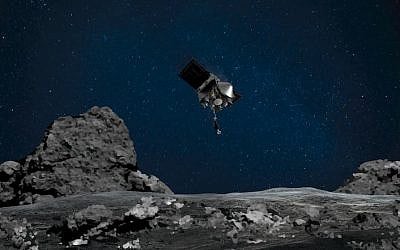
Illustrative (Public Domain): Artist’s rendering of OSIRIS-REx above asteroid Bennu. Missions like these demonstrate humanity’s growing ability to reach and study small bodies in space. Courtesy of NASA/Goddard/University of Arizona. NASA imagery is generally public domain
The recent discovery of unusually deuterium-rich water in the interstellar object 3I/ATLAS may prove important far beyond astronomy. It offers not only a glimpse into the birth conditions of a distant planetary system, but also a clue to how humanity may one day think about energy, logistics, and industrial production beyond Earth.
Using observations from ALMA Observatory, researchers reported a deuterium-to-hydrogen ratio far above the levels typically seen in comets of our own solar system. Such enrichment suggests that the water in 3I/ATLAS formed in an extremely cold, dark, and radiation-poor environment — preserving material from the earliest stages of another star system.
For scientists, this is a clue to cosmic history. For strategists, it raises another question: if deuterium-rich icy bodies are common in the universe, could future civilizations see them not only as objects of study, but as economic and energy resources?
Deuterium is a valuable isotope of hydrogen. It is already used in heavy-water nuclear reactors and remains one of the leading candidate fuels for future fusion energy systems. Fusion technology is not yet commercially mature, but if it advances in the coming decades, deuterium could become one of the most important strategic resources of the space age.
That is where the logic changes.
Today, nearly everything used in space must be launched from Earth at enormous cost. Fuel is heavy, launch is expensive, and every kilogram matters. Yet in deep space, especially around icy bodies, some of the most costly industrial conditions on Earth already exist naturally:
Extreme cold for cryogenic storage
Natural vacuum for certain manufacturing processes
Low gravity for extraction and transport
Large reserves of ice that can be converted into water, oxygen, and hydrogen
In other words, the future space economy may depend less on lifting mass from Earth and more on producing locally where the environment is already favorable.
From this perspective, two realistic long-term possibilities emerge.
1. Mining icy bodies within our solar system
Comets and frozen objects in the Kuiper Belt or the Oort Cloud could one day serve as sources of water, hydrogen, oxygen, and perhaps deuterium. Instead of launching all fuel from Earth, humanity could gradually build orbital depots, processing hubs, and refueling stations in space itself.
2. Spacecraft that produce their own fuel and continue onward
A robotic spacecraft could be sent to a comet, extract water, split it into hydrogen and oxygen for propulsion, and eventually use deuterium for advanced onboard power systems. Rather than being limited to a one-time mission, such a spacecraft could refuel itself and continue deeper into space.
Artificial intelligence would likely be essential. Mining, maintenance, navigation, and materials processing across vast distances cannot rely on constant instructions from Earth. Autonomous systems may become the first workforce of off-world industry.
None of this means that 3I/ATLAS is a ready-made fuel depot. The engineering barriers remain substantial: interception speeds, autonomous extraction, long-duration storage, and above all, practical fusion power.
But history often begins with a signal rather than a solution.
Coal was once just black rock. Oil was once mysterious seepage. Uranium was once an obscure metal. Today, deuterium-rich ice in an interstellar object may be hinting at something similar: the resources of tomorrow may already be moving through space.
For that reason, space agencies, research institutions, and long-term technology planners may wish to begin serious study of how extraterrestrial ice resources could support future energy systems, propulsion, and deep-space logistics.
The greatest value of 3I/ATLAS may not be what it reveals about the past of another solar system — but what it suggests about the future of our own.
Rafi Glick is a writer, lecturer, farmer, and business executive with decades of experience at the intersection of academia, technology, agriculture, and international trade.
• He has served as a Senior Teaching Associate at Ben-Gurion University of the Negev, Ono Academic College, Ariel University, Ruppin Academic Center, and as a guest lecturer at Sofia University’s Faculty of Economics and Business Administration (FEBA). At Ben-Gurion University he also advised the BGU–NHSA Accelerator in the Faculty of Science.
• In business, Rafi was CEO of Bidsnet Ltd., a pioneer in deploying fiber-optic cables through unconventional infrastructure (in partnership with CableRunner), delivering high-speed connectivity to homes, enterprises, institutions, and cellular networks. Earlier he held senior roles at ECI Telecom and served on the board of RLF Venture Capital, working with partners such as Intel, Teva, and the Jerusalem Development Authority.
• He contributed extensively to Israel’s trade and investment ecosystem: he directed industrial and agricultural technology divisions at the Israel Export Institute, founded Israel’s AGRITECH as international exhibition, and served on the board of the Israeli Investment Center at the Ministry of Industry and Trade.
• In his early career, Rafi established and served as the first director of the Cargo and Aircraft Supply Security Department in the Security Division at Ben-Gurion Airport (1972–1976). He lived in Kibbutz Parod until 1974.
• Rafi has also been recognized for his writing: in 2008 he was named Best Economic Blogger by TheMarker, Israel’s leading business daily.
• Today he continues to publish essays and commentary—with a special passion for astrophysics, space exploration, technology, economics, and social issues.
From Kibbutz Parod to the global stage, Rafi Glick’s career reflects a lifelong commitment to building connections—between people, industries, and ideas.
Email: rafi.glick@gmail.com