
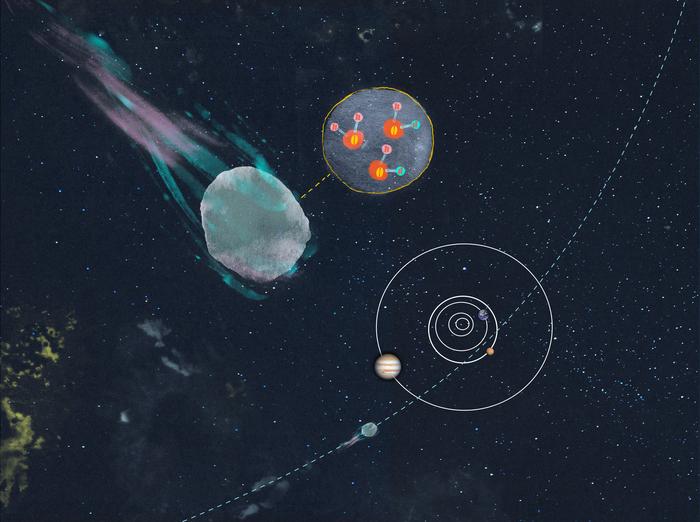
 A new study of the interstellar comet 3I/ATLAS led by the University of Michigan shows that its water has a remarkably high content of deuterium. This form of hydrogen is comparatively less abundant in our solar system, enabling researchers to glean new insights about other planetary processes at work in our galaxy. Image credit: U-M News/Hans Anderson
Credit ©
U-M News/Hans Anderson
University of Michigan astronomers have found that the interstellar comet 3I/ATLAS contains 30 times more “heavy water” (deuterium) than local comets
Less than a year after its discovery, the interstellar comet 3I/ATLAS has provided astronomers with a startling revelation, our solar system’s origins may be the exception, not the rule.
A University of Michigan-led study published in Nature Astronomy in April 2026 shows that this visitor from another star system was born in an environment far colder and darker than the one that created Earth.
The “heaviness” of alien water on an interstellar comet
The breakthrough came from analysing the comet’s water. While all water is $H_2O$, not all hydrogen atoms are identical. Some contain a neutron in addition to the standard proton; this isotope is called deuterium, and it creates “heavy water.”
Using the Atacama Large Millimetre/submillimeter Array (ALMA) in Chile, researchers measured the ratio of deuterium to ordinary hydrogen in 3I/ATLAS.
The results were unprecedented:
30x higher:
40x higher:
It was 40 times the value found in Earth’s oceans.
A birthplace in the dark
These chemical ratios act as a cosmic thermometer. High levels of deuterium only accumulate in environments that are extremely cold and shielded from radiation.
This discovery proves that 3I/ATLAS formed in a planetary system that evolved much differently from ours. While our Sun provided a relatively warm, radiation-rich cradle for the planets, 3I/ATLAS likely originated in the distant, frozen outskirts of a much dimmer star or within a particularly shielded region of a protoplanetary disk.
As co-leader Teresa Paneque-Carreño noted, it is definitive proof that the conditions of our solar system are not “ubiquitous” throughout the galaxy.
Hunting for “Giant Slayers” of the Sky3I/ATLAS is only the third interstellar object ever discovered (following ‘Oumuamua and 2I/Borisov). Its analysis was a feat of timing and collaboration, moving from initial detection in Arizona to high-resolution chemical mapping in Chile.
The researchers emphasise that as we build more powerful observatories, we will find more of these “messengers” from other stars. However, they also issued a warning: to see these faint, tiny objects, we must protect our “dark skies” from light pollution and satellite interference.
Each interstellar visitor like 3I/ATLAS offers a rare, free sample of a world we may never be able to visit, telling us the story of how different—or similar—other corners of the galaxy truly are.