
Back to Article List
Now in Pisces, Comet C/2025 R3 (PanSTARRS) is just past perihelion and bright but sinking fast in the predawn sky.

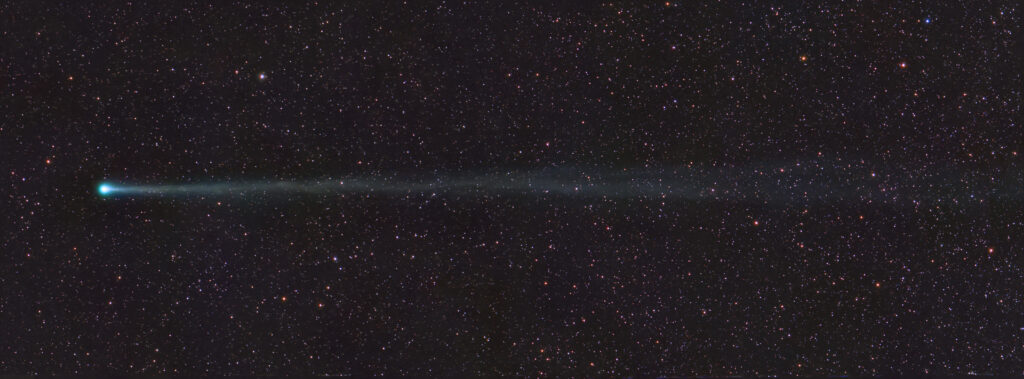
This stunning two-panel mosaic of C/2025 R3 (PanSTARRS) was captured with an 8-inch RASA f/2 from Payson, Arizona, on April 8, 2026. Credit: Chris Schur
Looking for a sky event this week? Check out our full Sky This Week column.
April 20: A trio of predawn planets
Have you had a chance to spot Comet C/2025 R3 (PanSTARRS) yet? It’s sinking quickly toward the horizon in the Northern Hemisphere, so if you have clear skies this morning, give it a try. Its visibility will only diminish from here, and quickly.
Standing only 2° above the eastern horizon an hour before sunrise, PanSTARRS remains a stunning and popular target for astroimagers and is just brighter than 5th magnitude. Now a few days past perihelion, its tail spans several degrees and its nucleus glows that bright, familiar cometary green, generated by diatomic carbon (C2).
PanSTARRS is now located in Pisces, to the lower left of the Great Square of Pegasus. The nearest bright star is Algenib (Gamma [γ] Pegasi), which glows at magnitude 2.8. From this star, scan 9.4° due east (to the lower left) to land on the comet. Although it’s technically bright enough to see with the naked eye, binoculars may be your best bet. You can also try taking a several-second exposure of the eastern sky with your smartphone to see if that picks it up as well. Follow the comet as long as you can while the sky brightens, but put away any optics before sunrise.
Sunrise: 6:13 A.M.
Sunset: 7:45 P.M.
Moonrise: 9:07 A.M.
Moonset: 12:16 A.M.
Moon Phase: Waxing crescent (28%)
*Times for sunrise, sunset, moonrise, and moonset are given in local time from 40° N 90° W. The Moon’s illumination is given at 10 P.M. local time from the same location.
The Lyrid meteor shower peaks the morning of April 22 with minimal moonlight to interfere. The shower’s radiant — the point from which its meteors appear to originate — rises late in the evening and stands more than 60° high in the east by 3 A.M. local daylight time. This point is located just to the right of the blazingly bright star Vega, Lyra’s alpha star and one point in the famous Summer Triangle asterism, now visible in its entirety in the east.
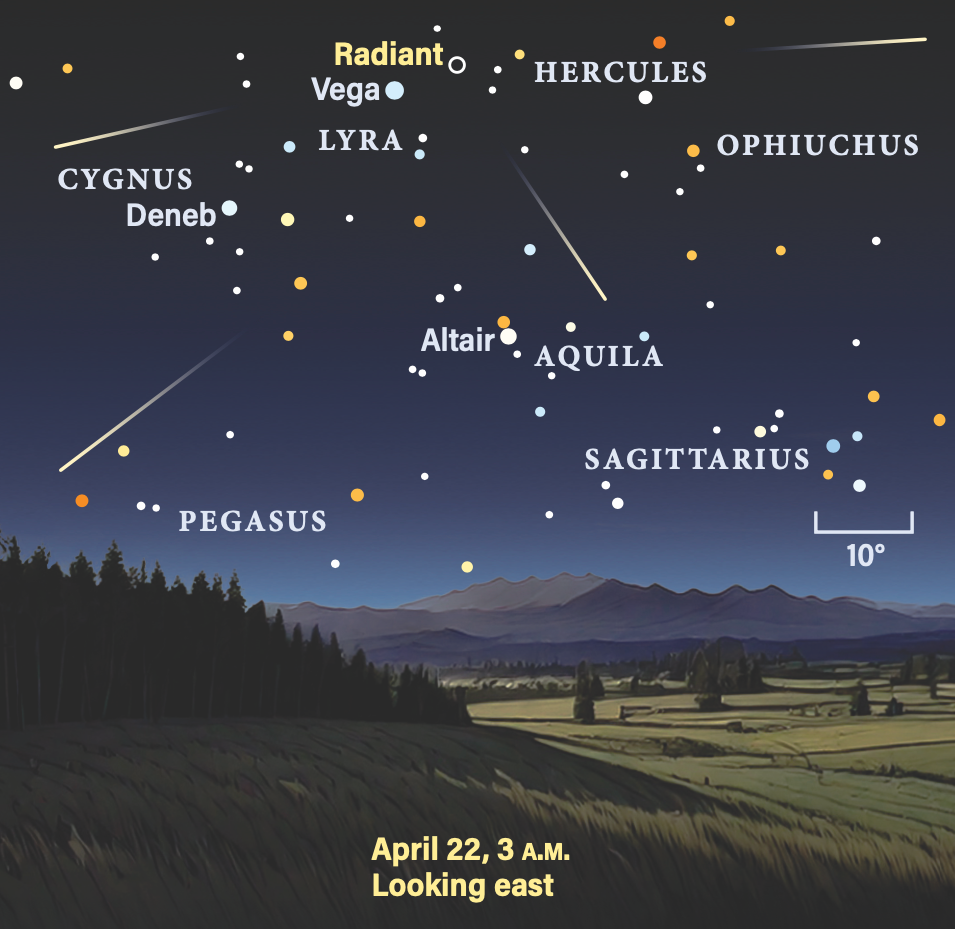
The Lyrids’ radiant is high in the east in the hours before dawn. Use this chart to locate it on the 22nd or 23rd, when meteor rates will be highest. Credit: Astronomy: Roen Kelly
The best time to view the shower is in the early-morning hours after the Moon sets (shortly before 1:30 A.M. local daylight time), when the sky is darkest and the radiant is high above the horizon. The maximum zenithal hourly rate of meteors expected — the very highest the rate can be — is about 20 meteors per hour, which means you should still see several meteors each hour you stargaze as sunrise draws closer. Most Lyrid meteors are considered medium-fast meteors, streaking through our atmosphere at some 30 miles per second (48 km/s). These streaks originated as dust shed by comet C/1861 G1 (Thatcher), whose orbit around the Sun takes more than 400 years to complete.