

Comet 41P reduced its rotation and then began to spin in the opposite direction after approaching the Sun in 2017, revealing a phenomenon never before observed in icy bodies of this type.
Hubble records unprecedented change in Comet 41P
Astronomers associated with NASA’s Hubble Space Telescope detected unprecedented behavior in the Solar System.
Comet 41P suddenly decelerated and, shortly after, began to spin in the opposite direction.

This is the first observed evidence of a comet reversing its direction of rotation. The discovery offers a rare insight into the physical evolution of small, fragile, icy bodies.
The object is 41P/Tuttle-Giacobini-Kresák. It likely originated in the Kuiper Belt and, under Jupiter’s influence, was captured into an orbit that brings it into the inner Solar System every 5.4 years.
After its approach to the Sun in 2017, the Swift Observatory showed that the comet was spinning three times slower than months before, when it was studied with the Discovery Channel Telescope.
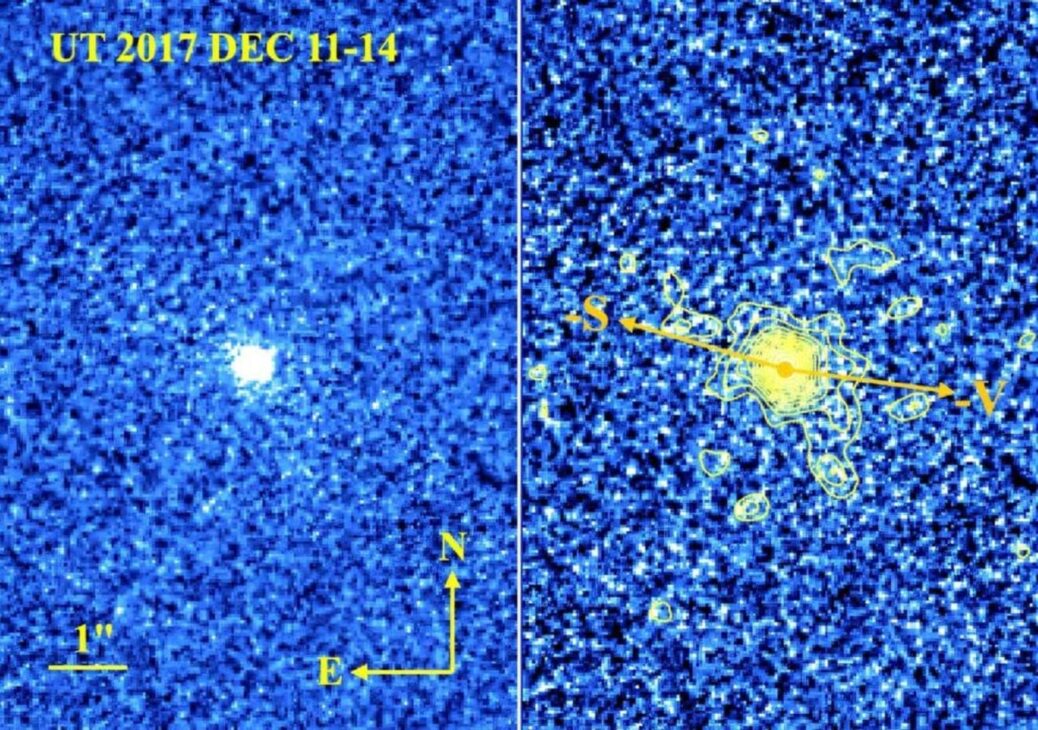 Left panel: Composite image with a 3840 s TGK integration. A 1″ scale bar and indicated cardinal directions apply to both panels. Right panel: The same image with contours to highlight the coma near the nucleus. Arrows indicate the anti-solar direction (–S) and the projected negative heliocentric velocity vector (–V). Source: David Jewitt. (2026).
Rotation slowed down before the reversal
The most surprising change appeared in images captured by Hubble in December 2017. The nucleus accelerated again, but not as predicted.
The rotation period was then about 14 hours. This data contrasted with Swift’s measurements, which indicated between 46 and 60 hours.
The simplest explanation presented by the authors is that the nucleus almost stopped before being pushed in the opposite direction. The force would have come from gas jets escaping from the surface.
The study, published in The Astronomical Journal, describes an unusual scenario, but one compatible with small objects rich in volatile materials.
Gas jets acted like small engines
Hubble images also helped estimate the size of the nucleus. It is just over one kilometer in diameter, about three times the height of the Eiffel Tower.
This reduced size makes the body easier to deform. When a comet approaches the Sun, heat causes the ice to sublimate, generating jets of gas and dust.
These natural geysers can act as thrusters. David Jewitt, an astronomer at the University of California, Los Angeles, and author of the study, explains that the jets function like small engines.
When unevenly distributed, they can strongly alter a comet’s rotation. The effect is greater when the nucleus is small, as in 41P/Tuttle-Giacobini-Kresák.
In Comet 41P, the jets first reduced the original rotation. Then, by continuing to exert thrust, they completely reversed the direction of spin.
Activity dropped almost tenfold in 2017
The study also shows that the overall activity of Comet 41P decreased in recent passages. In 2001, during its approach to the Sun, it exhibited unusual activity for its size.
In 2017, gas production had dropped almost tenfold. The change suggests a rapidly transforming surface, perhaps because volatile materials are disappearing or being covered by dust.
Cometary transformations usually take centuries or millennia. Monitoring such rapid variations offers an unusual chance to observe a comet’s physical evolution in real time.
Models based on torsional forces and mass loss indicate that, if the process continues, the nucleus could become unstable. Excessive rotation could fragment it or cause its disintegration.
David Jewitt believes this nucleus will self-destruct soon. Nevertheless, 41P/Tuttle-Giacobini-Kresák has been traversing its current trajectory around the Sun for about 1,500 years.
Ancient archives revealed the discovery
The discovery emerged from the Hubble archives, which hold over three decades of astronomical data. Jewitt found the observations while exploring this database.
The images had been captured years earlier but had not yet been analyzed. NASA’s open data policy allowed old records to be used to answer a new question.
In this case, the material revealed an unexpected story: a small comet, coming from a long orbital trajectory, capable of almost stopping, changing course, and recording an unprecedented rotation reversal.
Archived data can gain new value. It also indicates that icy bodies can undergo rapid and difficult changes directly.
With information from Tempo.