
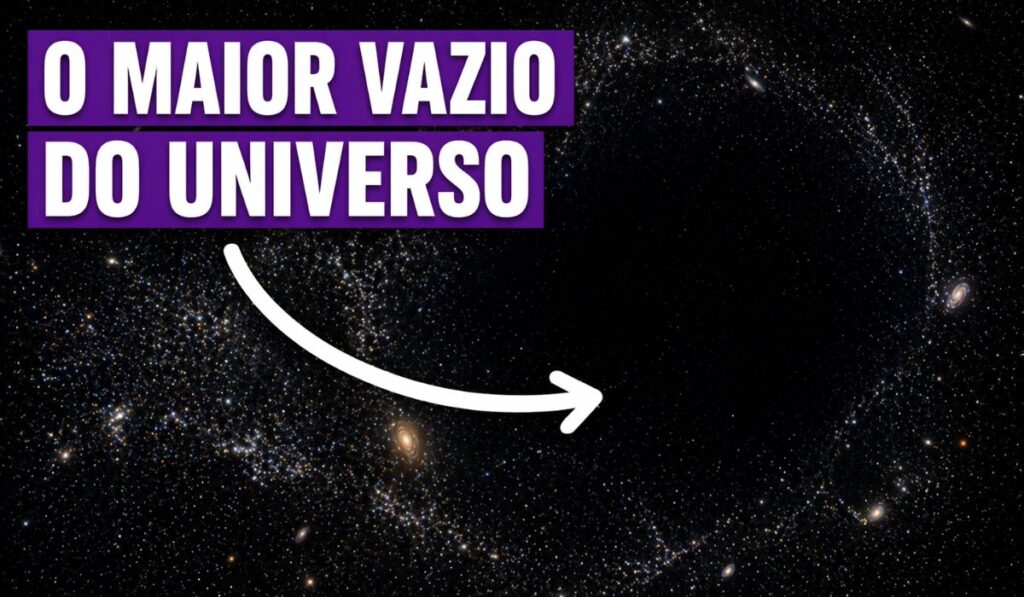
Colossal structure mapped by astronomers challenges the expected distribution of galaxies and maintains the Boötes Void at the center of studies on the cosmic web, the expansion of the universe, and the limits of astronomical observation.
The Boötes Void is one of the largest underdense regions ever identified in the large-scale structure of the universe.
Located in the direction of the constellation of Boötes, it was described from redshift surveys in the early 1980s and contains about 60 galaxies, a number much lower than what is typically estimated for a similar volume.
In practice, the nickname “Great Nothing” does not correspond to an absolute void.
In astronomy, the term designates an area with very low matter density compared to other regions of the cosmos.
In the case of Boötes, this contrast has made the structure a frequent subject of study in research on the distribution of galaxies.
The scale also explains the scientific interest.
In outreach materials from NASA, the void is described as having a dimension of about 250 to 330 million light-years.
The classic confirmation study, published in 1987, treated the structure as an approximately spherical void with a radius of 62 megaparsecs, a measurement consistent with the order of magnitude cited in outreach texts.
Boötes Void in the galaxy network
The universe does not exhibit a uniform distribution of matter.
Observations accumulated over the last few decades indicate that galaxies are organized into filaments, groups, and clusters, separated by less dense areas known as cosmic voids.
In this context, the Boötes Void has come to be cited as an extreme case.
The comparison with more populated regions helps to size the difference: while the Local Group, where the Milky Way is located, contains more than 50 galaxies on a much smaller scale, Boötes occupies a much larger volume with a significantly reduced galactic population.
 Image: Reproduction/Youtube Cosmoknowledge
In addition to the low density, surveys cited by NASA indicate that the galaxies observed within the void are not distributed homogeneously throughout the volume.
Part of them seems to concentrate in an elongated band, rather than filling the region in a more dispersed manner.
How the Boötes Void was identified
The identification of the Boötes Void occurred during measurements of redshift of the light emitted by galaxies.
This technique allows for estimating distance and velocity of recession, which helps to reconstruct the three-dimensional map of the universe.
In a paper published in 1981, Robert Kirshner and other researchers reported the measurement of 133 redshifts in three fields of the sky.
According to the expected distribution, the number of galaxies should peak at a certain velocity range.
In the initial survey, however, there were almost no objects in that central region, indicating a large underdense area.
In the following years, the hypothesis was expanded and tested with new observations.
In 1987, another work from the group reported the measurement of 239 additional redshifts and confirmed the presence of a large approximately spherical void in the direction of Boötes.
The same study recorded the existence of some galaxies within the structure, including objects with particular spectral characteristics.
Still, the observed quantity remained well below the expected standard for a volume of that size.
What the “hole” in space means
The term “hole” is often used in popular science texts to simplify the description of the structure, but it does not refer to a literal opening in space.
What exists there is a region where the density of matter is much lower than the average observed in other parts of the cosmic web.
This distinction is relevant because cosmic voids are not isolated anomalies.
They are part of the large-scale architecture of the universe.
The case of Boötes entered the literature prominently because it combines great extent and a reduced count of luminous galaxies.
For this reason, the structure has become a reference in studies about the formation of large voids and about the organization of matter on cosmological scales.
Instead of representing a complete absence, Boötes serves as an example of extreme rarefaction within a pattern already known by observational cosmology.
“`html
Hypotheses about the formation of the cosmic void
The explanations discussed in the consulted scientific literature remain in the field of observational cosmology.
One of the hypotheses suggests that large voids can grow over time by merging smaller voids.
Another line of interpretation considers the gravitational dynamics of these regions.
According to scientific outreach materials from NASA, matter tends to be displaced to the edges of voids, while the expansion of the universe enlarges already less dense areas.
In the case of Boötes, these readings appear as explanations compatible with what is known about the evolution of large-scale structure.
So far, there is no secure confirmation for exotic hypotheses associated with the absence of galaxies, and this type of speculation does not integrate the scientific consensus on the subject.
Why cosmic voids interest science
The study of regions sparsely populated by galaxies is considered relevant because these environments help test models about the evolution of the universe.
In a document from Astro2020, researchers describe voids as promising laboratories for extracting cosmological information.
According to this material, low-density areas are particularly useful for investigating effects associated with dark energy and for testing gravitational models on large scales.
The same line of research highlights that the emptying of these regions and the relative accumulation of matter at their edges are part of the evolution of the cosmic web.
In practical terms, the size, shape, and distribution of voids can provide clues about cosmological parameters and the history of the universe’s expansion.
Therefore, the scientific interest in these structures has ceased to be peripheral and has become part of broader programs for mapping the cosmos.
The place of Boötes on the maps of the universe
Within this set of studies, the Boötes Void is cited for historical and observational reasons.
The structure helped consolidate the perception that the universe has a network geometry, with filaments of galaxies delineating large underdense regions.
“`
At the same time, the case also shows that, in astronomy, “void” does not mean total absence of matter.
The term applies to areas where the observed density is much lower than the average, although there are still galaxies and other components distributed there.
With deeper surveys and more sensitive instruments, the trend is that new measurements will refine the picture of these regions.