
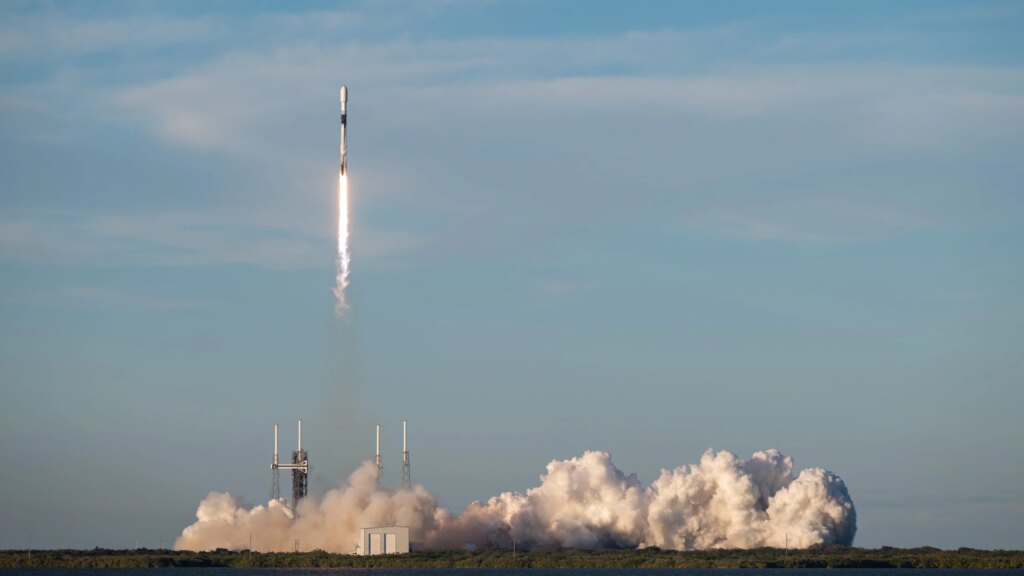
WASHINGTON — The Space Force once again does not plan to fund future iterations of a data relay constellation managed by the Space Development Agency (SDA), officials revealed, opting instead to build out a new constellation dubbed the “backbone” of the service’s budding Space Data Network (SDN).
“The Transport Layer for Tranche 3 is not funded,” a Space Force official said Tuesday during a briefing with reporters at the Pentagon for the unveiling of the service’s fiscal 2027 budget. “Those requirements are going to be rolled into the requirements being filled by the SDN backbone.”
For years, SDA has championed a satellite constellation known as the Transport Layer, composed of satellites launched to low-earth orbit in successive tranches. But the Space Force has recently drifted away from the concept; last year, the service attempted to axe funding for SDA’s Tranche 3 birds, but Congress reinstated $500 million to continue the effort.
Around that time, Space Force officials were weighing whether to terminate the Transport Layer in favor of a program dubbed MILNET, which Breaking Defense previously reported could potentially involve shifting the data relay mission to SpaceX satellites. While no longer called MILNET, the Space Force is still keen to shift toward that concept, but it’s not clear what systems may be used.
Speaking during the Tuesday budget briefing, Maj. Gen. Frank Verdugo the Air Force’s deputy assistant secretary for budget, confirmed that $1.6 billion in reconciliation funds requested by the service would build out the new SDN backbone consisting of a proliferated, low-earth orbit constellation. The backbone was “previously MILNET,” the general explained.
A Department of the Air Force (DAF) spokesperson additionally noted in a statement to Breaking Defense that the SDN backbone effort formerly known as MILNET will specifically be funded in a budget line for procurement dubbed “proliferated LEO SATCOM.”
The umbrella SDN concept will function similarly to how the Transport Layer was envisioned — a global satellite communications (SATCOM) network that can quickly move data between sensors and shooters. The architecture will be overseen by Col. Ryan Frazier, the Space Force’s Space-Based Sensing and Targeting portfolio acquisition executive, and could be critical for marquee projects like the Golden Dome missile defense shield.
“The SDN program line fields a proliferated LEO mesh constellation and associated ground architecture providing resilient, high-volume, low-latency communications and tactical data links for the Joint Force. Key efforts include the procurement of relay satellites as part of the SDN build-out, fielding ground gateways, and onboarding additional vendors into the architecture,” the spokesperson said. “The goal is to employ competition across the SDN architecture while adhering to rapid delivery timelines.”
Budget documents released earlier this month show the Space Force is requesting roughly $1.5 billion, all drawn from reconciliation, for research and development under the dedicated SDN budget line.
SDA is also launching missile warning satellites in what’s known as the tracking layer, but Acting Director Gurpartap “GP” Sandhoo told reporters April 15 that the agency “probably won’t” exist down the road as the new portfolio approach absorbs and reorganizes various space acquisition efforts. Sandhoo separately confirmed the SDN’s scope has expanded to include the transport layer. The acting director himself is slated to be named as a portfolio executive overseeing missile warning and tracking programs.
Space Force In FY27: A Massive Funding Surge
Officials during the Tuesday briefing underscored the explosive growth of Space Force resources in FY27. The cash splurge is consistent across accounts: Compared to enacted FY26 levels, the Pentagon is requesting a whopping 342 percent boost for buying space systems; a doubling of the service’s R&D; a 70 percent increase for operations and maintenance; and a 29 percent boost to military personnel.
Overall, officials are requesting a $71.1 billion budget for the Space Force in FY27. That’s up from $31.6 billion in FY26, a 124 percent increase, according to a budget overview shared with reporters. (The above figures are inclusive of reconciliation funds requested alongside the Pentagon’s base budget, and exclude non-blue or “passthrough” spending that technically goes to agencies outside the Pentagon.)
Those extra dollars will fund priorities like adding 2,800 Guardians to the service’s end strength, Verdugo said, with a specific focus on “space, intelligence, cyber and acquisition career fields.” Similarly, Verdugo said funding boosts will benefit other missions like space domain awareness, secure satellite communications and even an ambitious project to track aircraft from the heavens.
Despite the funding boost, not all programs survived. A day before the budget drop, the Space Force killed a long-troubled GPS ground system dubbed OCX. And on budget day, the DAF spokesperson confirmed the Space Force is not requesting any funding for a missile warning satellite in polar orbit, known as Next-Gen Overhead Persistent Infrared (OPIR) Polar, or NGP.
Like with the transport layer, the Space Force attempted to zero funding for the polar birds in FY26, but Congress restored $436 million to continue their development. The spokesperson said the service is “evaluating the viability” of the NGP program “and will have an acquisition decision in FY27.”