
Agency
1252 views
5 likes
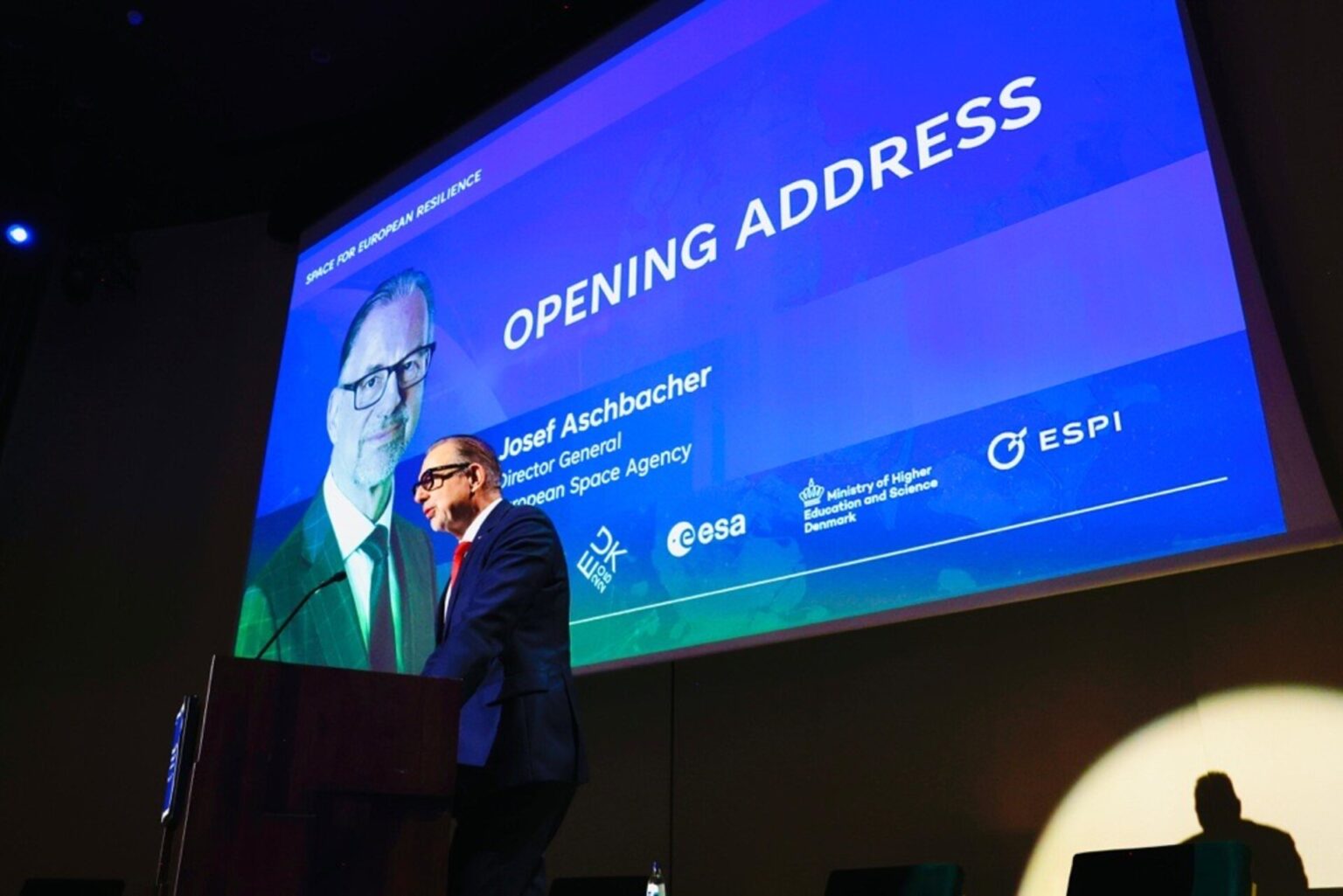
Speech delivered by the European Space Agency Director General Josef Aschbacher at the conference ‘Space for European Resilience: rising to the collective challenge’.
The event was organised under the auspices of the Danish presidency of the Council of the European Union and with the support of the European Commission by the ESA and the European Space Policy Institute (ESPI).
Dear Minister Domański and Dear Commissioner Kubilius, Your Excellencies, Ladies and Gentlemen.
Thank you for your inspiring speeches, Minister Domański and Commissioner Kubilius. First, I would like to thank the Danish Presidency of the EU for joining forces with ESA on the European Resilience from Space Conference. This is a show of the political urgency of a key topic that has been largely overlooked until recently, but is at the forefront of Europe’s political agenda today.
Along with the Danish Presidency’s strong support, I would also like to give thanks to the European Commission’s unwavering cooperative spirit regarding our joint efforts to increase European resilience and autonomy in and through space.
At ESA’s 3rd Security Conference earlier this year in Warsaw, I warned that Europe was facing unprecedented security threats – a warning that recent events have only confirmed. Russian drones have repeatedly violated EU airspace, including incidents here in Belgium, causing damage and posing serious risks to citizens and critical infrastructure. At the same time, persistent PNT jamming continues to endanger air traffic safety, most recently during European Commission President Ursula von der Leyen’s visit to Bulgaria.
These developments combined with rising geopolitical instability globally and wavering US support in Europe, underscore that the threat to our security has not diminished—and that urgent, coordinated action is needed.
As we meet here today, defence budgets across Europe are expanding. According to the Boston Consulting Group, projections indicate an increase from under 2% to over 3% of GDP within the next five years. Germany is leading the way with plans to invest €35 billion in space defence by 2030. Yet, overall space-related defence allocations remain modest in Europe – despite space being widely recognised as a strategic enabler across all defence domains.
Encouragingly, industry trends point to a growing convergence: space companies are increasingly pivoting towards defence-oriented solutions and applications, while European defence firms are actively integrating space capabilities.
Thus, in this moment of rapid change, there is a critical need to synchronise European initiatives by aligning space for defence competencies, avoiding duplication and pooling resources for scale. We still remain too fragmented to guarantee Europe with genuine, comprehensive and autonomous space resilience. We have an opportunity to change that, and we must.
The stakes and challenges we face demand a stronger ESA–EU partnership and a shared strategic vision. As the next EU Multiannual Financial Framework (MFF) is being prepared over the coming three years, ESA will lay the groundwork through its European Resilience from Space proposal–known as ERS–at the upcoming Ministerial Council in November. This marks the start of a sustained cycle of capacity development and decision-making extending towards 2035. A renewed political commitment and joint capability-building effort between ESA and the European Union will strengthen Europe’s defence readiness through space, enhancing our ability to dissuade and mitigate acts of aggression.
ERS is designed to deliver advanced space-enabled capabilities–intelligence, surveillance and reconnaissance [ISR], navigation, and secure communications–to help safeguard Europe’s citizens, infrastructure, supply chains, institutions, strategic interests, and core values.
Developed hand-in-hand with the Commission and aligned with Member States’ sovereignty and priorities, ERS – alongside the Commission’s EOGS –forms one of the twin pillars of Europe’s future space security architecture.
ESA’s ERS is a bold, dual-use system of systems that will, for the first time, enable critical reactivity—transforming strategic planning, decision-making, and operational response across Europe.
I want to be clear that I am not at all suggesting a Europeanisation of space for defence across the board. ESA will never replace national efforts or sovereign capabilities. Key space capabilities for security should absolutely remain under national control. That’s an undeniable part of Europe’s deterrence and responsiveness. However, ESA can play a vital role through a pooling and sharing model, where each contributor retains full control of their systems while benefiting from others’ excess capacity, and vice-versa.
Together with the EU, ESA will also enhance capabilities – boosting observation frequency and introducing advanced technologies such as infrared sensors, AI, edge computing, intersatellite links, and quantum-secure communications. With its proven project management and technical expertise, ESA can architect a system that ensures seamless interaction and meets the highest security standards and requirements.
ESA’s ERS will not duplicate but rather build upon existing systems such as national ISR assets, which are quickly saturated in times of high-intensity crisis. It will leverage capabilities from Copernicus, Galileo, IRIS2, ESA missions, national infrastructures, and industrial solutions. By integrating remote sensing, connectivity, PNT, spectrum monitoring, and IoT systems, ERS aims to provide security and defence users with the most secure, agile, and rapid response capabilities possible.
In Earth observation, we aim for a persistent, all-weather, real-time capability, augmented with rapid tasking, low latency and high revisit time of under 30 minutes.
In PNT, we aim for highly accurate and resilient positioning, resistant against jamming, spoofing and interference.
In connectivity, we aim for secure global communication links at any time from any location, strengthened by emerging quantum technologies to ensure unprecedented levels of security.
Europe has relied on foreign strategic capabilities for far too long. This is especially true in security and defence. We must leverage space as a testing platform for European cooperation in defence, given space’s dual nature and proven track record in cooperation over the last 50 years, at least.
ESA itself is one of Europe’s most significant collaborative and cooperative success stories. The entry of the EU into space some 20 years ago only made us stronger, as we developed key security-ready systems while also growing our technological capabilities and expertise. Examples include Galileo with its Public Regulated Service and Copernicus with its various services relevant for security.
I have already established that some capabilities will always remain military and under national control. However, by streamlining budgets and initiatives on a European level, ESA can offer a fast and additional cost-effective layer of defence to strengthen European resilience, developing the technologies and providing the infrastructure that one single European country simply cannot afford on its own.
No new legal or international agreements are required. ESA already provides the necessary framework and the precedent to enable immediate funding allocation in coordination with Member States and the European Commission. Subscriptions to the ERS programme can be confirmed as early as next month at ESA’s Ministerial Council, allowing contracts with industry to be initiated shortly thereafter. This streamlined approach paves the way for the first satellites to be launched as early as 2028.
We have before us an opportunity – coupled with an urgency – for Europe to concentrate its efforts on our collective strengths:
First, we have political institutions, whether in Member States or in the EU, that have clearly set a path towards effective cooperative defence cooperation. This comes on top of 50 years of space cooperation through ESA, and 20 years of cooperation with the EU. Space for defence must now become a more cooperative domain, not one of duplication and fragmentation.
Second, from a capability point of view, ESA and its Member States are already engaged in key security capabilities such as PNT, ISR and secured communications via Galileo, Copernicus and soon, IRIS2. The Commission’s EOGS and ESA’s ERS activities should be the next steps towards creating a genuine space infrastructure for security and defence in Europe.
Third, we have competitive space and defence industries that boast world-class, innovative teams, currently poised for additional public investments to keep skills, innovation and output at home.
Finally, ESA will fully leverage on its partnerships with agencies and entities such as the EU SatCen and the European Defence Agency, who are already delivering in the areas of security and defence.
I would like to thank you again for participating in today’s space and security dialogue. The ways in which the world has changed over the past five years has challenged Europe. ESA’s Ministerial Council will be more than just another ministerial. It marks the start of a marathon of budgetary and political milestones – including ESA’s Ministerial Council in 2028 and the EU’s MFF 2028-34 – which will shape Europe’s long-term resilience and autonomy in space.
Let’s be brave enough and pragmatic enough to see it as an opportunity to unite, align and streamline European efforts for the betterment and safety of all of our Member States and their citizens. Thank you.
Like