
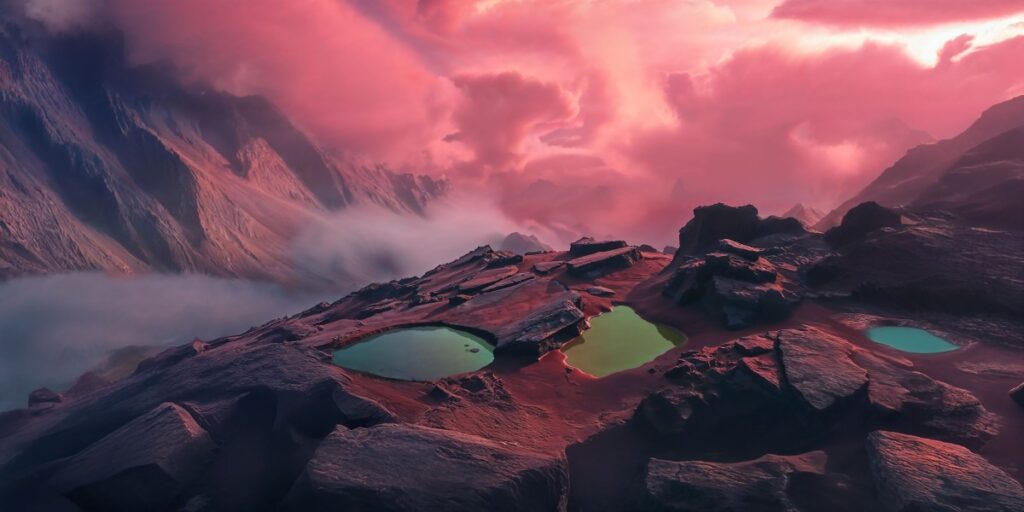
Exploring whether anything might be able to survive—and perhaps even thrive—in these hypothetical pools involved a field trip, a cloud chamber, and lab experiments that yielded surprising results.
Building an alien world
To study Venus on Earth, we sent Iakubivskyi to Lake Ijen, nestled in the mountains on the island of Java in Indonesia. Lake Ijen’s seductive, incandescent turquoise color belies its hostility to earthly life; its 0.3 pH makes it the most acidic crater lake in the world. Just as the Mars Desert Research station in Utah helps scientists role-play working on another planet (astronaut suits and all), Lake Ijen served as a Venus analogue that Seager and Iakubivskyi used to characterize the fictional planet Phaínōterra. “It’s a way to anticipate alien biologies beyond Earth,” Iakubivskyi told me.
When Iakubivskyi arrived at Lake Ijen, he was met with thick clouds of acidic volcanic gas, treacherous terrain, and even a mini earthquake. He carefully steered a drone over the lake, using a system custom-designed for acidic lakes to capture samples. Armed with insights from Lake Ijen, Iakubivskyi returned to MIT, where he built an enclosed, boxy particle detector called a cloud chamber in Seager’s lab in Building E25 and injected concentrated sulfuric acid to simulate the clouds of Venus.
Meanwhile, Seager’s lab and collaborators conducted experiments exploring whether biological building blocks could survive in highly acidic environments like those of Venus and Venus-like exoplanets. One involved mixing “biogenic” amino acids—those essential to all life on Earth—with sulfuric acid at concentrations known to exist in the clouds of Venus. Out of 20 amino acids they tested, 19 survived. Even more surprising, all 19 were stable for at least a month, with a handful chemically modified by the acid, and the team found that some small peptides, nucleic acid bases, and lipids also persist in sulfuric acid. This research showed that biological building blocks could remain stable in what was thought to be an environment completely inhospitable to life.
How could life eke out an existence in places long thought to be totally uninhabitable?
Separately, while readying sulfuric acid mixtures for mass spectrometry analysis in preparation for future Venus missions, Seager’s lab discovered that sulfuric acid mixed with an organic compound didn’t completely evaporate, even in a vacuum. In further experiments with collaborators, mixing sulfuric acid with various nitrogen-bearing organics (such as those that could be delivered to Venus and Venus-like exoplanets by meteorites) produced ionic liquid, a fluid mixture of salts that stuck around. The work revealed that sulfuric acid environments can produce a new kind of liquid that might itself sustain life.
“Our specific biological path only works with what we have on Earth,” Iakubivskyi says. “But if you swap the parts from the beginning, life could potentially exist in these solvents.” And that chemistry in an alien environment could perhaps nurture life just one planet away from Earth.
Seager’s lab is now using insights from both the Phaínōterra cloud chamber and the sulfuric acid chemistry experiments to design instruments for a Venus habitability probe mission targeted to launch in the 2030s.
Not-so-basic chemistry?
When scientists led by the Nobel Prize–winning microbiologist Joshua Lederberg pioneered space biology in the 1950s, they entertained all kinds of chemical combinations that might have produced life in our backyard. As they anticipated NASA’s upcoming missions to the moon, Mars, and even Venus, they imagined that organic compounds might litter the extraterrestrial environment and hypothesized that the same ingredients could have brewed wholly alien molecules, cells—and even creatures.