

Published on Apr. 20, 2026, 8:00 AM
The oldest meteor shower on record reaches its peak this week
After an odd uptick in the number of fireballs streaking through our skies, we have now slipped into the debris stream of an ancient comet that should produce even more of these bright meteors, as the Lyrid meteor shower soon reaches its peak.
On April 14, our planet began passing through a concentrated stream of ice, dust, and pebbles, left behind by a comet named C/1861 G1 (Thatcher). Comet Thatcher is, currently, far out in the solar system, well beyond the orbit of Pluto, and not due to return to Earth’s vicinity until the year 2283.
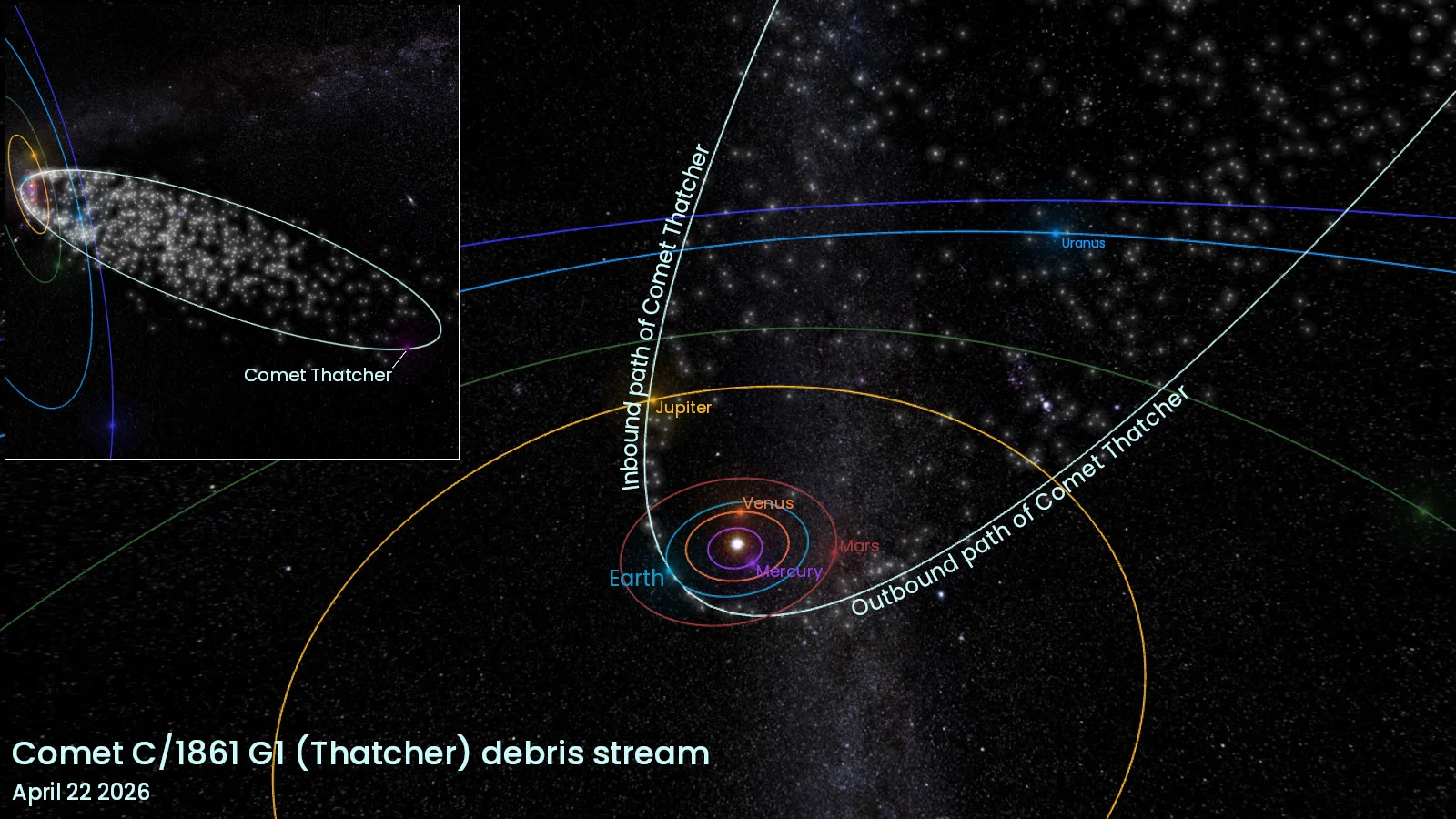
This simulation shows the orbit and debris stream from Comet Thatcher, as viewed from far out in the solar system. The locations of the inner planets are indicated as of April 22, 2026, with Earth intersecting the orbital path of the comet. Inset is a fully-zoomed out view, showing the comet’s current position in the outer solar system. Credit: Meteorshowers.org/Scott Sutherland
RELATED: What’s going on with all the bright fireball meteors lately?
Every year during the latter half of April, though, our planet’s atmosphere sweeps up meteoroids from this comet, as its debris stream . As these meteoroids pass through the upper atmosphere, they put enormous pressure on the air in their path, causing that air to light up in a flash known as a meteor.
As all of these particular meteors can be traced back to a point in the sky near the constellation Lyra, this is known as the Lyrid meteor shower.
The Lyrids is the oldest of all the yearly meteor showers. According to records, it was first observed over 2,700 years ago!
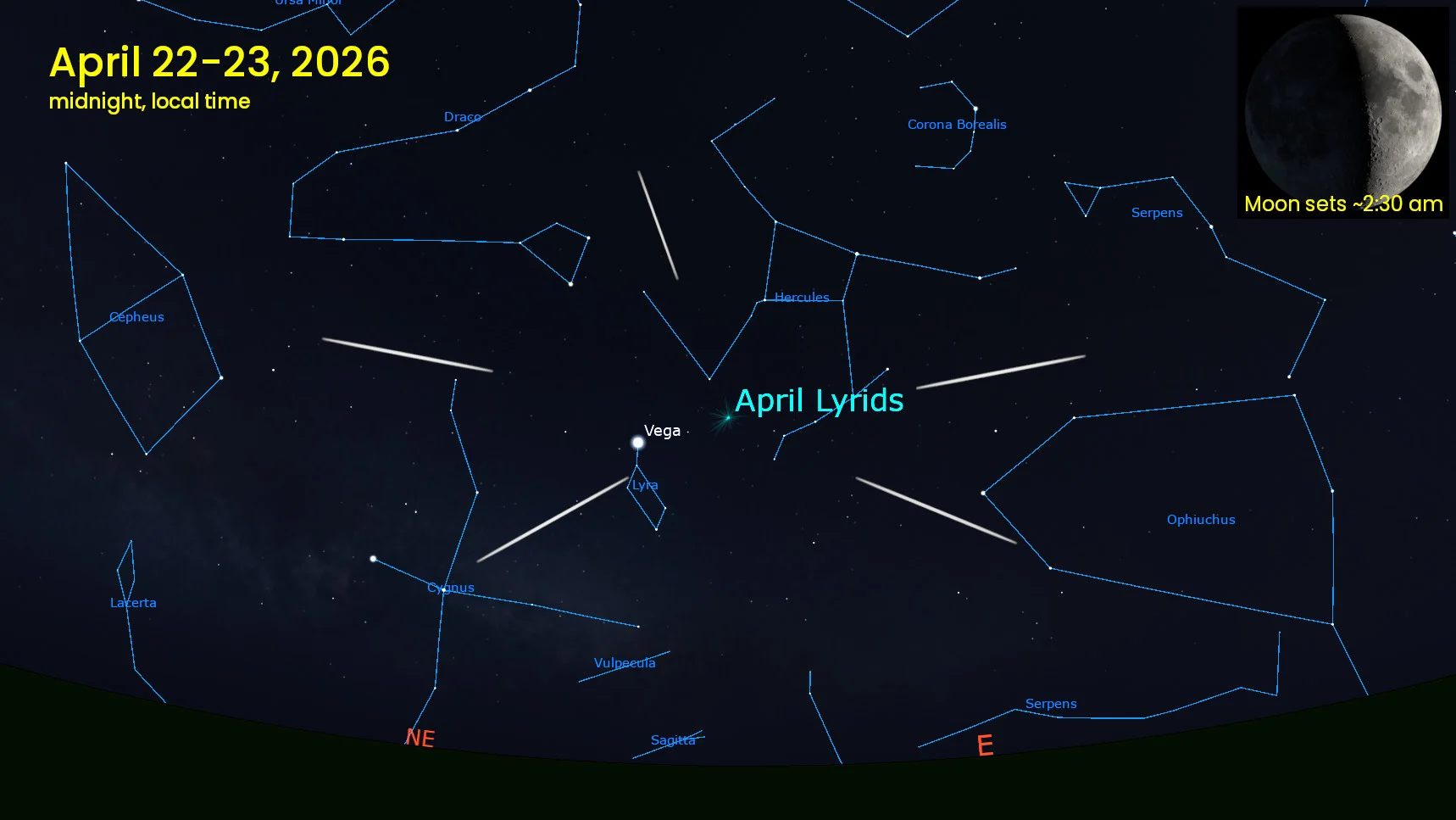
The position of the Lyrid ‘radiant’, in the northeastern sky, around midnight on the night of April 22-23, 2026, when the Lyrids peak. We will have a Waxing Crescent Moon on that night, which will rise before noon on the 22nd, and set after midnight on the 23rd. (Stellarium)
DON’T MISS: Artemis 2 Splashdown – Fiery plunge was the riskiest stage of Orion’s flight
As with nearly all meteor showers, the Lyrids follow a specific pattern, night-to-night. During the first week or so, it only produces a few meteors every hour. Then, their numbers ramp up, reaching a peak as we pass through the densest part of the debris stream. After that, their numbers ramp down again until the shower ends when we pass out of the stream altogether.