
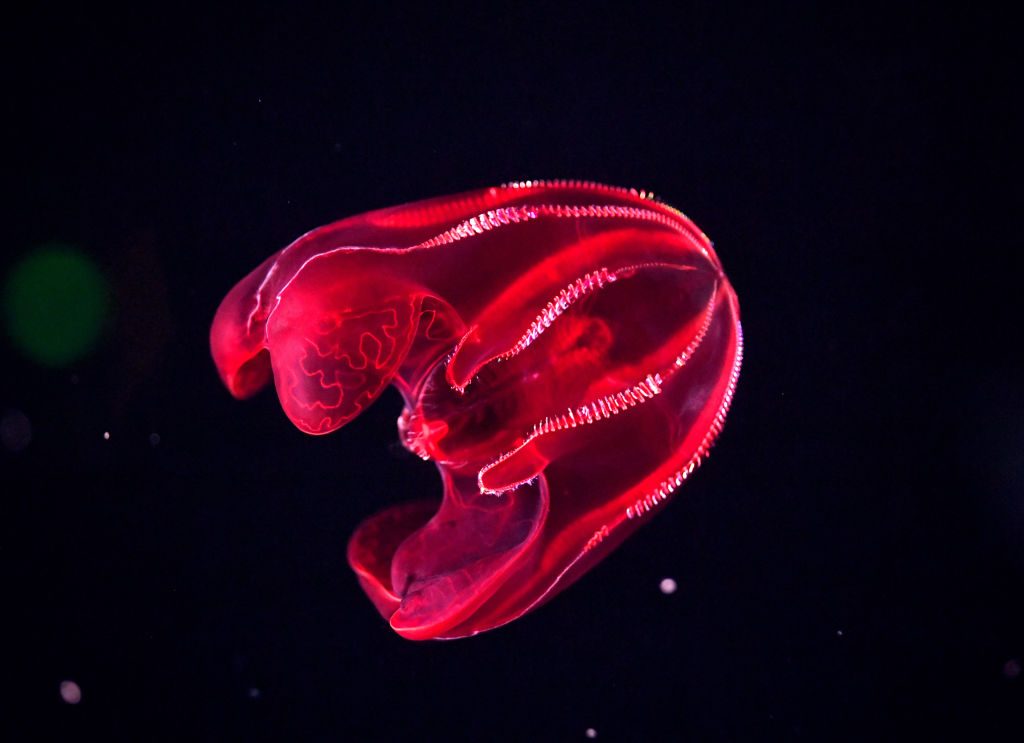
You know from their name that bloodybelly comb jellies are going to be fascinating animals – and that there’s a good chance they have a red belly.
These marine invertebrates are found hundreds of metres deep in the twilight zone where their deep red coloration works like an invisibility cloak, keeping them hidden from predators.
They are named for their iconic red stomachs, which are probably a way of masking bioluminescent prey they’ve swallowed. In the dark ocean where any light could attract predators, you don’t want a beacon glowing from your belly!
What are bloodybelly comb jellies?
Comb jellies are a type of marine invertebrate found in oceans all over the world. The fancy name for them is ctenophores. There are lots of different types of comb jelly, all of which have eight rows of hair-like cilia which beat in a wave-like motion to help them move through the water.
The bloodybelly comb jelly (Lampocteis cruentiventer) is a particular species named for – you guessed it – their sangria-coloured stomachs.
What do they look like?
With their translucent red bodies shimmering with rainbow lights, these gelatinous creatures could easily be mistaken for some kind of alien spaceship. That, or a festive blood clot. They can appear different shades of red but always have a deep ruby belly, hence the name. As they swim through the water, the movement of their cilia makes the light scatter in a way that looks like a rainbow is dancing up and down the sides of their bodies.
Where do they live?
These crimson critters live in the midwater zone – also called the mesopelagic or ‘twilight zone’ – in the North Pacific Ocean, from Japan to California. They are typically found between around 250 and 1,500 metres deep where there is very little sunlight. Below 1000m, in the bathypelagic (midnight) zone, there is no sunlight at all. The only light comes from the glimmer of bioluminescence.
The bloodybelly’s habitat is the reason for their vermillion hue. In photos and videos, this comb jelly looks like it stands out like a sore thumb against the black water but that’s because scientists shone a light on the animal to take a photo. Without that light source, it would look almost invisible.
It might sound strange for such a bright colour but red can’t be seen in the deep sea. When light shines into water, colours with longer wavelengths are absorbed first. Red has the longest wavelengths of all so it quickly vanishes – only remaining visible in waters around 10 metres deep.
So, without the light from a submersible, red animals look black. That’s why so many deep-sea animals – fromsiphonophores and corals to jellyfish and crabs – are red. It’s a clever form of camouflage.
What do they eat?
Exactly what bloodybellies eat is currently unknown but it’s likely that – like other comb jellies – they munch on tiny plankton in the water, such as copepods and larvae.
Why is it red?
Its cherry-red belly has an important purpose: if this translucent ctenophore ate something bioluminescent, the glowing prey inside its tummy would soon give its whereabouts away to potential predators. So, its scarlet stomach acts like an invisibility cloak, masking any bioluminescent light from inside its full gut.
How do they hunt?
Comb jellies are not true jellyfish and don’t have stinging cells. Instead, many comb jellies use sticky cells called colloblasts to trap their prey.
How do they reproduce?
Most comb jellies are simultaneous hermaphrodites, which means they have both male and female sexual organs and can release both eggs and sperm into the water to spawn.
Are they dangerous to humans?
No. Although their bright red bodies look rather haunting against the inky black ocean, these creatures live so deep that you’re never going to run into one. Even if you did, they aren’t interested in humans and wouldn’t be able to hurt you. They don’t have stinging cells and if you lifted them out of the water, the delicate animal would probably disintegrate.
Are they under threat?
It’s hard to say. The bloodybelly comb jelly hasn’t been evaluated by the IUCN Red List of Threatened Species.
But there’s a strong chance we are impacting it. Although this blood-red beastie lives far from humans, that doesn’t mean we can’t cause it harm. Climate change is affecting animals all around the world, both on land and in our seas, and as the ocean absorbs more carbon dioxide, it’s becoming more acidic. Chemicals being pumped into the water can also harm aquatic animals and plastic pollution has been found in the deepest part of the ocean.