
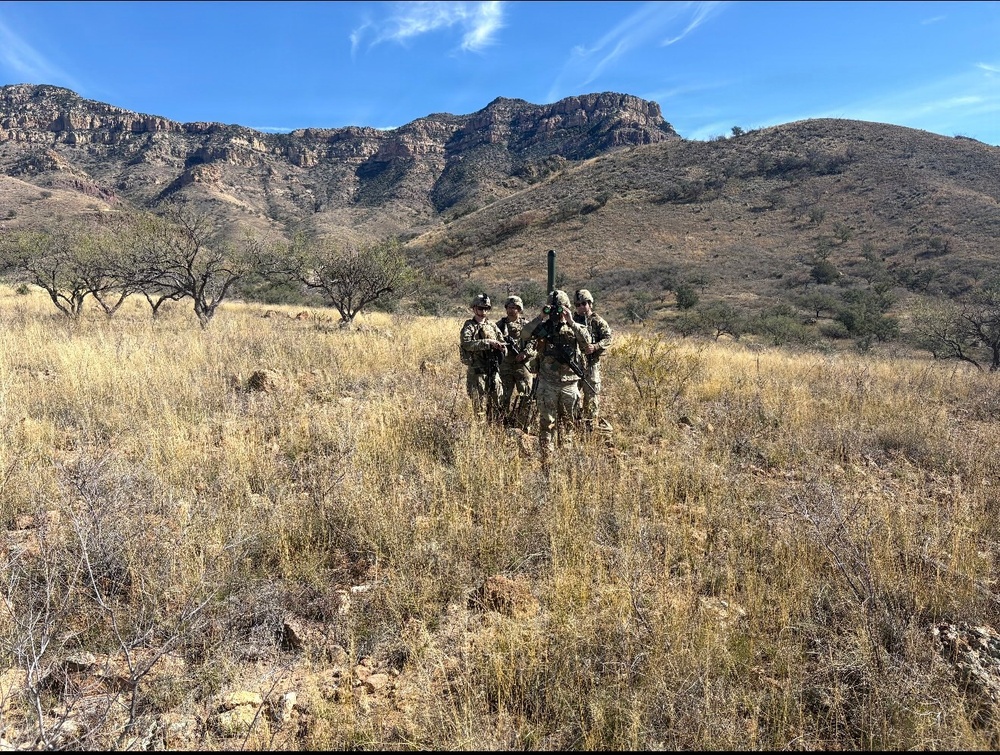
FORT HUACHUCA, Ariz. – Joint Task Force-Southern Border (JTF-SB) continues to embrace the southern border as an “innovation laboratory” and proving ground for new technologies. Service members employ advanced systems to test and refine next-generation technology, enhancing both border security and the readiness of the joint force. The Terrestrial Layered System Manpack (TLS Manpack) is one such capability.
The U.S. Army began fielding the TLS Manpack, a new generation of electronic warfare technology, in 2024 to give soldiers a critical advantage in the electromagnetic spectrum. This dismounted system integrates signal intelligence and electronic attack capabilities into a single, soldier-carried package. Designed for operational flexibility, the TLS Manpack can be scaled from a lightweight, five-pound handheld device to a 30-pound backpack for more demanding missions. The system provides commanders with on-the-move capabilities to jam, locate, and listen to adversary signals.
The TLS Manpack is operationally employed along the southern border to detect communication frequencies originating from Mexico. This capability enables JTF-SB service members to be mobile while using this sensor on patrol, adding a key detection tool to the mission on the border. An electronic warfare (EW) platoon attached to 1st Battalion, 35th Armored Regiment, 2nd Armored Brigade Combat Team, 1st Armored Division recently put the TLS Manpack to the test in January 2026.
“The shift to LSCO [Large Scale Combat Operations] and the inclusion of the electronic warfare platoon in brigades created a need for the Army to have the right tools for operations in the electromagnetic spectrum,” said U.S. Army 1st Lt. Joshua Orteza, Electronic Warfare Platoon Leader, Headquarters and Headquarters Company, 2nd Armored Brigade Combat Team, 1st Armored Division. “The TLS system, particularly the Manpack, is the capability to fill the need for mobility within the electronic warfare domain.”
The platoon utilized the TLS Manpack alongside the battalion’s other assets, aerial observation, ground movement, and surveillance platforms, near Nogales, Arizona, to counter transnational criminal organizations (TCOs) that smuggle illegal aliens (IAs) into the U.S. The TLS Manpack enabled service members to not only sense and detect signals of interest but also to leverage listening and jamming capabilities to identify voices and deny communication between TCO personnel. The service members reported these detections to U.S. Customs and Border Protection (CBP), enabling rapid deployment of patrol agents to the area, resulting in apprehensions of seven IAs.
“The TLS Manpack has been successfully used in eight plus missions to provide early warning and situational awareness, allowing us to see the full picture on the border, not just what we can visually detect.” said Orteza, “Our platoon has learned a tremendous amount from utilizing it in an operational setting, and this mission has provided us an operational proving ground to test our system and processes.”
Through synchronized planning, rapid mobility and persistent presence, JTF-SB has enhanced southern border security with expanded detection and monitoring, improved data sharing, enabling U.S. law enforcement partners to increase apprehensions while also improving the warfighting readiness of assigned units. These efforts have led to historically low numbers of individuals attempting to cross the southern border illegally. Furthermore, our support of CBP has contributed to their historically effective rates of arresting or repelling individuals who try to cross the border unlawfully.