
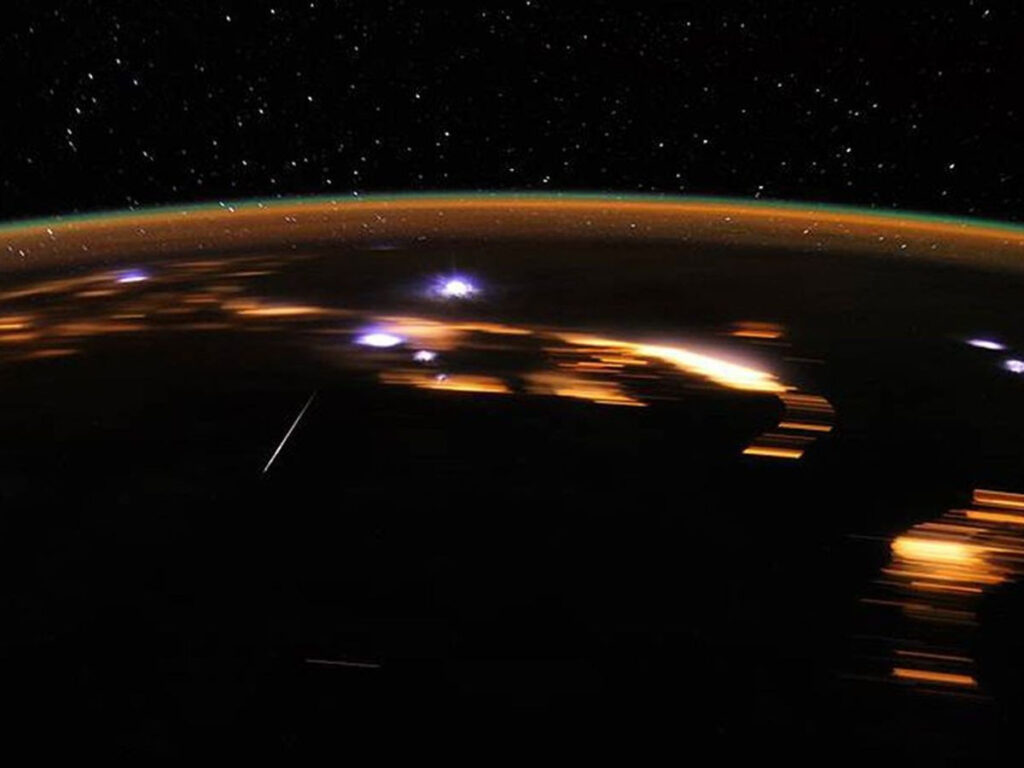
Now, the Lyrid meteor shower is one of the oldest of its kind recorded, offering a brief but significant display of meteors each April, though mainly over the northern hemisphere. It’s expected to peak in the coming days when the Earth passes a stream of debris left behind by Comet Thatcher – which was first discovered in the 1860s. Chris Smith asked Megan Argo, a space scientist at the University of Lancashire, for the lowdown…
Megan – The Lyrids is one of a number of meteor showers that we see throughout the year. So we get these showers at the same time every year, caused by a different comet or asteroid in each case. And the way I like to think of it, if you’ve ever seen something like the Red Arrows fly overhead when they’ve got the coloured smoke coming out of the back of the aircraft, when a comet flies around the Solar System it’s a bit like one of those aircraft leaving a smoke trail behind it, except instead of smoke it’s little bits of dust and rock that get left behind. And just like those smoke trails dissipate, they get wider and wider, and less dense and less dense until they just disappear altogether, these trails of debris do the same thing. And as those debris trails are left in the solar system, if the Earth’s orbit happens to pass through one of them, then those bits of dust and rock that are left behind in that trail hit our atmosphere, and as they do they heat up quite dramatically, they heat the air around them and they start to essentially disintegrate and burn up. And that’s what we see as a shooting star in the sky. And the Lyrids happen in April every year when we pass through the trail of one of these comets, and this year the peak will be on the night of April the 21st into the 22nd. That’s when you’ll stand the best chance of actually seeing some of these meteors.
Chris – So as we see the lights coming down in the sky, we’re actually seeing bits of comet burning up?
Megan – Anything from bits of dust that are the size of grains of sand you might find on the beach, anything up to maybe golf ball sized. The bigger the bit of rock, the brighter the meteor, because the more material there is to burn up in the atmosphere. So the smaller ones tend to be the fainter ones. And in any of these distributions, there is always a range of sizes, and a range of numbers of those sizes. So if you look at the statistics of the sizes of stuff, you usually see a lot more of the fainter ones, a lot more of the smaller particles and fewer of the bigger ones. So with any meteor shower, you’ll see far more faint meteors than you will bright meteors. So the best chance of seeing anything is to get somewhere away from as much light pollution as you can so you can see those fainter ones.
Chris – Do they have specific colours? Does the chemistry of what is in the particle make a difference, or is it just superheated air as it comes in and interacts with the atmosphere, therefore colour isn’t part of it?
Megan – Colour does vary from meteor shower to meteor shower. Some of them are quite pronounced, so you get some meteor showers where you often see quite a lot of green and it’s to do with the chemistry of particles in the same way it is to do with the chemistry of what’s in the air. So as these are burning up in the air, if you’ve got a big bright one, then there’s lots of material there to burn up and depending on exactly what chemicals there are in the rock, you see different colours. Most often they look white but sometimes you’ll see green ones, sometimes you’ll see more of a yellow tinge to them.
Chris – And talking of the particles, do we know what the origin in cometary terms is of these particles?
Megan – This particular one is from a comet which is called Comet Thatcher, and it’s a long period comet. We actually haven’t seen it come back since it was first recorded back in 1861. So we know that it’s got a long period and we think it’s about 422 years because we’ve only seen it pass once. There’s some uncertainty in that orbit determination. So we’re expecting it to come back in the year 2283. So none of us will be around to see it come past but hopefully astronomers at the time will see it and we’ll get a better determination of its orbit.
Chris – Why have we not got showers and showers and showers of meteors going around? Why is it just the odd one that seems to do this? Or are comets much rarer than I’m giving them credit for?
Megan – There are an awful lot of comets in the solar system. We do see them on a very regular basis. In fact, we’re finding new ones on a very, very regular basis with some of the sky surveys, and some of the telescopes that stare at the Sun, often there are comets that pass through the field of view. The reason we don’t see as many meteor showers as we see comets is because the conditions have to be just right for us to see a meteor shower. The comet’s orbit has to intersect with the orbit of the Earth so that it leaves a debris trail that the Earth will then pass through on its next orbit around the Sun. Most comets do not directly cross the Earth’s orbit. They’re going in different trajectories that mean they just don’t intersect with our path around the Sun at any time and if they never do that then we’re never going to see a meteor shower from that particular comet.
Chris – I suppose then, and probably this is not going to happen for a very long time, but if it is on an Earth-crossing orbit there is a small risk that on one of those 453 year-long orbital passes it could hit us.
Megan – It’s a very, very small possibility. You’re right, there is a risk there. But the comet has to be at just the right point in its orbit at the same time the Earth is coming past the right point in its orbit. And given that we think the orbit of this comet, it takes 422 years to go around one complete orbit, and the Earth takes 325 and a bit days to go around its orbit, the chances of them being in exactly the same place are very, very, very small.
Chris – I shall take some comfort from that. So just before you go Megan, if people want to see this meteor shower, where do they look and when?
Megan – It’s active over a period of a few weeks but the night when you’re most likely to see a good rate of meteors is over the night of April the 21st into the 22nd. The Moon will be up but it will only be about a quarter full. When the Moon is brighter, it reduces your ability to see the fainter end of the meteor distribution so you want ideally a night when there’s no Moon in the sky, but 27% is not as bad as it could be, it’s a lot better than it being a full Moon. What you want to do is get somewhere away from as much light pollution as you can, if you can’t do that, then use buildings or trees or something to try and block out the lights that are around you so you’ve got a better view of the sky above you. And the radiant, the place on the sky that the meteors appear to come from will be in at least in the UK in the early hours, it will be in sort of the northeast. The best way to observe meteors, it’s quite a nice way to observe the sky, is to get something like a deck chair and a sleeping bag, a woolly hat, and a flask of coffee, and just look up and just enjoy the sky, and if you’re lucky, and if you’re outside for long enough you’ll see meteors streaking across the sky.