
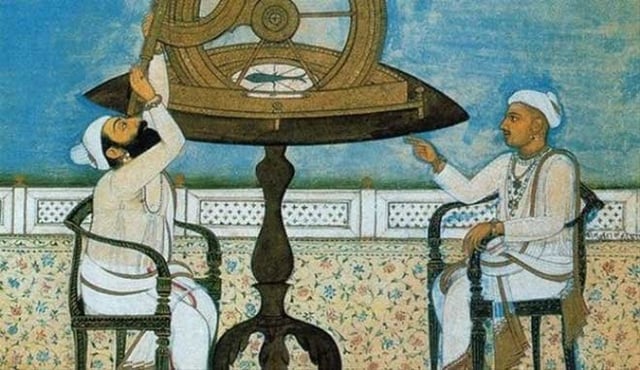

Imagine being so accurate at predicting the future that it eventually becomes your death warrant.
In the mid-17th century, the Ottoman Empire was under the influence of Hüseyin Efendi, the Chief Astrologer. He wasn't just a mystic; he was a highly educated scholar who mastered ilm-i nücum—a complex blend of advanced mathematics and celestial cycles. He rose from an ordinary official to a powerhouse who had the ear of the Sultans.
His legend began with the Calendar of Omens (Ahkâm Takvimi) he prepared for the year 1640. In it, he hid a brilliant but deadly wordplay: 'Hüseyin-i Nâ-Murad'.
To a regular person, this simply meant 'Hüseyin the Unfulfilled'. However, in Ottoman Turkish, 'Murad' was both the Sultan's name and the word for 'desire/goal'. By adding the Persian prefix 'Nâ-' (meaning 'without'), he was secretly signaling 'A world without Murad'. That same year, the formidable Sultan Murad IV died, exactly as Hüseyin calculated. His fame became absolute. He repeated this 'miracle' in 1648, predicting the death of Sultan Ibrahim and the rise of a child king.
Hüseyin became the most sought-after man in Istanbul. His wealth grew so vast that he started influencing state diplomacy and even accepting bribes to 'adjust' his predictions. He was no longer just an astronomer; he was a political titan who knew everyone's secrets before they even happened.
But his downfall was written in the same stars he served. For the year 1650, he calculated a 'void' for the 8-year-old Sultan Mehmed IV. He whispered the forbidden: 'The Sultan will die.' This time, his enemies—who had long been waiting for him to stumble—pounced. They convinced the child Sultan that the Astrologer was plotting his death. Hüseyin was stripped of his titles and ordered into exile.
The chilling part is what happened next: Hüseyin Efendi didn't flee the city. He hid in a waterfront mansion on the Bosphorus. According to historical records, he spent his final hours running the numbers on his own birth chart. He realized his math was inescapable: the stars showed 'absolute danger' arriving that very morning.
He didn't wait for the guards to knock. He scrambled into a small boat, desperate to outrun the very calculations he had spent his life perfecting. But as if fate was a mathematical trap, the Sultan’s executioners intercepted him near the Rumeli Fortress. They strangled him on the spot and threw his body into the dark waters of the Bosphorus.
Days later, the sea returned his body to the shore. The man who could map the fate of empires and predict the death of kings had correctly calculated the hour of his own murder—but he couldn't change a single digit of the result.
He found a glitch in the clockwork of time, and in the end, the clockwork crushed him.
Sources & Links:
https://www.fikriyat.com/galeri/tarih/osmanlida-muneccimler-padisahin-olecegini-bilince-olduruldu
https://yenidenergenekon.com/670-osmanli-nostradamusu-muneccim-huseyin-efendi/
by bortakci34
1 Comment
Dude could predict his death down to the hour, but didn’t know where the group of guards would be?
Seems like a skill issue to me.