
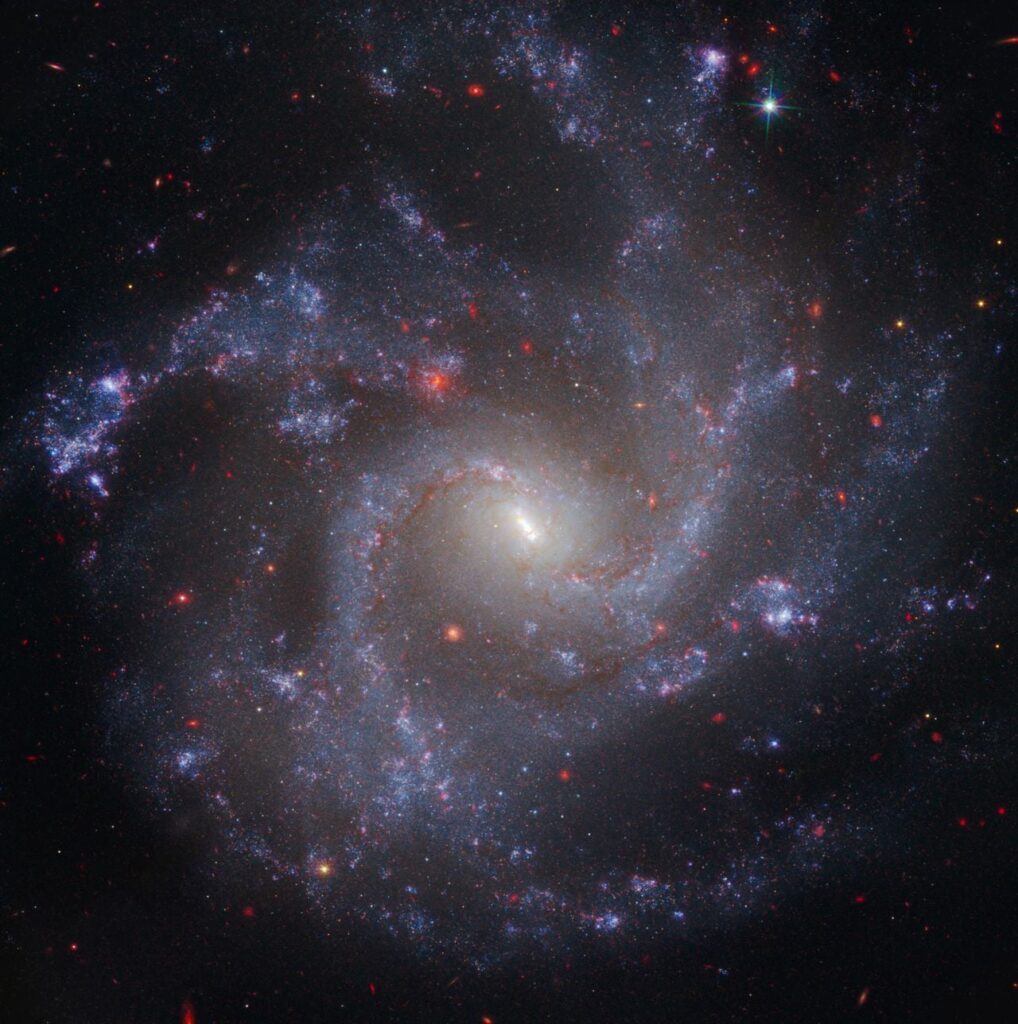
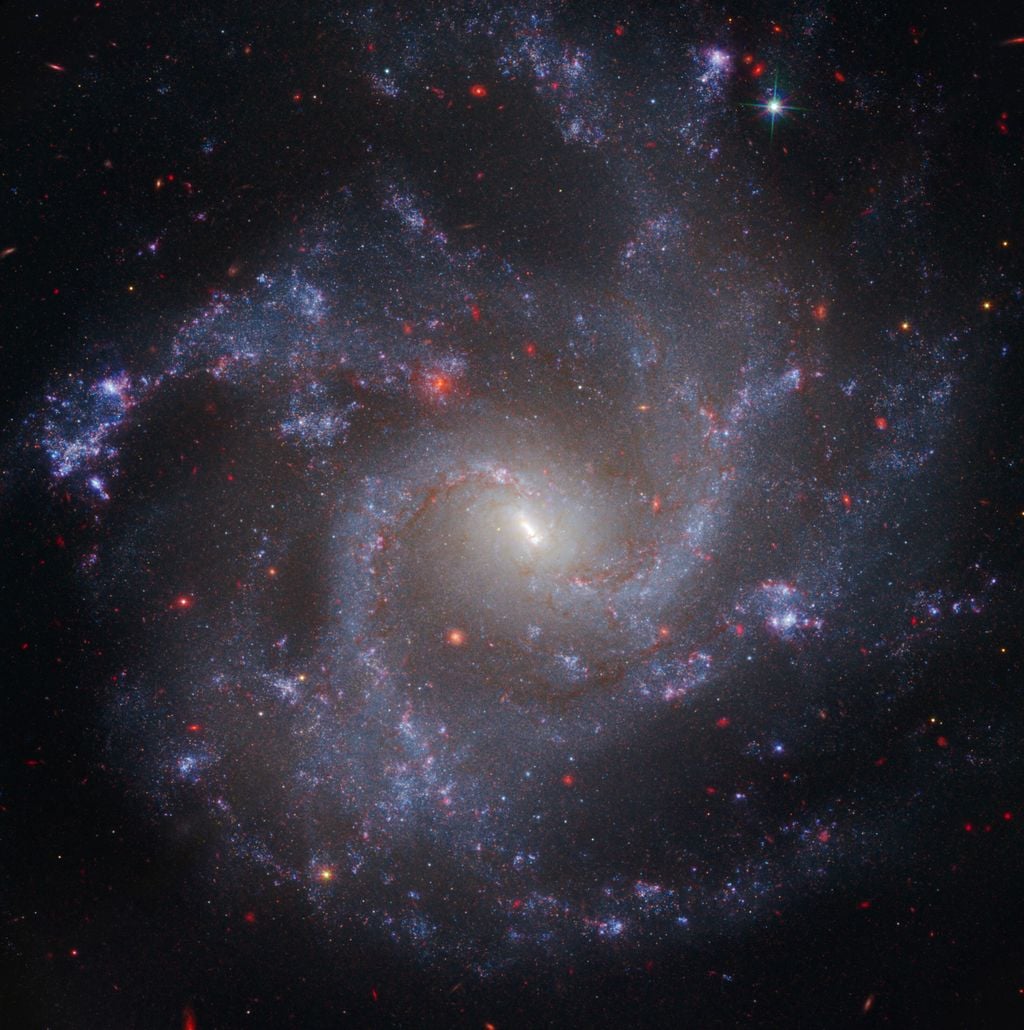
 Image of NGC 5468, a galaxy located about 130 million light years from Earth. NASA, ESA, CSA, STScI, Adam Riess
  Francisco Martín León Meteored Spain 17/04/2026 14:00 9 min
The Institute of Space Sciences is involved in the work of the H0 Distance Network collaboration, published in the journal Astronomy & Astrophysics. The results show, with a precision of around 1 percent, that the universe expands at 73.5 kilometres per second for every megaparsec of distance, that is, for every 3.26 million light years.
The Hubble constant establishes the rate of expansion of the universe based on a linear relationship between the speed at which galaxies move away from us and their distance: the greater the distance of a galaxy, the faster it appears to recede. For nearly a century, astronomy has used the so called cosmic distance ladder to measure this constant, calibrating increasingly distant cosmic objects through a sequence of interconnected steps.
This method has represented enormous progress, but it also means that uncertainties can propagate along the chain, without the advantage of distributing risk or sharing the load. For this reason, the H0 Distance Network collaboration adopted a broader mathematical framework, replacing a single measurement pathway with a Local Distance Network that simultaneously links numerous distance indicators.
The collaboration has determined that the value of the Hubble constant is 73.5 kilometres per second per megaparsec of distance, with a margin of error of plus or minus 0.81 kilometres per second per megaparsec, and therefore with a precision close to 1 percent. This means that a galaxy located one megaparsec from Earth, approximately 3.26 million light years, would be observed moving away from us at a speed of 73.5 kilometres per second. This new measurement refines previous estimates which, depending on the method used, placed the value between 67 and 73 kilometres per second per megaparsec.
“The real novelty is that a large part of the community locked ourselves in for a week in Bern to discuss every detail of each measurement method, agreeing on how to combine them all to improve statistics and obtain the most precise measurement possible,” says Lluís Galbany, researcher at ICE-CSIC and the Institut d’Estudis Espacials de Catalunya.
“At the same time, we decided to make the analysis code public, which combines and recalculates the expansion rate of the universe. This means that in future, new data can easily be added to the network and recalculated,” he adds.
Instead of relying on a single measurement path, the network connects a wide range of independent and overlapping distance indicators. These include, within a single coherent analysis: Cepheid variable stars, a type of pulsating star larger and brighter than the Sun, the tip of the red giant branch, Mira variable stars, megamasers, Type Ia and Type II supernovae, surface brightness fluctuations, the Tully Fisher relation and the fundamental plane.
Essentially, the network explicitly accounts for shared uncertainties and correlations between methods using full covariance weighting, an advanced statistical technique that combines multiple data sources. This allows, for the first time, the coherence of the entire system to be evaluated transparently.
“This is not just a new number for H₀, but a framework created by the community that brings together decades of independent distance measurements in a transparent and accessible way,” says Adam Riess, professor at Johns Hopkins University and astrophysicist at the Space Telescope Science Institute. Riess was one of the three winners of the Nobel Prize in Physics in 2011 for his work on the accelerated expansion of the universe through observations of distant supernovae.
A network, not a single path
The study is the result of a broad community effort launched at the ISSI Breakthrough Workshop, held at the International Space Science Institute in Bern, Switzerland, in March 2025. Around 40 experts in distance measurements and cosmology, representing a wide range of institutions and methodological approaches, participated directly in the sessions, including Lluís Galbany.
Before performing calculations, participants voted on the set of primary distance indicators, considered reference standards to define a baseline solution, along with predefined variants to test robustness.
The network analysis shows that independent distance indicators are mutually consistent within their stated uncertainties and without outliers. It also shows that removing or replacing key components such as Cepheids, TRGB or Type Ia supernovae produces only minor changes in the inferred value of the Hubble constant, and that no single method dominates the final result.
To encourage critical analysis and reuse, the collaboration publishes open source software and data products, allowing anyone to reproduce the analysis, explore alternative assumptions or incorporate future measurements as new data become available.
Implications for precision cosmology in the future
With unprecedented precision and internal consistency, the new local measurement still shows significant discrepancies with values inferred from observations of the early universe under the standard cosmological model Lambda-CDM model. The obtained expansion rate differs by approximately 5 to 7 standard deviations from recent measurements based on the cosmic microwave background and baryon acoustic oscillations. In other words, these discrepancies are not due to calculation errors but indicate that the current cosmological model is incomplete.
Rather than pointing to a flaw in a single measurement technique, the distance network result broadens the basis of the local Hubble constant measurement. Until now, there were two ways to calculate this constant: measuring nearby galaxies gives a value of around 73 kilometres per second per megaparsec, while calculations based on the cosmic microwave background give about 67 kilometres per second per megaparsec. This discrepancy is known as the Hubble tension, a major debate in modern cosmology.
“This work effectively rules out explanations of the Hubble tension based on a single overlooked error in local distance measurements. If the tension is real, as growing evidence suggests, it could point to new physics beyond the standard cosmological model,” says Stefano Casertano, researcher at the Space Telescope Science Institute.
In addition to providing the most precise direct measurement of the Hubble constant to date, the Local Distance Network establishes a flexible and extensible framework for the future. With new observatories, improved calibrations and additional geometric distance references, these elements can be integrated to refine our understanding of cosmic expansion and help resolve the Hubble tension.
“This work shows that explanations invoking a single overlooked systematic error in local distance measurements are increasingly difficult to sustain. If this tension reflects real physics, it could indicate new components beyond the standard cosmological model or require a reassessment of our understanding of the early universe,” concludes Eleonora Di Valentino, researcher at University of Sheffield.
Source: ICE-CSIC
Reference of the news
The Local Distance Network: a community consensus report on the measurement of the Hubble constant at ∼1% precisión. Astronomy & Astrophysics. DOI: doi.org/10.1051/0004-6361/202557993