
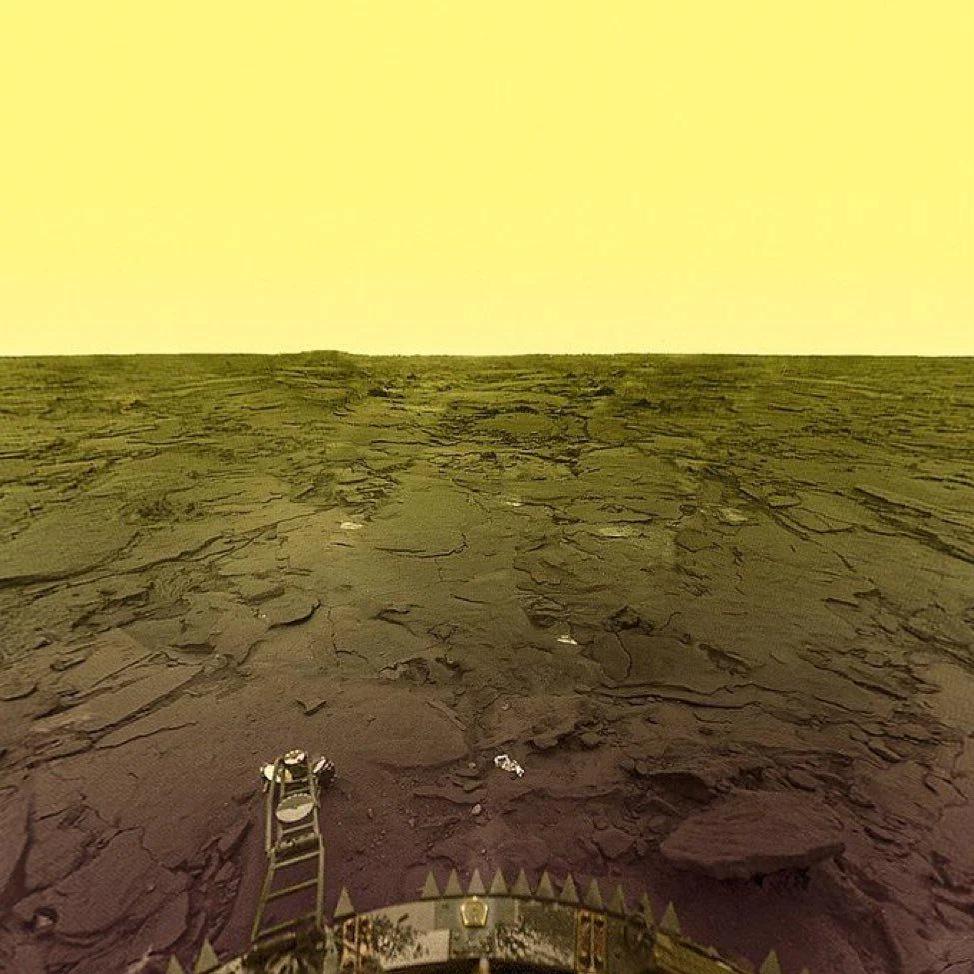
On March 1, 1982, the Soviet Venera 13 lander touched down on the surface of Venus. It was only designed to survive for 32 minutes; it managed to hold on for 127 minutes before the planet's brutal environment finally won.
The Environment at a Glance:
Temperature: A constant 457°C (855°F), hot enough to melt lead.
Pressure: Approximately 90 times that of Earth's sea level. Standing here would feel like being 3,000 feet (900m) underwater.
Atmosphere: A thick, choking cocktail of Carbon Dioxide with clouds of Sulfuric Acid.
What You’re Looking At
The yellowish-orange tint isn't a filter; it’s the result of the thick atmosphere scattering light, stripping away the blues and leaving a permanent, oppressive sepia glow. The landscape is a flat, jagged plain of basaltic rock, indicative of the planet's massive volcanic history.
In the foreground, you can see the lander’s jagged stabilization ring and the lens cap (the small white object) that was ejected upon landing. Ironically, on the other mission (Venera 14), the lens cap landed exactly where the probe's soil-testing arm was supposed to touch down, meaning they accidentally ended up measuring the compressibility of a lens cap instead of the planet!
by albusvercus
10 Comments
Pictures like this are so cool. I used to spend hours on NASA’s website looking at all the Mars rovers pictures. It’s the closest I can be to standing on a different planet.
So Cool. Wish we would go back with 4K cameras and newer technology.
Wait Venera 14 was a previous mission to Venera 13?
They sometimes choose the most boring areas to land though. I mean yeah they are landing on another planet but I want to see Geological stuff happening…..
This is awesome! And I’m so happy that you included so much contextual information, it made it *even cooler*.
😀
Cool pic, ugly place though
Unfortunately this isn’t a real photo, it’s an imagined one based off of the original.
So tired of AI descriptions/posts. (I know the image is real)
Whats neat is what the surface looks like when you color correct the atmosphere out. The area the probe was in was surprisingly cool toned. Lots of blues, greys, and whites.
Always found it interesting that even if you could design a suit to withstand the temperatures, the immense pressure of the atmosphere pushing down on you would make it so you couldn’t even really walk around at all.
You might be able to shuffle around slowly, but good luck lifting a leg off the ground, or even raising your arms.
Getting out of your hypothetical lander could possibly lock you out to standing outside on the surface forever (good luck climbing back inside).