
Link to the science release on ESA website
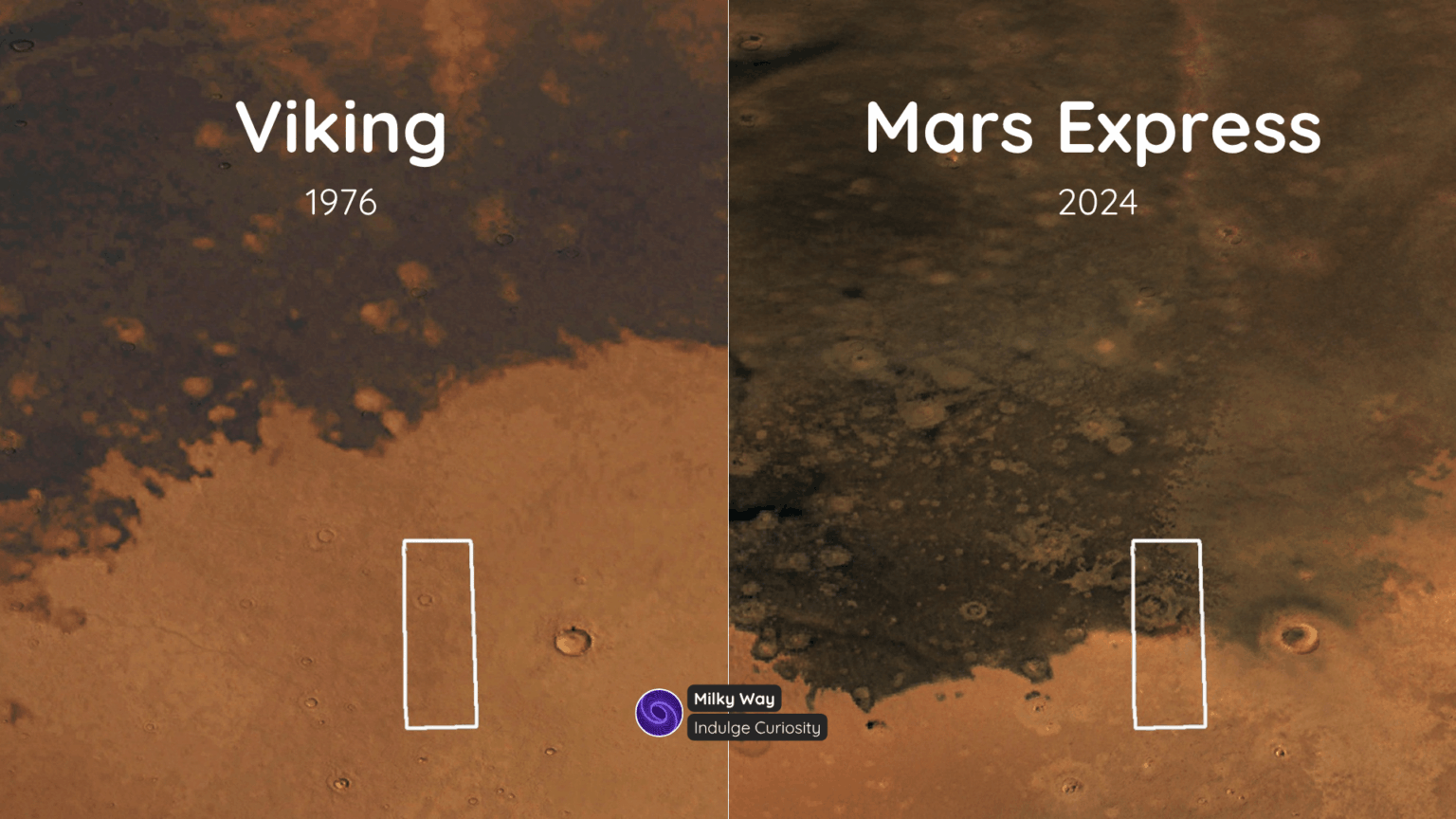
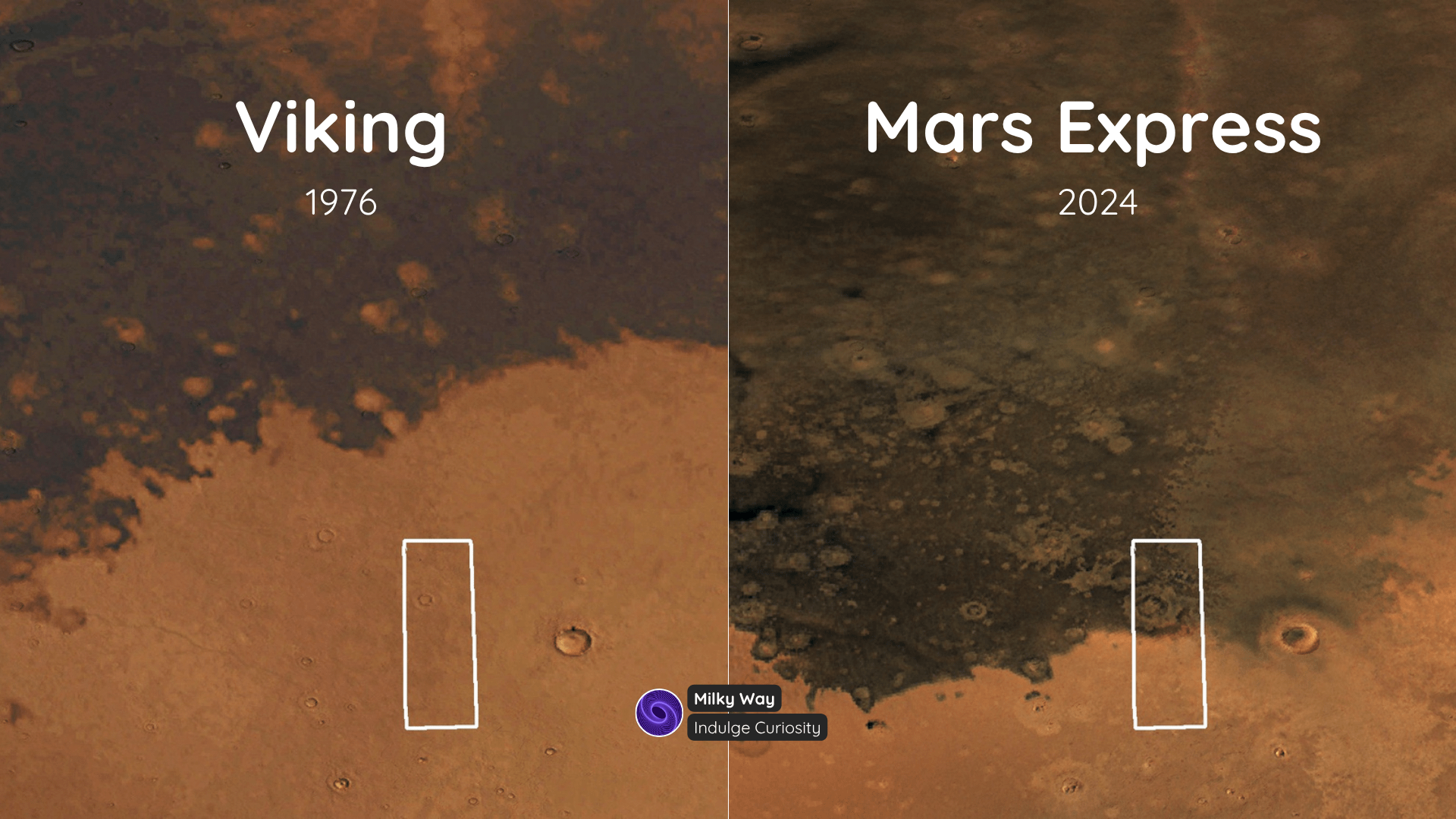
ESA's Mars Express spacecraft has photographed something surprisingly dynamic on a planet where major changes usually take millions of years: a spreading blanket of dark volcanic ash creeping across a region called Utopia Planitia.
Comparing these new images to photos taken by NASA's Viking orbiters in 1976, scientists can clearly see the ash has expanded significantly over just 50 years — either blown in by Martian winds or uncovered as lighter dust was swept away. The dark color comes from minerals like olivine and pyroxene, which form at high temperatures during volcanic activity. Within this ash field sits a 15-km-wide impact crater ringed by lighter material — debris thrown outward when the crater was formed — and laced with squiggly lines left behind by shifting ice.
Elsewhere in the region, bowl-shaped pits called scalloped depressions reveal where underground ice has slowly evaporated, causing the ground above to cave in. On the brighter, sandier half of the scene, long parallel trenches called grabens cut across the surface, formed by cracking ground from ancient tectonic activity or weak sediment layers.
Utopia Planitia itself is an enormous ancient basin, roughly twice the width of the Sahara, that once likely held a lake or ocean and still holds ice underground today.
by Busy_Yesterday9455
6 Comments
What’s with the Milky Way branding on content recently? These aren’t even their photos. The post today with the black hole size comparison really threw me off.
This is not just a before/after photo… it’s proof that Mars is still geologically alive. 48 years of ash spreading is like the planet coughing up volcanic dust. Insane.
Badass. That’s far more activity than I would imagine. Mars is so active still today geologically speaking. How long were the Viking orbiters able to take and send back pictures? I completely forgot about that ability.
Y’know it never occurred to me that mars is still geologically active
Where are the Vulcans?
I thought it had died geologically and that’s why it lost its magnetic field. Cool to find out that there’s still some life left in it!