
Dark matter makes up 27% of all matter in the Universe. So why is it so hard to find?
We got the chance to speak to one of the scientists making a map that leads us to it.
Richard Massey is an astrophysicist at the Institute for Computational Cosmology at Durham University in the UK, working on mapping dark matter and developing satellite instrumentation.
 Richard Massey is an astrophysicist at the Institute for Computational Cosmology at Durham University, working on mapping dark matter and developing satellite instrumentation
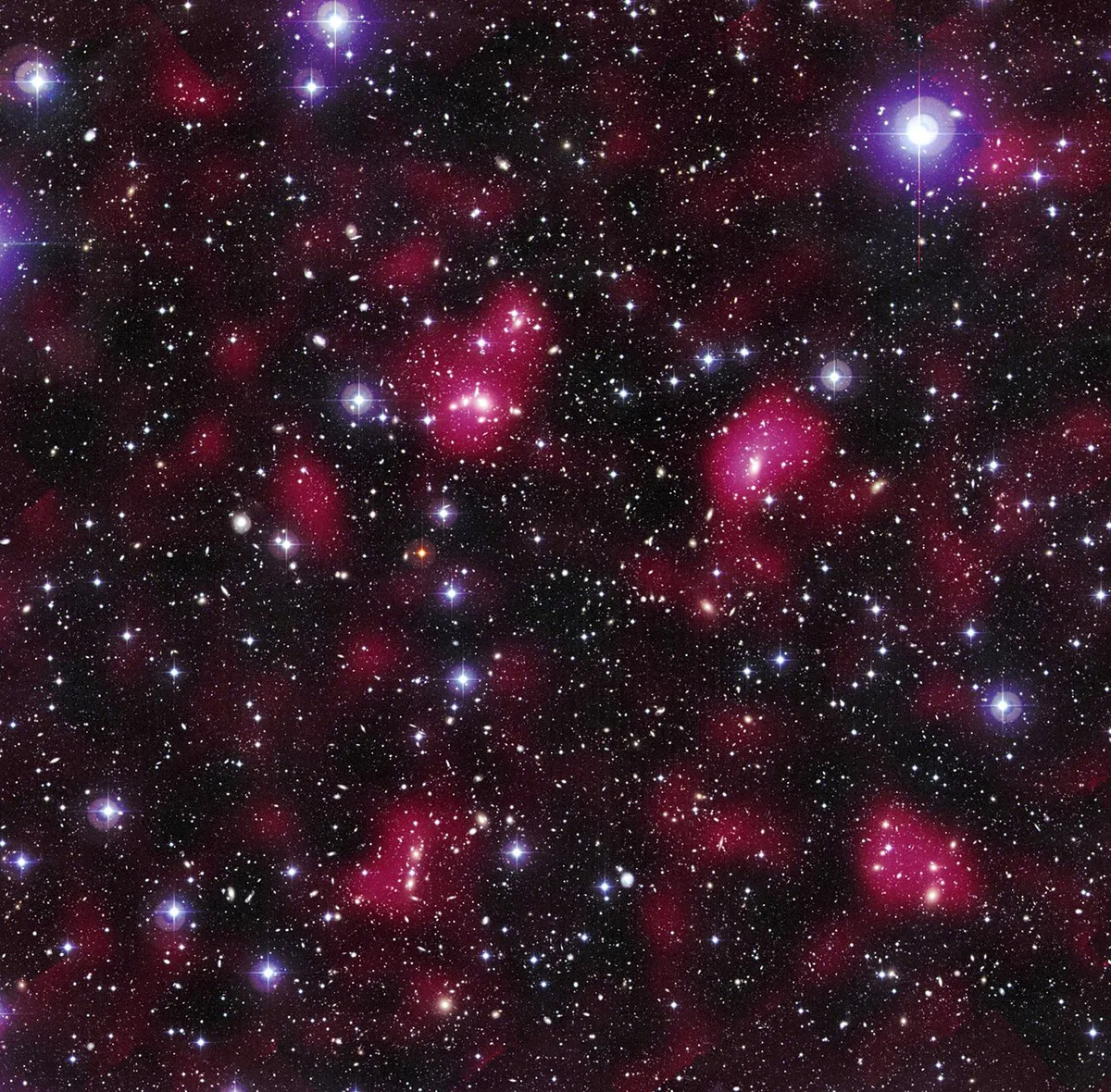 Credit: NASA, ESA, C. Heymans (University of British Columbia, Vancouver), M. Gray (University of Nottingham, U.K.), M. Barden (Innsbruck), and the STAGES collaboration
What is dark matter and why is it so difficult to find?
Dark matter is invisible, which naturally makes it difficult to study. But there are lots of invisible things that we can still measure.
The wind, for example, moves the leaves in the trees and we can learn something about it from that.
Dark matter has a similar role in the Universe. It’s the most common type of matter and it’s really heavy.
Its gravity pulls in ordinary material, gathering enough of it together to form stars and galaxies. It’s an invisible hand, putting everything together in one place.
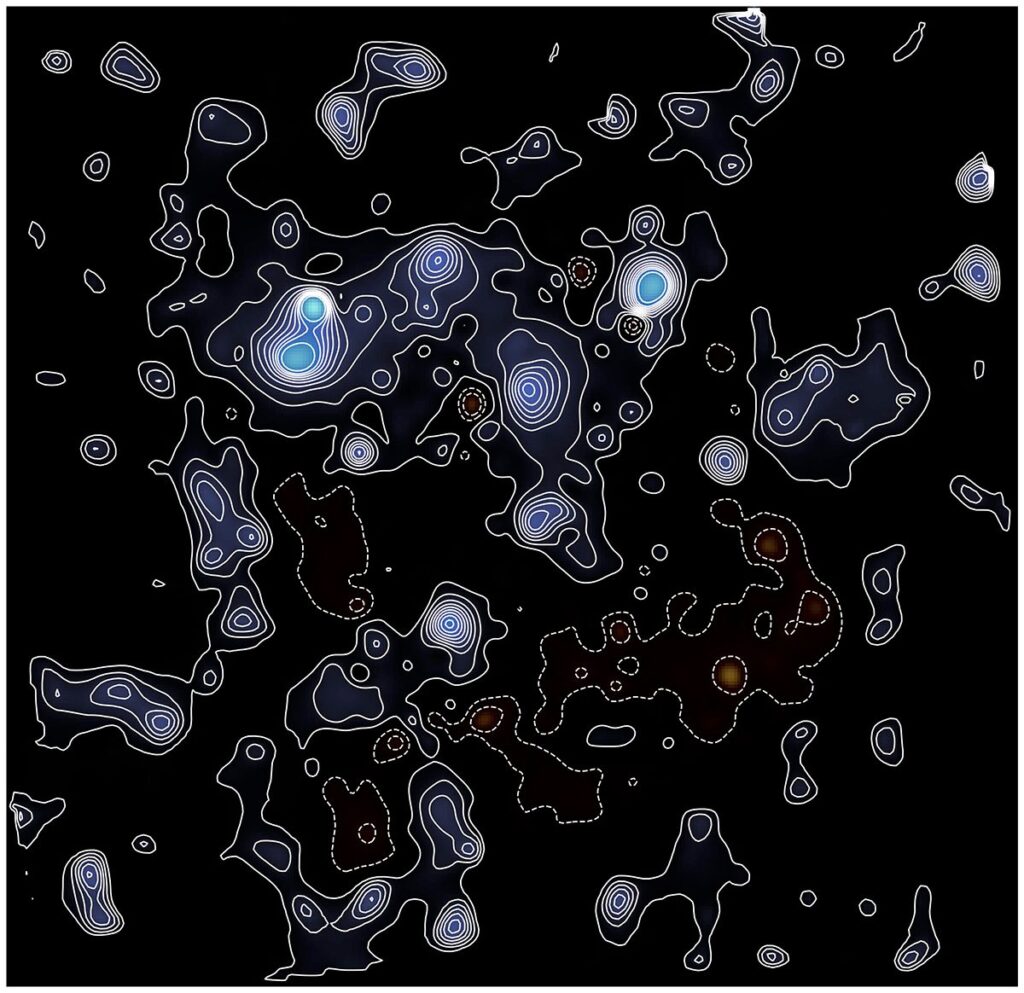
 The team produced the most detailed map of dark matter yet, using JWST data to measure where the light of distant galaxies is bent by an unseen substance. Blue shows where the dark matter is concentrated. Credit: Dr Gavin Leroy, Professor Richard Massey, Cosmos-Web Collaboration
If it’s invisible, how do scientists look for it?
Particle physicists go underground, to places that are dark and quiet – like the bottom of a mine – with huge tanks of liquid xenon, to see if a dark matter particle occasionally bumps into the xenon atoms.
Particle physicists at CERN try to create dark matter by smashing ordinary particles together.
On the other hand, astrophysicists go to the tops of mountains and gaze far away into space.
We know dark matter has gravity, so we look at regions where gravity has a significant effect, like where thousands of galaxies clump together.
I make maps of dark matter, looking at where big accumulations of matter have smashed into one another, to see what we might learn.
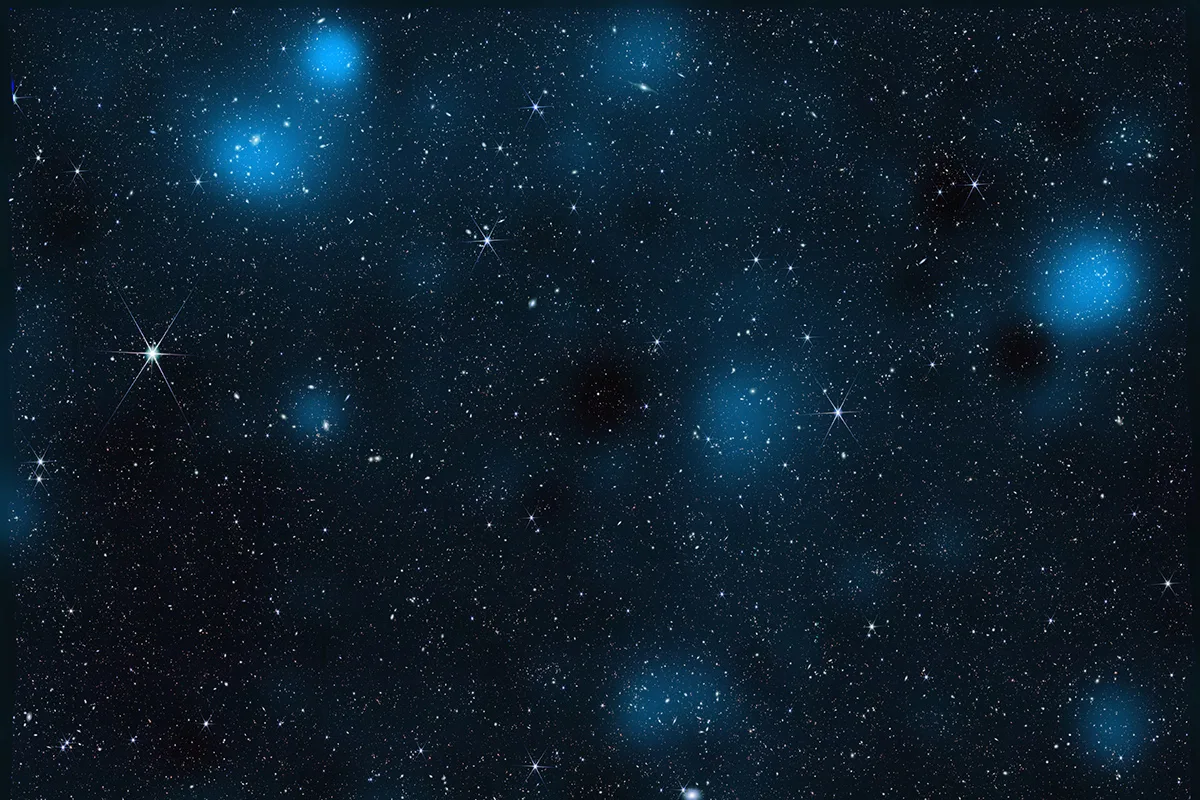 Section of a dark matter map created by the James Webb Space Telescope. Credit: NASA/STScI/J. DePasquale/A. Pagan
So how do you go about making a map of it?
To map dark matter, you look at how it warps light that passes through it.
Usually, light travels in straight lines, but dark matter bends light from distant galaxies as it travels towards us.
The effect is a bit like looking at a funhouse mirror: you see a distorted version with a characteristic pattern.
Whenever we see a weirdly shaped galaxy, that’s because there’s something invisible but heavy in front of it.
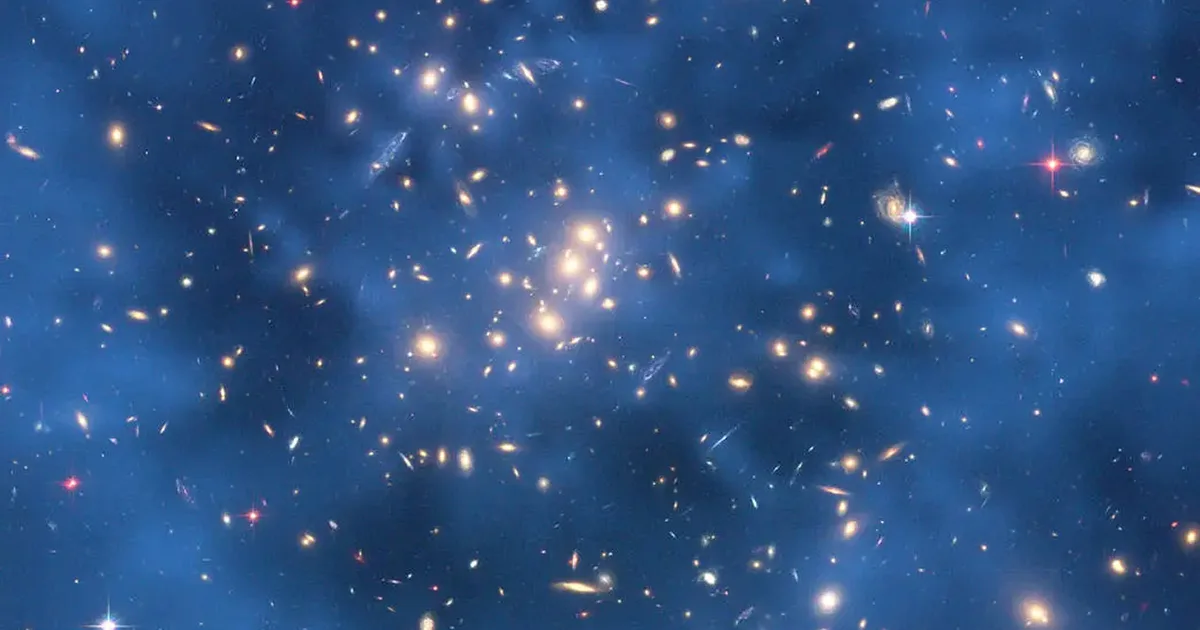 We can only see dark matter from its effect on stars and galaxies. Here, astronomers used the images of galaxies distorted by gravitational lensing to map out the dark matter, shown in blue. Credit: NASA, ESA, M. Jee and H. Ford (Johns Hopkins University)
What can a dark matter map tell us?
Our map tells us that dark matter behaves normally in terms of gravity, bending and pulling in light and ordinary matter exactly as you’d expect.
It sounds boring, but that’s the only positive thing that we know about dark matter.
We know lots of things it doesn’t do, but this is one thing we know it does for certain.
Beyond that, by creating incredibly detailed maps with telescopes like JWST and Euclid, we can see what individual areas we need to investigate in more detail to find out more about dark matter.
Just like a navigational map, we use it as a guide to finding what’s interesting.
What makes the map your team developed with JWST so special?
It’s higher resolution than any previous map. And it covers a big enough patch of sky that we can see the cosmic web and its filaments.
We can sample all these structures and the enormous – perhaps existentially terrifying – voids between them.
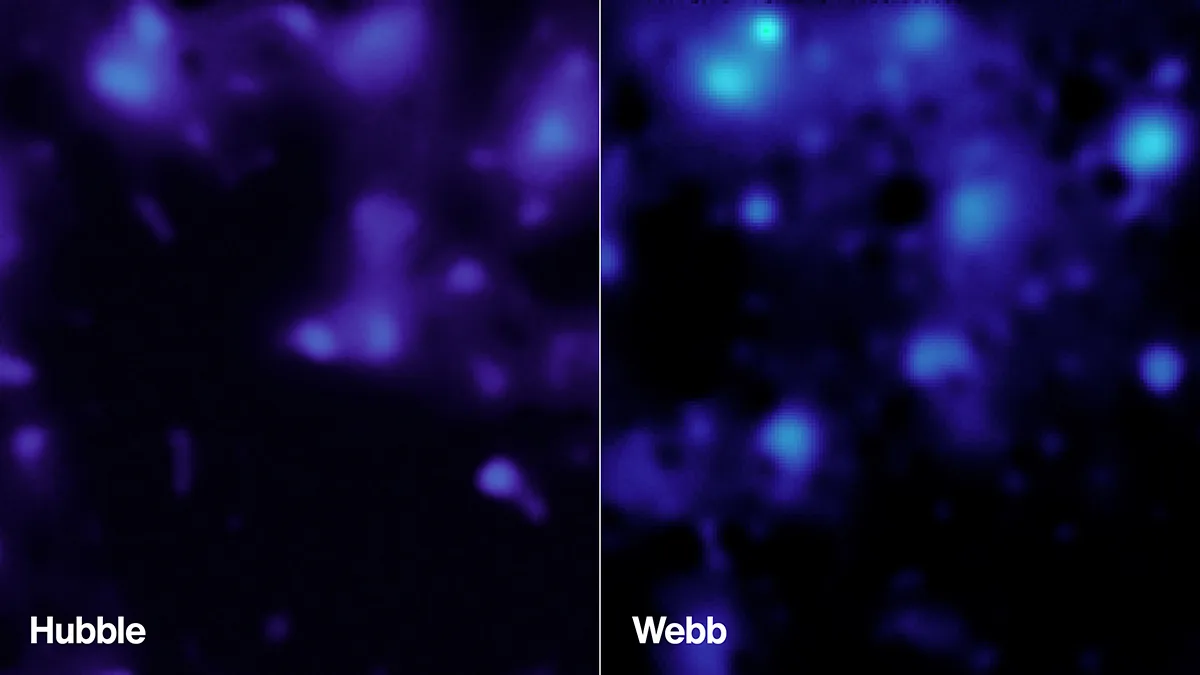 Two dark matter maps showing the same region of the sky, one made by the Hubble Space Telescope and the other by the James Webb Space Telescope. Credit: NASA/STScI/A. Pagan
Why is it important to understand dark matter?
Firstly, it’s the most common stuff in the Universe. After thousands of years of science, it might be considered embarrassing that we don’t know what the most common thing in the Universe is, especially given that it was essential to life.
But also, there’s a practical thing. When J J Thompson discovered the electron, he didn’t intend for it to be useful.
Who knows what dark matter might be useful for?
How did space telescopes help you make the map?
About 20 years ago, I made a map of dark matter with the Hubble Space Telescope. Hubble is amazing, but it could only see galaxies about halfway across the Universe.
We also only got a fuzzy view. Now we can use JWST, which has a much bigger mirror and lets us see galaxies almost at the far side of the Universe.
You can see much more dark matter and at higher resolution. In another 20 years, we’ll have the Habitable Worlds Observatory (planned for the early 2040s), which may be able to figure out what dark matter is, if we haven’t done so already.
There’s something very cool about large space telescope projects, where you need nations to work together.
When NASA, ESA and the UK Space Agency collaborate, we can see farther than we ever would alone – it’s heartening.