
New Webb observations of two exoplanets TRAPPIST-1b and TRAPPIST-1c show blistering days and frozen nights, offering the first detailed climate maps of rocky exoplanets and dimming hopes for habitability.
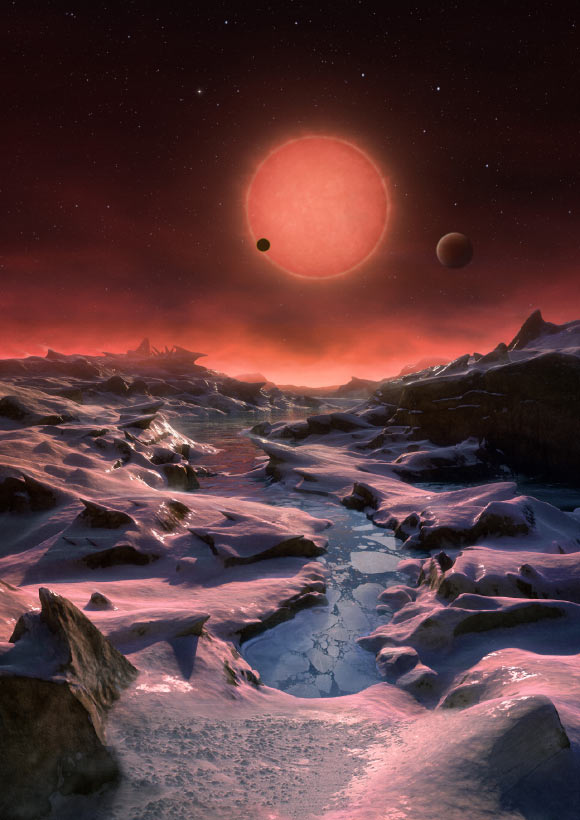
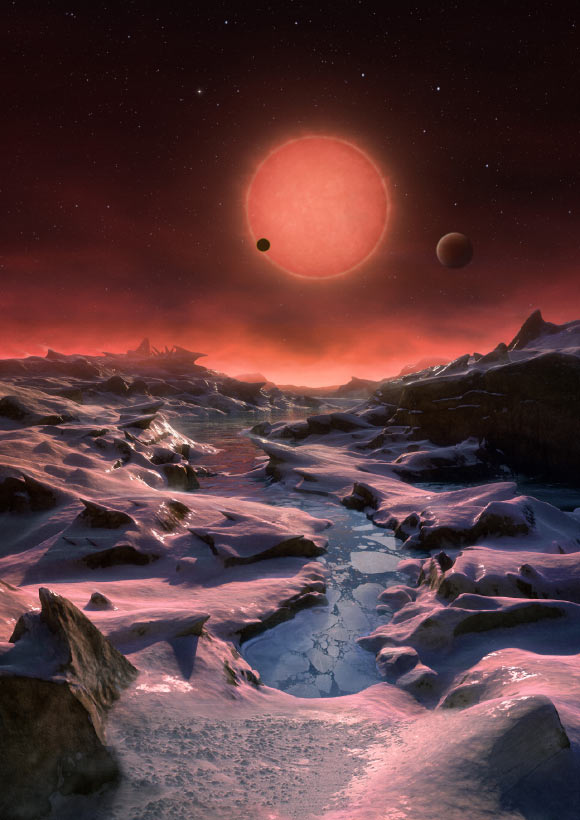
This artist’s impression shows an imagined view from the surface one of the three exoplanets orbiting the ultracool dwarf star TRAPPIST-1 38.8 light-years from Earth. These alien worlds have sizes and temperatures similar to those of Venus and Earth. In this view one of the inner planets is seen in transit across the disc of TRAPPIST-1. Image credit: M. Kornmesser / ESO.
Red dwarfs — smaller and cooler than our Sun — account for more than three-quarters of the stars in the Milky Way.
Astronomers have found that Earth-size planets are especially common around these dim stars, raising a pressing question: could life arise on worlds so different from our own?
One such system, TRAPPIST-1, has become a focal point of that search.
Discovered in 2017, the system is located 38.8 light-years away in the constellation of Aquarius.
It consists of seven transiting planets: TRAPPIST-1b, c, d, e, f, g and h.
All these worlds are similar in size to Earth and Venus, or slightly smaller, and have very short orbital periods.
“The TRAPPIST-1 system is incredible! Seven planets, some with masses similar to Earth’s, orbit the same star,” said UNIGE astronomer Emeline Bolmont.
“At least three planets are located in the star’s habitable zone, where the surface temperatures would allow for the presence of liquid water.”
“It is the perfect playground for comparative planetology, unraveling the mysteries of this type of planet and testing our hypotheses about the development of life around these stars.”
Dr. Bolmont and her colleagues used the NASA/ESA/CSA James Webb Space Telescope to observe two innermost planets in the system: TRAPPIST-1b and TRAPPIST-1c.
“While red dwarf stars and their planets are common in our Galaxy, their habitability is not necessarily guaranteed,” they said.
“First, these stars are very active and bombard their planets with intense ultraviolet radiation and energetic particle fluxes, which could erode their atmospheres and eradicate any life that might exist.”
“Second, planets in the habitable zone of a red dwarf orbit very close to their star, and tidal forces synchronize their rotation with their orbital period, much like the Moon with the Earth.”
“These planets therefore complete one rotation on their axis at the same time as they orbit their star. The result is a permanent day on one side and permanent night on the other.”
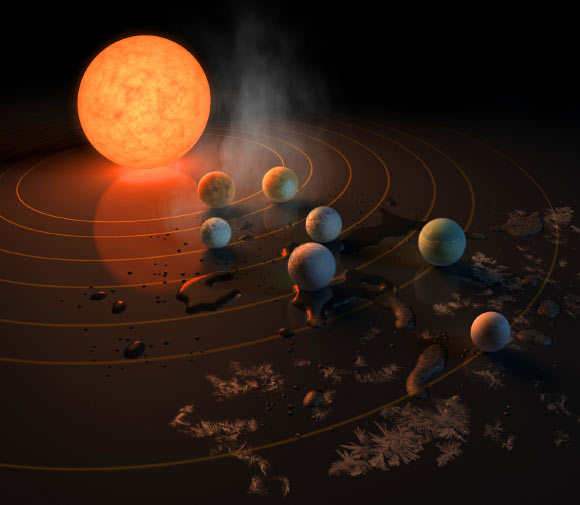
This artist’s impression displays TRAPPIST-1 and its planets reflected in a surface. Image credit: NASA / R. Hurt / T. Pyle.
By measuring the light flux from the star and the two planets, the astronomers were able to determine the surface temperatures of both TRAPPIST-1b and TRAPPIST-1c with great precision, on both their day and night sides.
During the day, the surface temperatures of the two planets exceed 200 degrees Celsius and nearly 100 degrees Celsius, respectively, while their nights are plunged into frigid temperatures below minus 200 degrees Celsius.
This enormous contrast suggests a lack of energy redistribution between the two sides of the planets, and therefore the absence of atmospheres.
If the two planets possessed atmospheres during their formation, these were completely stripped away by the extreme conditions imposed by their star.
According to the team, the lack of a dense atmosphere on the two inner planets of the TRAPPIST-1 system supports the hypothesis that intense radiation and energetic ejections from red dwarfs play a significant role in the evolution of planets around this type of star.
“TRAPPIST-1 serves as a reference system. Our theoretical models show that the outermost planets of the TRAPPIST-1 system can possess an atmosphere despite the absence of one on the two inner planets,” Dr. Bolmont said.
“This is similar to Mercury, the closest planet to our Sun, which has no atmosphere, while Venus and Earth have retained theirs.”
“We look forward to continuing the exploration of the TRAPPIST-1 system.”
The results were published April 3 in the journal Nature Astronomy.
_____
M. Gillon et al. No thick atmosphere around TRAPPIST-1 b and c from JWST thermal phase curves. Nat Astron, published online April 3, 2026; doi: 10.1038/s41550-026-02806-9