
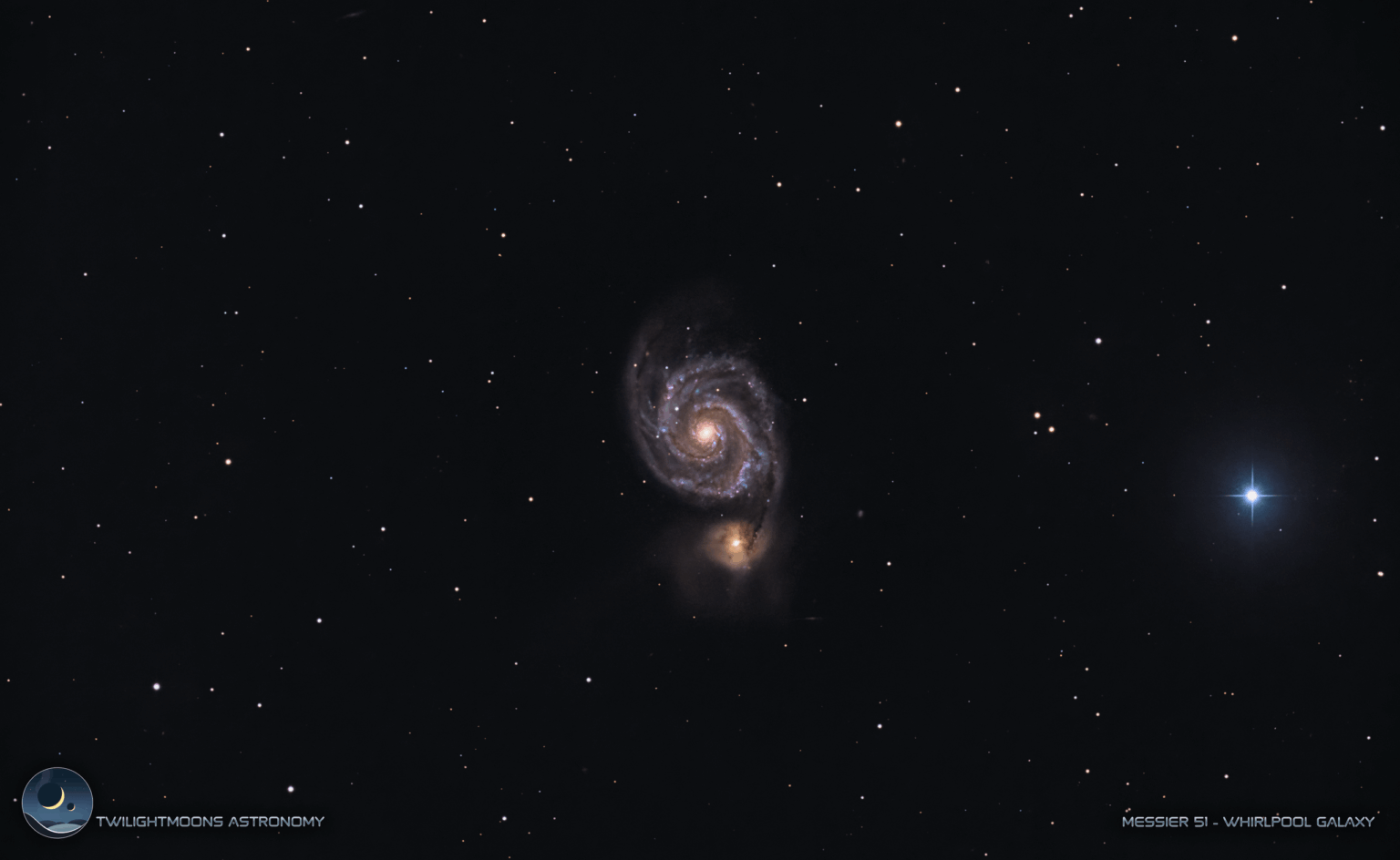
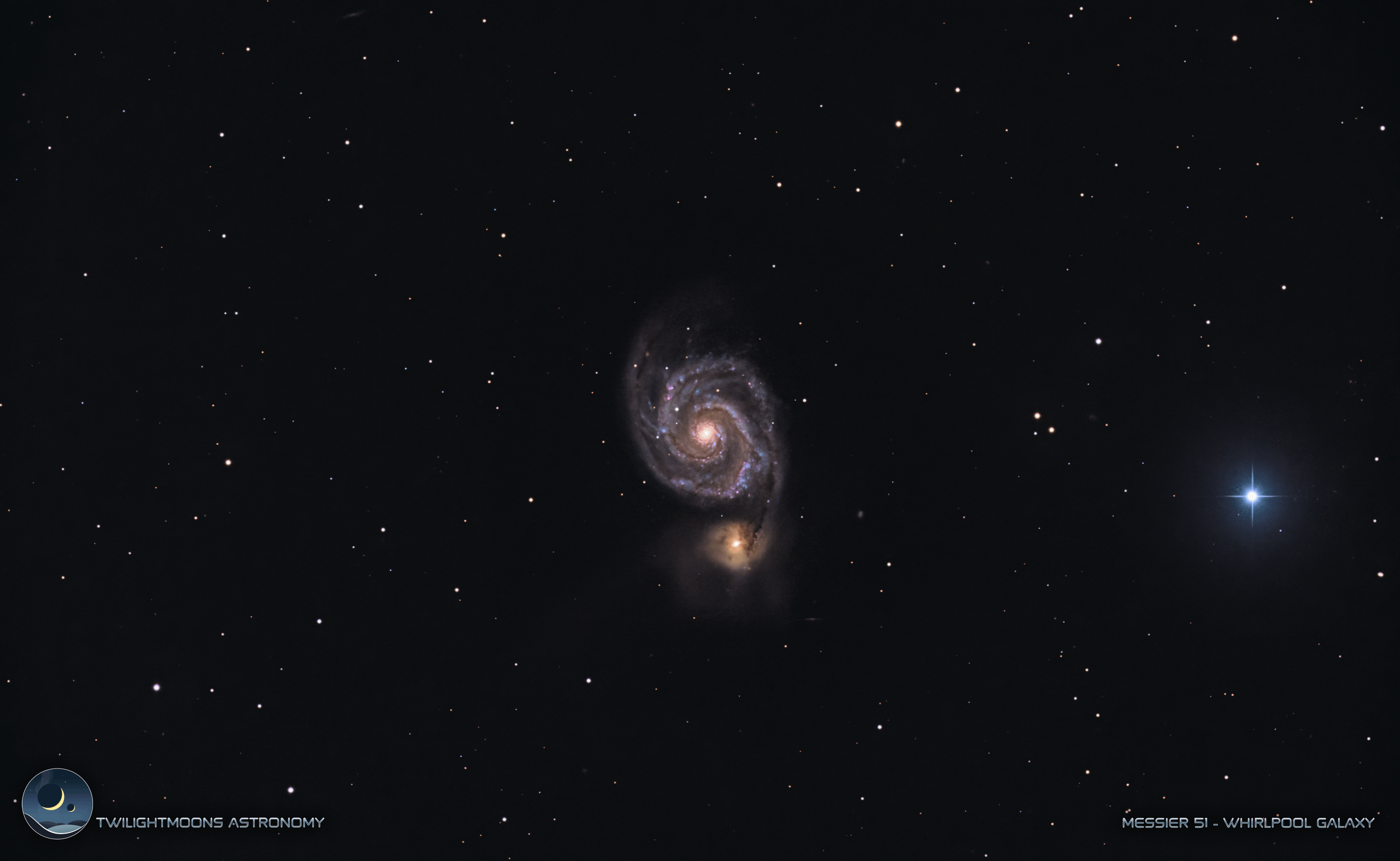
A grand-design spiral galaxy, Messier 51 bas large regions of extensive star formation, likely caused by the close encounter of NGC 5195, the small yellow galaxy at the end of one of the arms. From the dust lanes visible in the image, this smaller galaxy is, from our point of view, behind the larger spiral’s arm, causing tidal forces to trigger starburst activity.
Discovered by Charles Messier in 1773, M51 is about 31 million light-years from Earth in the constellation Canes Venatici. With a small telescope, it can be seen in the norther hemisphere in the evening in the spring.
Integration per filter:
– Lum/Clear: 10m (5 × 120")
– R: 10m (5 × 120")
– G: 10m (5 × 120")
– B: 10m (5 × 120")
– Hα: 10m (5 × 120")
Equipment:
– Telescope: Planewave CDK20 (f/4.4 version)
– Camera: FLI PL11002
– Filters: Astrodon Gen2 E-Series Tru-Balance Blue 50×50 mm, Astrodon Gen2 E-Series Tru-Balance Green 50×50 mm, Astrodon Gen2 E-Series Tru-Balance Red 50×50 mm, Chroma H-alpha 3nm Bandpass 50 mm, Chroma Lum 50 mm
– Software: Adobe Photoshop, Aries Productions Astro Pixel Processor (APP)
For more information: https://app.astrobin.com/i/jhgnqa?r=0
by twilightmoons