
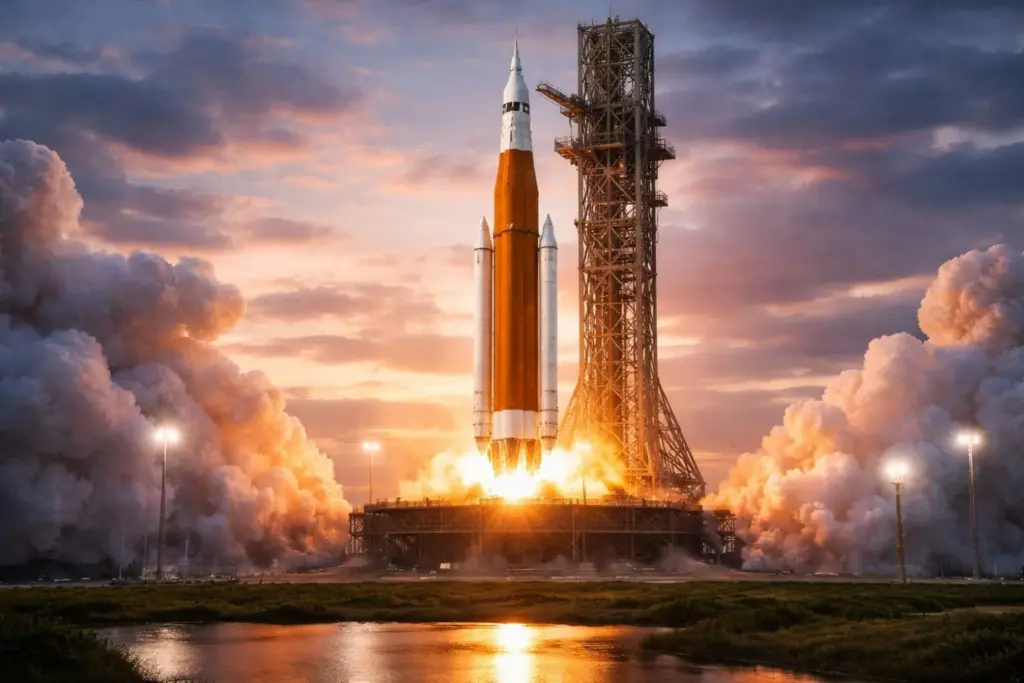
This Artemis II mission represents a fundamental milestone in the modern history of astronautics, marking the return of human presence to the vicinity of the Moon after more than half a century of absence. This project will send four astronauts on a voyage of approximately ten days, and it constitutes the first crewed test of this program following the success of Artemis I, which in 2022 completed an unmanned test flight.
Although the leadership of the program largely lies with international agencies, the European component and, very specifically, Spanish technological talent, play a decisive role in the mission’s viability and safety. The European Space Agency has supplied critical elements such as the European Service Module, responsible for guaranteeing the crew’s vital conditions through the supply of water, air, electricity and thermal regulation.
THE STRATEGIC CONTRIBUTION OF THE SPANISH INDUSTRY
Within this ecosystem of international collaboration, Spain stands out for the participation of four key companies: Airbus, ALTER, HV Sistemas and GMV. The latter has established a leadership position thanks to its close collaboration with the German Aerospace Center and its ability to develop complex operational solutions. The contribution of the Spanish firm is not limited to component manufacturing; it extends to the mission control center and to the direct preparation of the crew.
Its accumulated experience from previous projects, such as the operations of the Columbus Laboratory, has served as the foundation for adapting robust systems that are now integrated into the Orion spacecraft, meeting the stringent safety requirements and the new operational processes demanded by a deep-space exploration mission beyond Earth’s orbit.
TOOLS FOR HANDLING CRITICAL INCIDENTS
One of the fundamental pillars ensuring the success of Artemis II is the anomaly management tool developed specifically for this space venture. This centralized system enables reporting, tracking, coordination, and documentation of any irregularity that may arise aboard during the lunar journey.
It is an essential solution for detecting, analyzing and resolving incidents in real time, providing a shared operational view among all teams of the European Space Agency involved. The robustness of this technology is vital, as in the hostile environment of deep space, the ability to respond to any technical fault must be immediate and coordinated, ensuring that the mission can continue or abort safely according to the established protocols.
Astronaut safety is also addressed from the perspective of physical and mental health through the EveryWear system. This advanced telemedicine platform, developed jointly by the European Space Agency and the French National Center for Space Studies, continuously monitors the four crew members’ vital signs.
GMV, the Spanish company, has been responsible for training the astronauts to use this platform, for which its training team traveled to Houston. The importance of EveryWear lies in its ability to transmit health data in real time to Earth, allowing medical teams to intervene upon any detected anomaly, ensuring that the crew’s physical and psychological condition remains at optimal levels during the ten days of space travel.
COMMITMENT TO THE FUTURE OF SPACE EXPLORATION
The involvement of Spanish professionals does not end with launch, as they will be an active part of the ground control team, providing constant technical support throughout the development of all mission phases. According to statements by Miguel Ángel Molina, chair of GMV’s Space Council, “the company has a solid position to contribute to future milestones of crewed exploration, in a sector where real operational experience is a scarce and highly valuable asset.”
Participating in the Artemis program is a clear example of the commitment of Europe’s technology industry to developing new capabilities that will facilitate exploration beyond the Moon, reinforcing the competitiveness of continental technology in this new cycle of ambitious missions that aim to push the boundaries of human knowledge in the cosmos.