
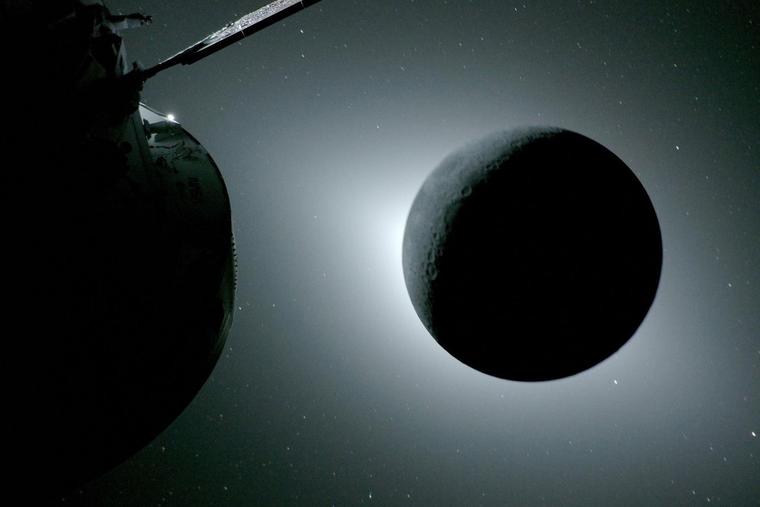
A touching tribute aboard the historic Artemis II mission echoes a centuries-old Catholic tradition.
More than 50 years after humans last traveled to the lunar surface, Artemis II has marked a new chapter in space exploration. The 10-day mission, designed to test systems for future lunar landings, has taken four astronauts farther from Earth than any crew since the Apollo era.
Alongside its technical achievements, the mission has also drawn attention for something less expected: moments of faith, remembrance and a renewed sense of wonder at God’s creation.
Those moments came into focus during a broadcast from orbit when the crew proposed naming two lunar craters. Canadian astronaut Jeremy Hansen explained that one would be called “Integrity” after their spacecraft. The second, he said, was “especially meaningful for this crew.”
“We lost a loved one; her name was Carroll,” Hansen said, referring to the late wife of mission commander Reid Wiseman. Describing the crater as “a bright spot on the moon,” he added, “We would like to call it ‘Carroll.’”
Carroll Wiseman, a neonatal intensive care nurse, died in 2020 at the age of 46 following a five-year battle with cancer. When she first got sick, Reid Wiseman said he wanted them to leave Texas, where he worked at the Johnson Space Center, to be closer to family in Virginia and Maryland. “But she said, ‘No, this is where you work and you love your job. And we should not give that up for this,’” he told Baltimore Magazine earlier this year.
Video from the spacecraft captured the astronauts embracing in zero gravity after the proposal, with Wiseman and astronaut Christina Koch visibly wiping tears from their faces.
The moment stood out among many during the mission, particularly in the story of Wiseman, who has described himself as “a very proud father” of his two teenage daughters, Ellie and Katherine.
“Despite a long list of professional accolades,” his NASA biography reads, “Reid considers his time as an only parent as his greatest challenge and the most rewarding phase of his life.”
The naming proposal will ultimately be reviewed by the International Astronomical Union (IAU), which oversees official names for planetary features.
Scientists or teams mapping and studying planetary surfaces can submit name proposals with a short justification, images of the feature, and relevant data. Proposals are first reviewed by an IAU Task Group, then by the Working Group for Planetary System Nomenclature, which approves names for use on maps and in publications. Final approval for a feature usually takes about a month.
But the idea of naming craters isn’t new. Centuries before astronauts orbited the moon, Jesuit astronomers were mapping its surface and giving it a language that scientists still use today.
In 1651, Jesuit astronomer Giovanni Battista Riccioli, working with Francesco Grimaldi, published one of the first detailed lunar maps, giving names to craters and regions with a system that brought order and coherence to the moon’s geography. Rather than naming features arbitrarily, Riccioli drew from a wide intellectual tradition, honoring scientists, philosophers and astronomers, including numerous Jesuits.
Some of those names remain in use today — Clavius, Scheiner, Grimaldi and Kircher among them. In fact, more than 30 lunar craters bear Jesuit names, reflecting the order’s longstanding engagement with scientific discovery.
That work was part of a much broader Jesuit engagement with the sciences. Christopher Clavius, a 16th-century mathematician, helped develop the Gregorian calendar, aligning the Church’s liturgical year with celestial cycles.
In the generations that followed, Jesuit scientists continued to observe and interpret the skies: Niccolò Zucchi experimented with early reflective telescopes, Christoph Scheiner carefully studied sunspots and Francesco de Vico discovered several comets. Ferdinand Augustin Hallerstein, meanwhile, brought this astronomical expertise abroad, working with the Chinese Imperial Observatory and cataloging stars with remarkable precision.
That tradition continues at the Vatican Observatory. Astronomers there study stars, galaxies and planetary systems, carrying forward centuries of Jesuit inquiry into the cosmos.
Brother Guy Consolmagno, the observatory’s former director and a leading planetary scientist, could not comment on Artemis II’s crater-naming proposal because of his role with the IAU, but the mission reflects a continuity of Jesuit engagement with the heavens, from mapping the moon to exploring the broader universe.
If the name “Carroll” is approved, it will join a lunar landscape shaped by centuries of Jesuit contributions — from Riccioli’s early lunar maps to modern research at the Vatican Observatory — linking a personal story in space to a long history of scientific inquiry.