
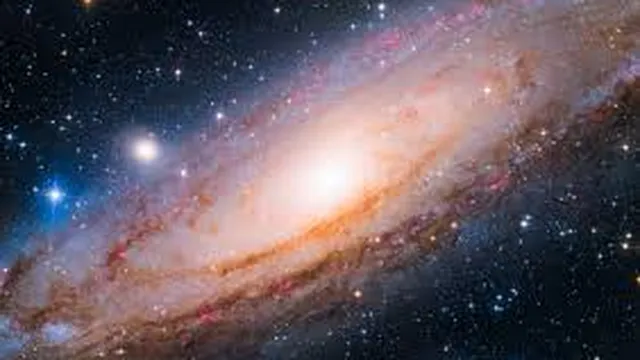
A star within the Milky Way turns out to be the purest ancient object ever discovered by astronomers.
A star within the Milky Way has turned out to be the purest ancient object ever discovered by astronomers, according to the website “Science Alert.”
This means that it is almost completely devoid of so-called “metals”—elements that form only after the first stars have already been born and died. The object represents a unique cosmic “fossil” from the early Universe, likely formed from gas enriched by the explosion of one of the first supernovae.
The star SDSS J0715-7334 was once small, similar to the Sun, but today it is a red giant at the end of its life cycle. It has survived long enough to provide valuable information about the earliest stages of the universe’s development.
“These primordial stars are a window into the dawn of stars and galaxies in the Universe,” says cosmologist Alexander Ji of the University of Chicago, the study’s lead author.
After the universe came into being in the Big Bang, space was filled with hot, dense plasma consisting of atomic nuclei and free electrons. Light had a hard time passing through this “fog” because photons were constantly scattering off one another.
About 300,000 years later, the universe cooled enough for protons and electrons to combine into neutral hydrogen and small amounts of helium. It was from the condensations of this primordial gas that the first stars were born—the so-called Population III.
Heavier elements appeared much later. Stars create new elements through nuclear fusion—first hydrogen into helium, then helium into carbon, and so on. The process reaches iron, and even heavier elements are formed during supernova explosions, which scatter the material into space.
All stars observed to date contain such “metals,” but in varying amounts. Those poorest in heavy elements are classified as Population II and carry information about the first generation of stars.
“Population III stars have never been observed—either because they were massive and had short lifespans, or because those that have survived to this day are extremely rare,” explains astronomer Kevin Schlaufman of Johns Hopkins University.
The star SDSS J0715-7334 was discovered almost by accident through the Sloan Digital Sky Survey project. Upon closer examination, it was found to consist almost entirely of hydrogen and helium. Its metallicity is just 0.005% of that of the Sun—almost twice as low as the previous record.
Particularly striking is the extremely low carbon content. “The star contains so little carbon that this suggests the involvement of early cosmic dust particles in its formation. This mechanism has been observed only once before,” notes Ji.
Normally, carbon and oxygen play a key role in cooling the gas necessary for star formation. In this case, however, the amount of carbon is too small, suggesting an alternative process—likely involving dust left over from the explosions of the first stars.
The data also suggest that the star likely does not originate from the Milky Way, but from the Large Magellanic Cloud—a satellite galaxy orbiting it. This increases the likelihood that other similar objects will be discovered there.
“It is possible that galaxies like the Magellanic Clouds have a higher proportion of ultra-metal-poor stars than our own galaxy,” says Schlaufman.
Research on these types of objects will continue to reveal details about the early history of the universe. The current results show that our knowledge still covers only a small fraction of the processes that took place at the dawn of cosmic evolution. | BGNES
A star within the Milky Way turns out to be the purest ancient object discovered so far by astronomers, reports the website “Science Alert.”
This means that it is almost completely devoid of so-called “metals”—elements that form only after the first stars have already been born and died. The object represents a unique cosmic “fossil” from the early Universe, likely formed from gas enriched following the explosion of one of the first supernovae.
The star SDSS J0715-7334 was once small, similar to the Sun, but today it is a red giant at the end of its life cycle. It has survived long enough to provide valuable information about the earliest stages of the universe’s development.
“These primordial stars are a window into the dawn of stars and galaxies in the Universe,” says cosmologist Alexander Ji of the University of Chicago, the study’s lead author.
After the universe came into being in the Big Bang, space was filled with hot, dense plasma consisting of atomic nuclei and free electrons. Light had a hard time traveling through this “fog” because photons were constantly scattering off one another.
About 300,000 years later, the universe cooled enough for protons and electrons to combine into neutral hydrogen and small amounts of helium. It was from the condensations of this primordial gas that the first stars were born—the so-called Population III.
Heavier elements appear much later. Stars create new elements through nuclear fusion—first hydrogen into helium, then helium into carbon, and so on. The process reaches iron, and even heavier elements are formed during supernova explosions, which scatter the material into space.
All stars observed to date contain such “metals,” but in varying amounts. Those poorest in heavy elements are classified as Population II and carry information about the first generation of stars.
“Population III stars have never been observed—either because they were massive and had short lifespans, or because those that have survived to this day are extremely rare,” explains astronomer Kevin Schlaufman of Johns Hopkins University.
The star SDSS J0715-7334 was discovered almost by accident through the Sloan Digital Sky Survey project. Upon closer examination, it was found to consist almost entirely of hydrogen and helium. Its metallicity is just 0.005% of that of the Sun—almost twice as low as the previous record.
Particularly striking is the extremely low carbon content. “The star contains so little carbon that this suggests the involvement of early cosmic dust particles in its formation. This mechanism has been observed only once before,” notes Ji.
Normally, carbon and oxygen play a key role in cooling the gas necessary for star formation. In this case, however, the amount of carbon is too small, suggesting an alternative process—likely involving dust left over from the explosions of the first stars.
The data also suggest that the star likely does not originate from the Milky Way, but from the Large Magellanic Cloud—a satellite galaxy orbiting it. This increases the likelihood that other similar objects will be discovered there.
“It is possible that galaxies like the Magellanic Clouds have a higher proportion of ultra-metal-poor stars than our own galaxy,” says Schlaufman.
Research on these types of objects will continue to reveal details about the early history of the universe. The current results show that our knowledge still covers only a small fraction of the processes that took place at the dawn of cosmic evolution. | BGNES