
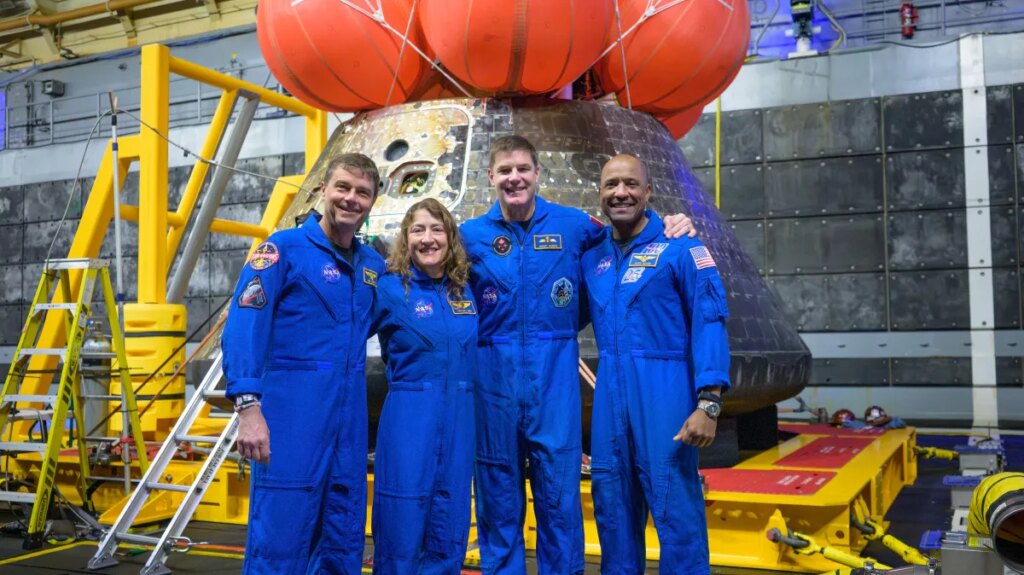
They boldly went where no man or woman had gone before and then, after a historic trip round the far side of the moon, the crew of the Artemis II mission boldly returned to Earth.
Reid Wiseman, Victor Glover, Christina Koch and Jeremy Hansen were safely in the arms of loved ones on Saturday following a 700,237-mile journey aboard their Orion capsule, Integrity. But Nasa is already looking to the future, making the case for an ambitious moon vision that proved beyond a previous generation of space explorers.
“The path to the lunar surface is open,” said the US space agency’s associate administrator, Amit Kshatriya. “Fifty three years ago, humanity left the moon. Let us finish what they started. Let us focus on what was left undone. Let us not go to plant flags and leave but to stay, with firmness in our purpose, with gratitude for the hands that built the machines and with love for the ones we carry with us.”
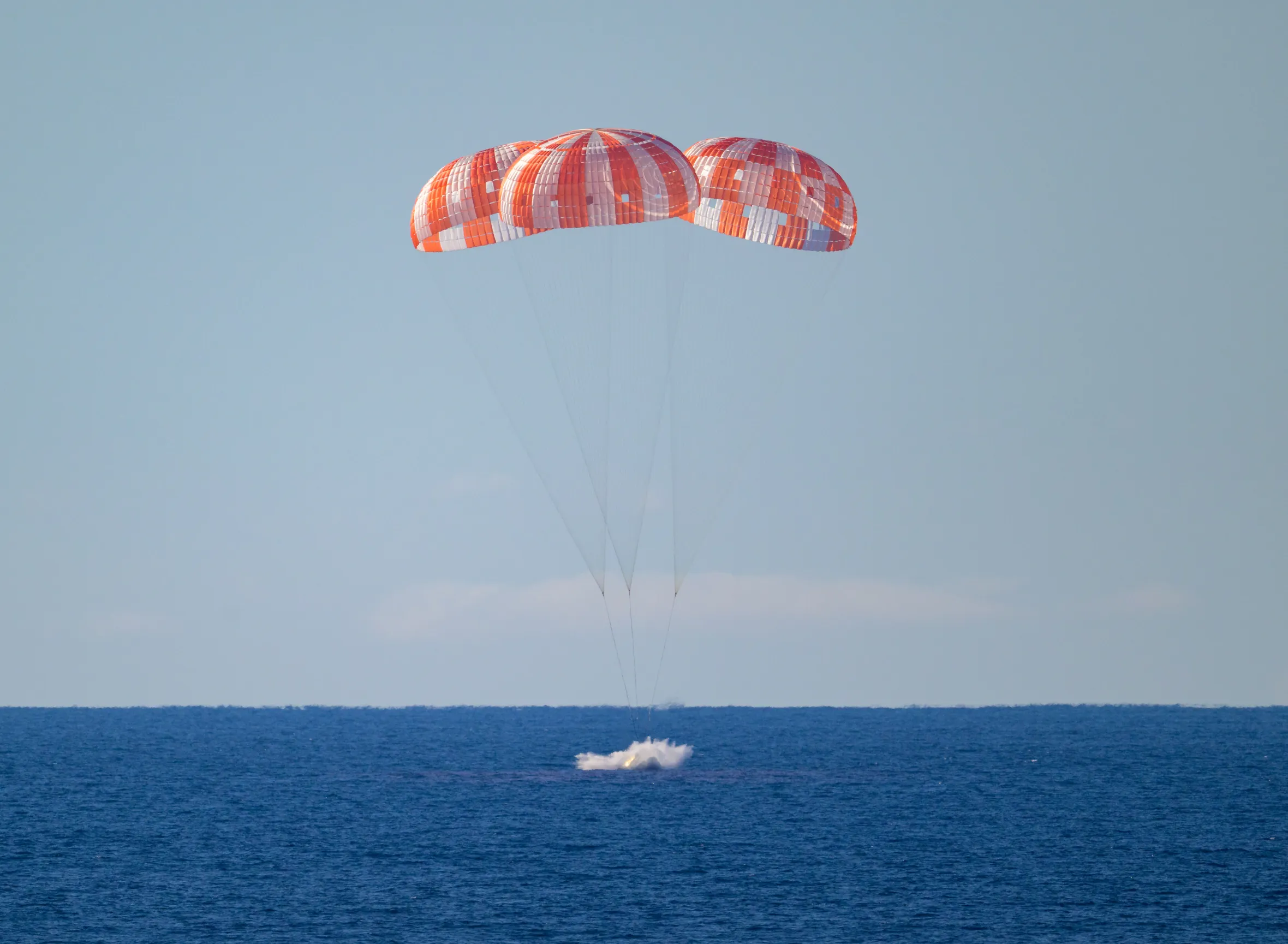 Integrity splashes down and, below, Glover and KochBill Ingalls/nasa
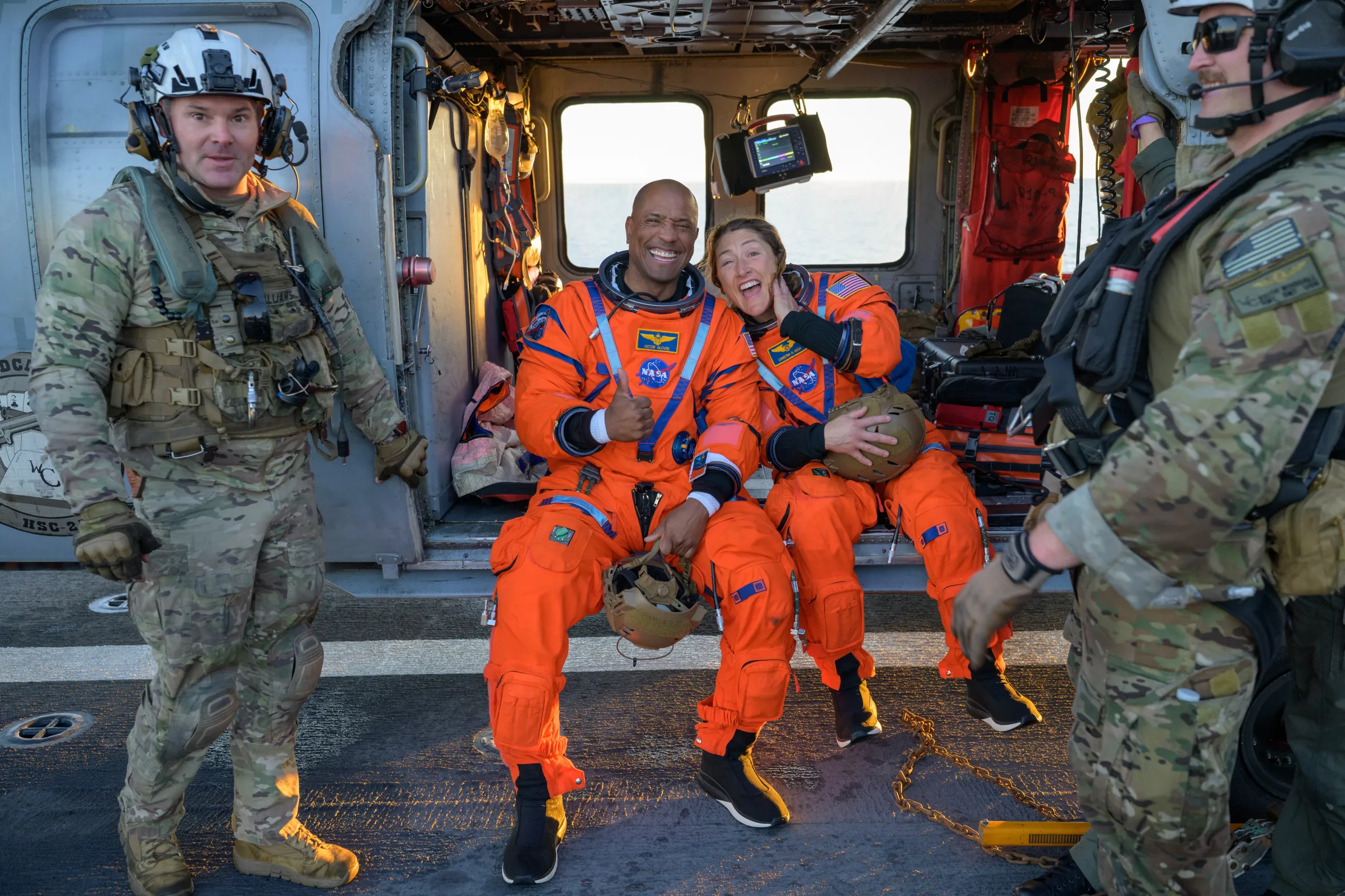 Bill Ingalls/nasa
Integrity splashed down under three main parachutes in the Pacific Ocean off the coast of San Diego at 1.07am BST on Saturday. It arrived precisely on target after a fiery descent through Earth’s atmosphere that reached a peak speed of 24,664mph.
During the ten-day mission, the capsule took humans deeper into space than ever before and showed parts of the moon’s far side that humans had never seen for themselves. Wiseman and his crew were the first humans to reach or pass the moon since 1972.
“To the generation that now knows what we are capable of: welcome to our moonshot,” said Lori Glaze, Nasa’s deputy associate administrator.
The capsule was powered off the planet by the Space Launch System rocket at Kennedy Space Centre, Florida, on April 1, and flew a figure of eight around the moon, coming within 4,067 miles of the lunar surface. Then they headed for home.
Taking one more look at the Earth suspended in space, Wiseman described it as “just a great big blue hue — and it’s beautiful”.
The spacecraft’s heatshield had not held up well during an uncrewed flight test in 2022. To counter the risk of a repeat and manage the thermal load of re-entry more effectively, Orion first performed a “skip” manoeuvre, dipping in and out of the atmosphere like a stone skimmed across a pond, at a steeper angle than before. The capsule then began its final, 13-minute descent.
There was a tense six-minute communications blackout during Integrity’s homeward plunge as plasma created by the scorching dynamics of re-entry at 32 times the speed of sound built up around the spacecraft.
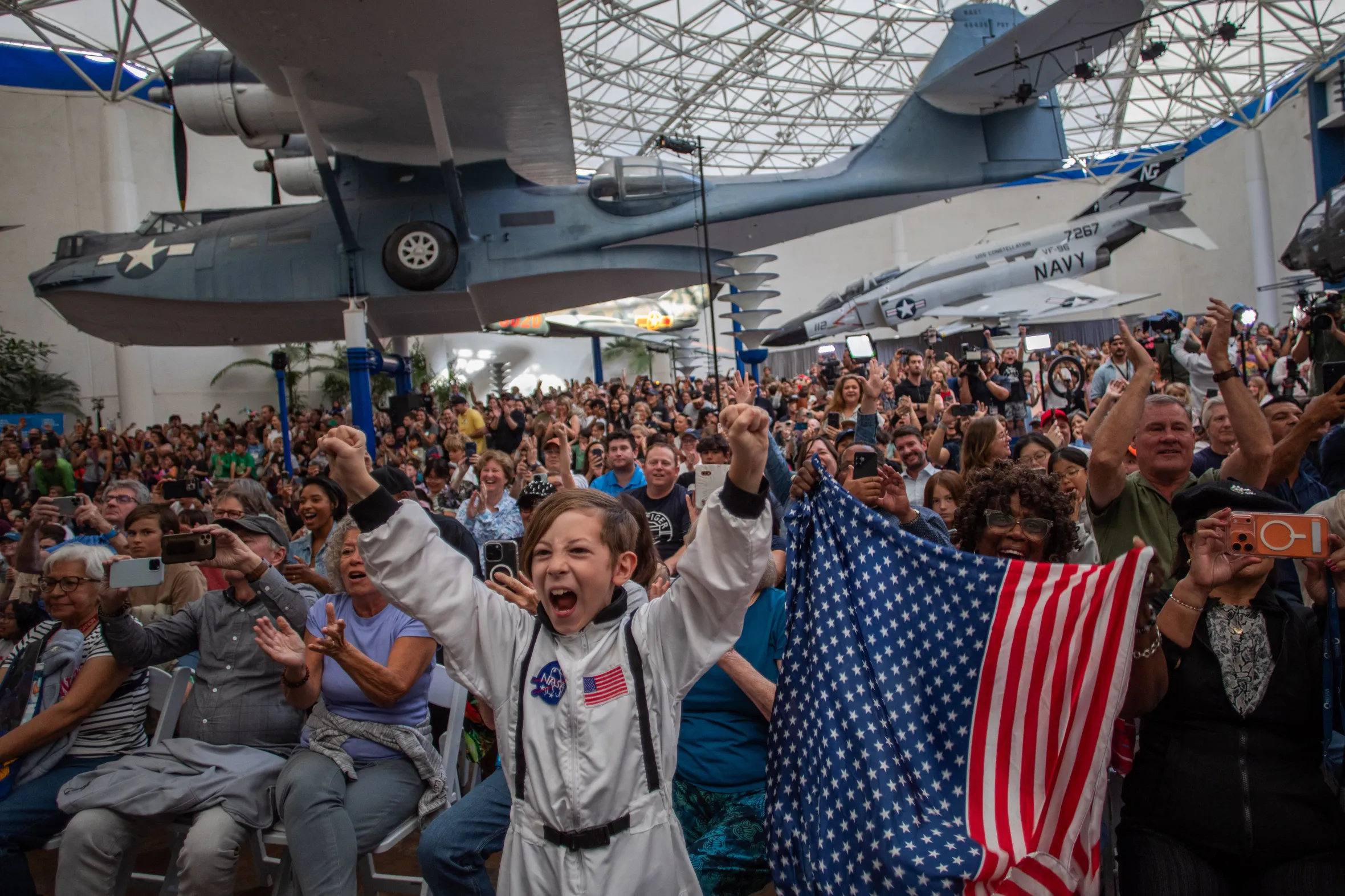 A boy cheers at the San Diego Air and Space Museum during a screening of the crew’s splashdownApu GOMES/AFP/Getty
When Wiseman’s voice came back over the radio — “Houston, Integrity, we have you loud and clear” — tears, cheers and applause broke out in the viewing gallery overlooking the mission control room at Johnson Space Centre in Houston, Texas, where the astronauts’ families gathered.
The vehicle had earlier jettisoned the European Service Module (ESM), the segment that provided its propulsion, power and life support systems throughout the mission. “It’s a beautiful-looking machine,” Wiseman observed as they parted company ahead of re-entry.
A leak in a helium pressurisation system aboard the ESM, which was built by Airbus, was confirmed during the mission but the problem was not deemed critical. Philippe Berthe, the European Space Agency’s project co-ordination manager for the ESM, said: “We’re very happy with the ESM; it has served well. We have evidence there is a leak and we are going to take the results and refine a strategy to fix it.”
Once it landed in the Pacific, Integrity was met by a recovery force that included US navy divers, fast boats, helicopters and an amphibious dock with a crew of 550.
The crew were en route home to Houston on Saturday to a heroes’ welcome.
“They are some of the most thoughtful, incredible people that I’ve ever known,” said Kshatriya, the highest-ranking civil servant at Nasa. He noted the crew’s tight-knit relationship and frequent expressions of devotion to one another and family.
“To me, that’s a great example of why we go and do these missions. If you can’t take love to the stars then what are we doing? Why would we even go?”
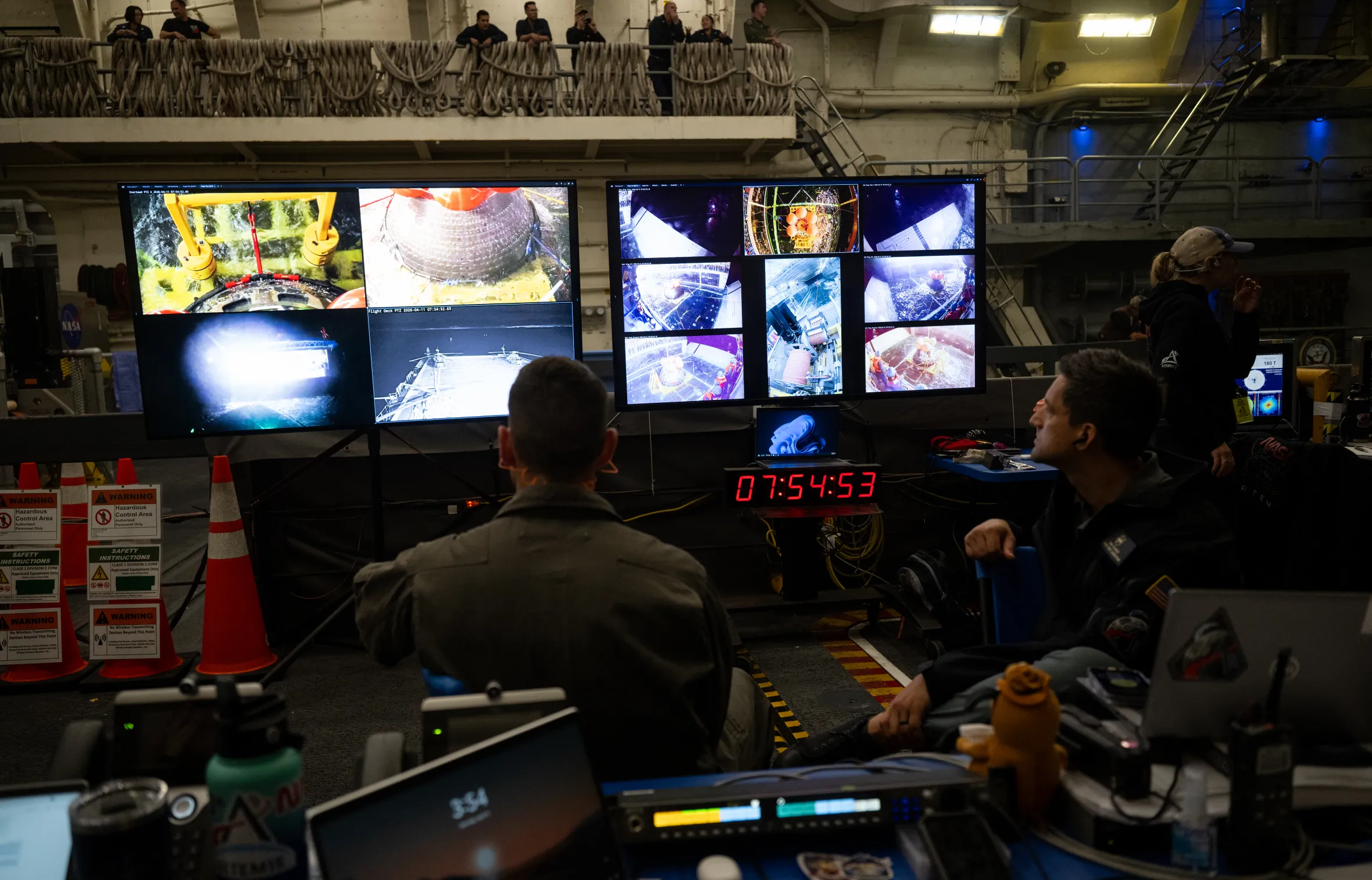 Nasa monitors the return of the Artemis II crew to EarthJoel Kowsky/NASA
With the Orion capsule proved fit to fly, Nasa will now step up the pace of lunar exploration, testing lunar landers next year and putting humans back on the moon’s surface in 2028.
Howard Hu, the Orion programme manager at Nasa, who resolved as a child that he would one day design a spaceship after seeing Star Wars, said the Artemis II mission had been “thousands of times better” than science fiction.
“That little kid was inspired by the stars and now we’re able to send our crew out to the stars, the furthest humans have ever been, and I can’t express how I feel and the goose bumps I have,” he said. “For all the kids out there: just pursue the dreams.”
Crew members were selected three years ago by Norman Knight, the head of Nasa’s flight operations directorate.“We were brought in to meet with our boss with another pretext, so none of us thought this meeting was as important and had the magnitude it would end up having. Some of us were late,” Koch told The Sunday Times before the mission.
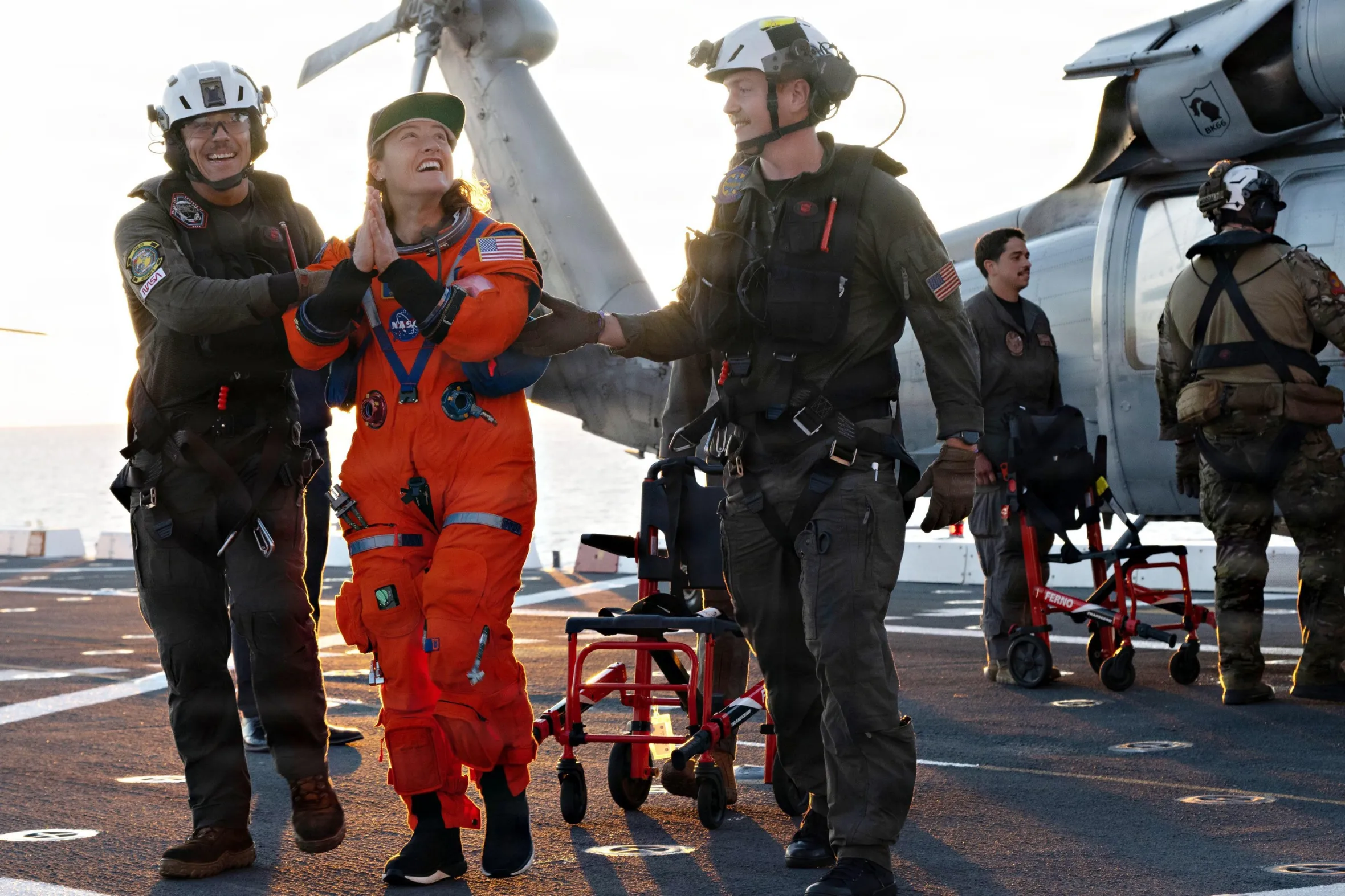 Koch arriving aboard the USS John P MurthaKenneth Melseth/US Navy/Alamy Live News
“I’ll never forget the words that Norm Knight used when he asked me — ‘How would you like to go flying on Artemis II?’ — and I was rendered speechless. When I regained my composure, I said, ‘Sir, it will be an honour’. And that is truly what it is.”
She added: “Questioning yourself, questioning the path that you’re on, questioning your ability, having confidence in yourself, have all been struggles I’ve had through the years and … the way to overcome those struggles isn’t to do less, it’s to do more. It’s to do what scares you … Go in that direction boldly.”