
Some of us had high hopes for Comet MAPS. Unfortunately, it bit the dust last week during its extremely close approach to the sun. The small object, just one-third of a mile across, was neither large enough nor structurally strong enough to survive the intensely hot and gravitationally stressful encounter. In the end it broke to pieces, transformed into a feather-like plume of dust speeding away from the sun into the abyss of space.
Good thing Earth is made of sturdier stuff. Many comets crumble because they’re small and composed of porous, loosely compacted, dirty ice. They more resemble the ‘fenderbergs’ that lodge in your car’s wheel wells after a snowstorm instead of ice cubes from your refrigerator.
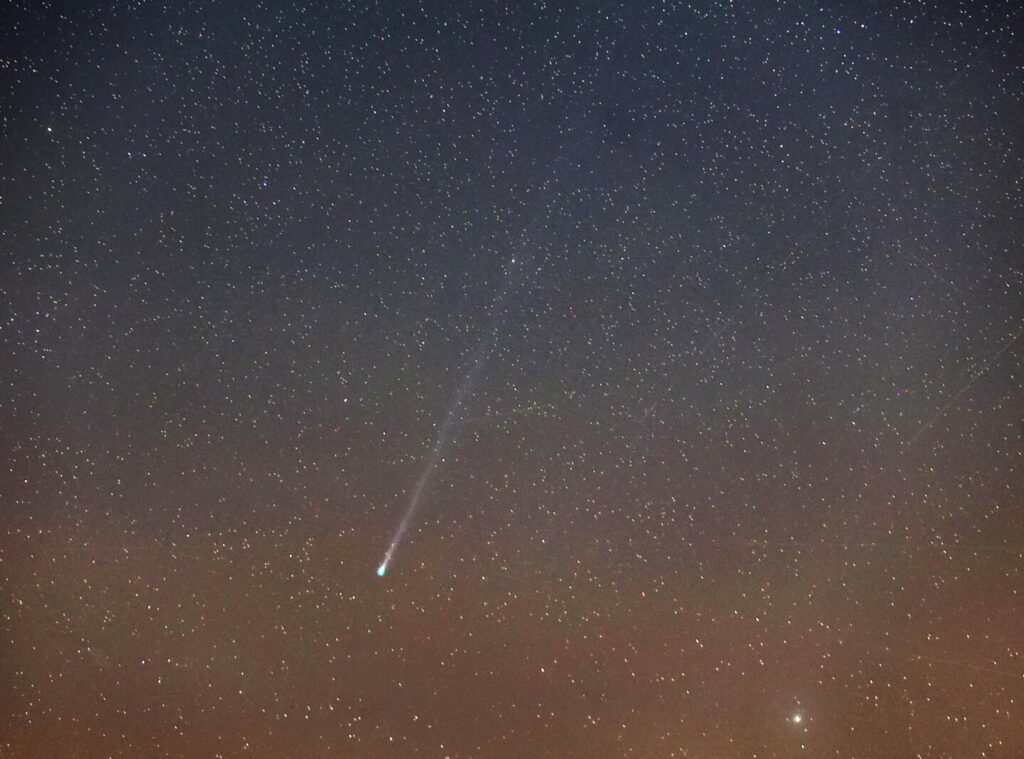
Now that Comet MAPS is no more, Comet Pan-STARRS (C/2025 R3) has moved into first position and carries the title of brightest current comet. I’ve seen it twice in the past few weeks, most recently on April 11 at the first inkling of dawn, about 1 hour and 45 minutes before sunrise or around 4:30 a.m. in the Duluth region. Getting up that early is a bit of a commitment. I always tell myself that I’ll be happier for the effort, and that’s often been the case.
All went smoothly. First, I found a place outside away the city with a dark sky to the east. Second, I made sure that trees didn’t block the view. Comet Pan-STARRS only climbs to an altitude of around 10-12 degrees (about one balled fist held at arm’s length) before the sky starts to brighten, making an unobstructed view crucial to finding it. The shore of Lake Superior at Brighton Beach, a flat North Dakota farmer’s field or a boreal bog makes an ideal observing site.
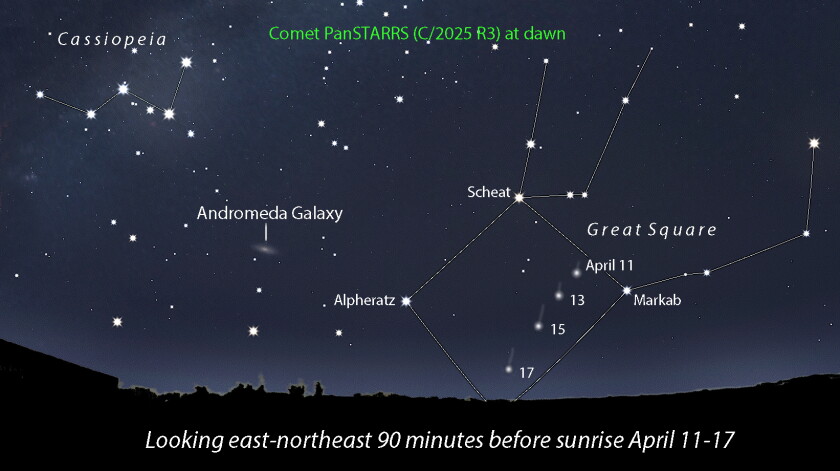
Unlike recently deceased Comet MAPS, Comet Pan-STARRS will likely survive its much more distant encounter with the sun on April 19. Before then, the comet will be visible in binoculars from outside the city just before the start of dawn. Look for it low in the eastern sky as it moves across the Great Square asterism. The object will look like a fuzzy star with a faint tail pointing up and to the right.
Contributed / Stellarium with additions by Bob King
In 10×50 binoculars the comet’s head resembled one of the brighter stars in the circle of view. But I quickly noticed it had that telltale fuzzy appearance peculiar to comets. To distinguish it from a star, make sure you carefully focus the binoculars. Once identified, it took only a moment to spy the faint, wispy tail that extended halfway across the field.
Often, comets are blurry, tail-less blobs, but this one had all the classic features. At the time, it glowed around magnitude 6, right at the naked-eye limit under the best skies.
While you can see much with just your eyes and a pair of binoculars, sometimes a telescope comes in handy. It can take a dim object and turn it into technicolor. I eagerly pointed my 15-inch scope the comet’s way, and it didn’t disappoint. The coma glowed a gorgeous aqua hue from fluorescing carbon gas, and the center of the object was so dense and bright it looked like an LED light behind frosted glass.
Comet Pan-STARRS will continue to brighten in the next week, possibly reaching magnitude 3. That would make it easily visible without optical aid were it not for one caveat – its decreasing altitude. Pan-STARRS drops a little lower each morning on its way to an April 19 perihelion, when it swings closest to the sun. That means we have about a week left to get out and see it.
Fortunately, the moon will be a crescent or less and not interfere. After perihelion the comet will only be visible in the southern hemisphere.
There are lots and lots of Pan-STARRS comets. All of them were discovered by the automated Panoramic Survey Telescope and Rapid Response System (Pan-STARRS) operated by the University of Hawaii Institute for Astronomy.
This particular one, C/2025 R3 Pan-STARRS, turned up last September. Its orbit points back to an origin in the distant Oort Cloud, a vast spherical reservoir of billions of comets between 186 billion and 9.3 trillion miles away. If you thought Pluto was far, it’s our next-door neighbor compared to where most comets come from. Comets are thought to be icy leftovers from the formation of the solar system some 4.6 billion years ago.
Comet Pan-STARRS took some 170,000 years to travel from the Oort Cloud to its current location in the inner solar system. During that long journey, its orbit was altered by the gravity of the giant planets (primarily Jupiter), which gave the cosmic fenderberg a kick. After its solar passage, it will be ejected from the solar system. You know what that means. We have but one precious opportunity to see it.

“Astro” Bob King is a freelance writer and retired photographer for the Duluth News Tribune. You can reach him at nightsky55@gmail.com.