
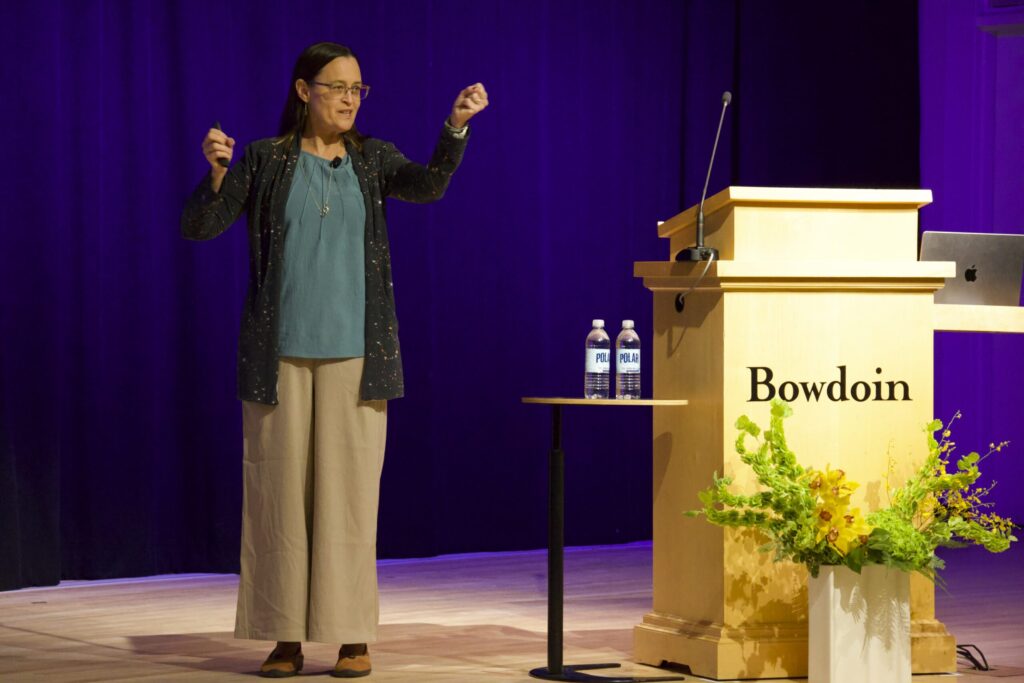
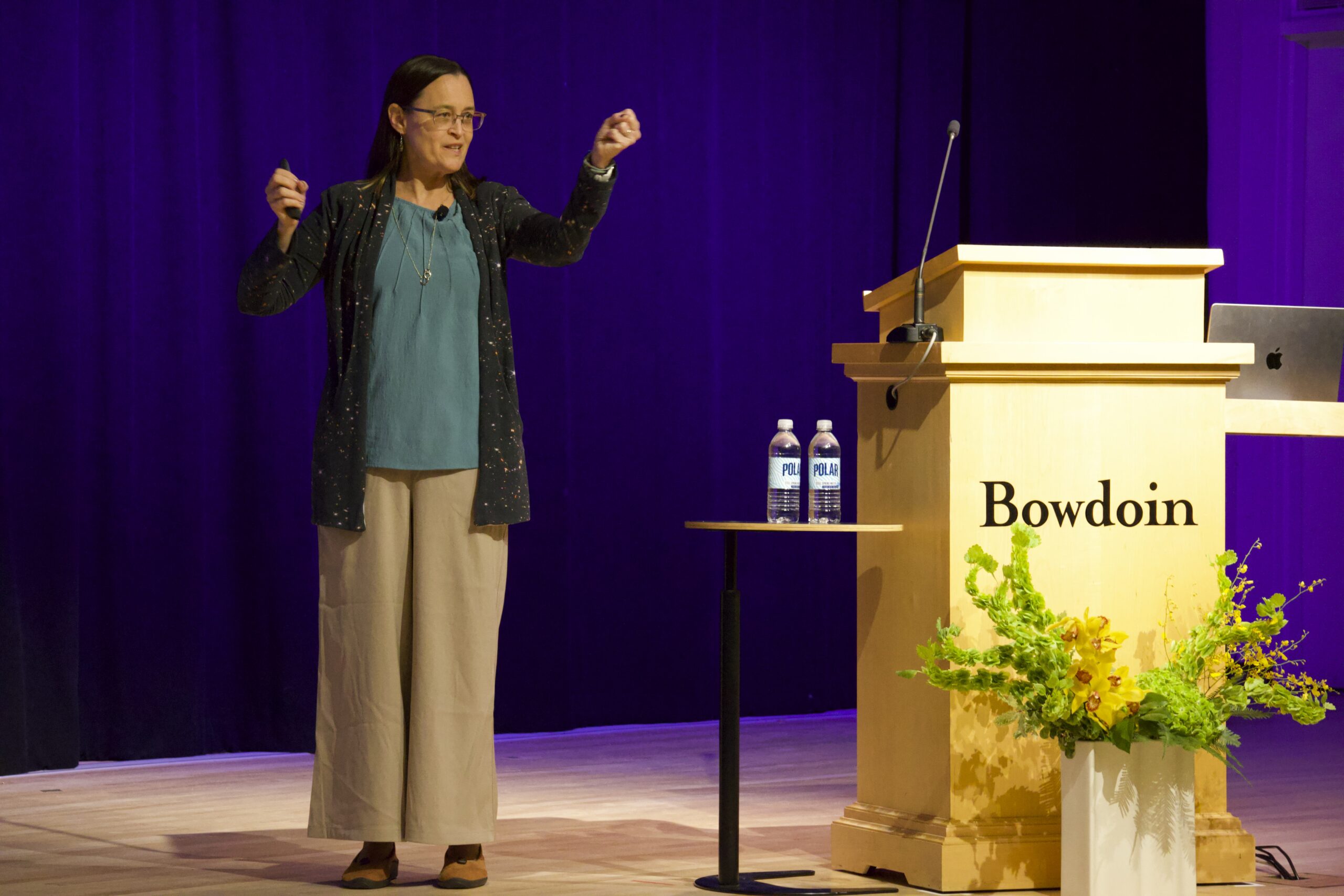
 Addison MooreTHE (W)HOLE IDEA: Professor of Physics and Astronomy at West Virginia University Maura McLaughlin speaks on Wednesday night in Kresge Auditorium. McLaughlin discussed fundamental processes of the universe, such as black hole mergers, and how physicists seek to understand them.
On Wednesday evening, professor of physics and astronomy at West Virginia University Maura McLaughlin delivered a talk titled, “Timing the Cosmos: Pulsars, Gravitational Waves and Monster Black Holes,” in Kresge Auditorium as part of the Kibbe Science Lecture series. McLaughlin studies neutron stars and pulsars to understand fundamental processes of the universe, including black hole mergers.
“We would like to detect extremely massive black holes and learn things about the universe that we can’t learn through normal light with normal telescopes,” McLaughlin said.
To explain her research, McLaughlin began by introducing its core principle: general relativity, pioneered by Albert Einstein.
“The basic idea of general relativity is that we live in four dimensional spacetime, and massive objects distort the shape of space,” McLaughlin said. “As [objects] orbit each other, they will cause spacetime to ripple, and these ripples are called gravitational waves.”
Ever since the discovery of general relativity, physicists have sought to detect gravitational waves. While observatories have identified waves from smaller black hole mergers, McLaughlin’s research focuses on more massive systems, including black holes in other galaxies that are millions to billions of times the mass of the Sun.
To do this, McLaughlin analyzes the pulses emitted by neutron stars, known as pulsars. These objects are the extremely dense remnants of supernovae, formed when stars run out of energy and collapse in on themselves.
“If you took every single person on earth, every single one, and you smoosh them all into a thimble that would sit on your finger—that is the density of a neutron star,” McLaughlin said.
Because of their incredible density, pulsars can rotate up to 700 times per second. The specific pulsars McLaughlin studies, known as millisecond pulsars, spin with periods of under a few milliseconds. Their unique properties allow radio telescopes on Earth to measure their rotation.
“[Pulsars] have incredibly high magnetic fields, and these properties produce radio emission,” McLaughlin said. “Every time this pulsar rotates, and the beam crosses our line of sight, if we are pointing at it with a radio telescope, we’ll observe a pulse for every single rotation.”
Researchers have mapped a network of pulsars that rotate with incredible precision. Because of this, tiny disruptions in the signals of these “cosmic clocks” are optimal for detecting gravitational waves.
“When a gravitational wave travels through this network, the pulsars are being stretched and squeezed by these perturbations, affecting the arrival times of pulses from these objects,” McLaughlin said.
To measure these discrepancies, researchers create detailed models to show the predicted arrival times of the pulses, then compare those predictions with the actual signals. The differences in timing, known as residuals, are then plotted and analyzed.
“With gravitational waves, we expect this very special correlation in those residuals,” McLaughlin said. “This correlation produces a distinct signature in the data.”
McLaughlin is a member of the International Pulsar Timing Array, a global collaboration with radio telescopes in Europe, Australia, India and South Africa. Every few years, data sets with pulsar data are released to the community, which has led to the discovery of many new pulsars. Ultimately, however, the goal is to detect the special signature of gravitational waves.
In the first 12 years of data collection, the residual plots showed no correlation. The researchers continued increasing both the number of pulsars in the data set and the precision of their timing. A few years later, McLaughlin’s team noticed a pattern consistent with a gravitational wave signature.
“I cried when I saw this plot for the first time because we had been looking for a very special signature,” she said. “[After] 15 years, we finally saw it in the data set. We can say that this noise that we saw is indeed these mysterious gravitational waves.”
While this discovery was groundbreaking, McLaughlin cautioned that the data is still preliminary. It is possible that the signature stems from other cosmic phenomena including cosmic strings, topological defects in spacetime or even residual waves from the earliest inflation of the universe.
McLaughlin also noted that rather than detecting a single event, the signal they measured was a “cosmic hum” created by the combined gravitational waves of many black holes orbiting each other throughout the universe. McLaughlin said that the next step would be to detect an individual supermassive black hole binary. To do this, McLaughlin’s team is currently working on the next 20-year data set, and the construction of bigger radio telescopes is underway.
Ultimately, McLaughlin hopes that this research can explain how galaxies merge to create bigger ones, including the Milky Way.
This project also involves a collaborative effort between high school and undergraduate students. Through a program called The Pulsar Science Collaboratory, students have discovered eight more pulsars so far.
Nathan Muchai ’29 said that he came to see the talk out of curiosity, but it inspired him to get involved in similar projects.
“I’m really interested in astronomy. I thought it would be a very interesting way of getting to know more about the universe,” Muchai said. “[McLaughlin] made her study of neutron stars in the galaxy sound very interesting. It made me very curious about how I can get myself involved in such research.”