
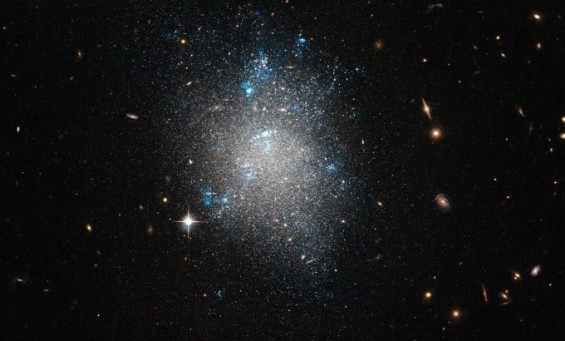
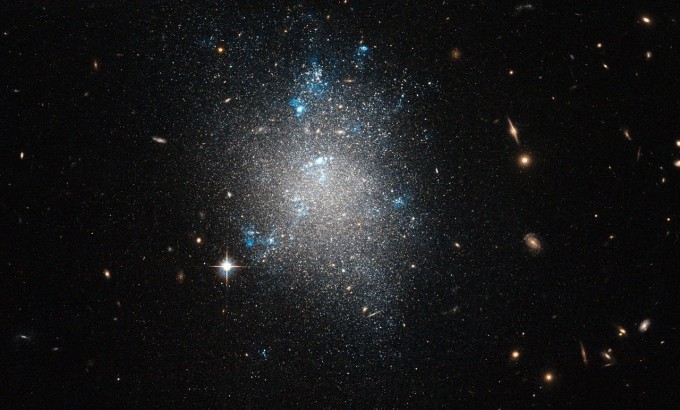
Dwarf galaxy NGC 5477. Because dwarf galaxies have a smaller proportion of stars and gas than other galaxies, dark matter is estimated to make up most of the galaxy’s mass. NASA/ESA provided
A new hypothesis has been proposed suggesting that ‘dark matter,’ a concept that explains the birth of the universe and the movement of celestial bodies, may exist in two different forms. This concept offers a smoother explanation for cosmic phenomena that are difficult to account for with mainstream theories alone.
A research team from Fermilab in the United States has proposed a theory that dark matter in the universe exists in two states, publishing their findings in the ‘Journal of Cosmology and Astroparticle Physics (JCAP)’ on the 9th.
● “Its form depends on the energy level”
According to the Standard Model of Cosmology, the universe is composed of 68.3% dark energy, 26.8% dark matter, and 4.9% ordinary matter. Dark energy is the driving force behind the universe’s expansion since the Big Bang, while dark matter is a concept introduced to explain the movement of celestial objects due to its mass.
Scientists assume the existence of dark matter and are searching for various candidates for its form. Since it has never been directly observed, no hypothesis has been proven with data.
Currently, the mainstream view in physics is that dark matter is a single particle or component. According to this assumption, in regions dense with dark matter, two dark matter particles can annihilate each other, releasing energy in the form of gamma rays, a type of radiation. There has been a long-standing debate over whether dark matter is the cause of the gamma-ray signals frequently observed at the center of our Milky Way galaxy.
Dwarf galaxies, with their low proportion of stars and gas, are expected to allow for relatively clean observations of dark matter’s effects. In a scenario where dark matter is of a single type, gamma-ray signals should also be generated in dwarf galaxies in proportion to the amount of dark matter.
Lim Sang-hee, a research fellow at the Particle Theory and Cosmology Group of the Institute for Basic Science (IBS), explained, “With current observation technology, we cannot yet accurately measure the magnitude of gamma rays from dwarf galaxies, so related claims cannot be confirmed.”
The Fermilab research team has proposed a new theory that the gamma-ray signals from the center of our Milky Way could still be due to dark matter, even if the signals from dwarf galaxies are weaker than expected or non-existent.
First, they hypothesized that dark matter can exist in two forms depending on its energy level: a ‘ground state’ and an ‘excited state.’ The ground state is closer to the dark matter proposed in existing theories and constitutes most of the universe today. The excited state has a slightly larger mass.
According to the hypothesis, annihilation does not occur when only ground-state dark matter exists. Pair annihilation, releasing energy, only happens when ground-state and excited-state dark matter particles combine. They suggested that in regions with large mass and high kinetic energy, like the center of the Milky Way, dark matter is more likely to transition to an excited state.
This proposed theory does not negate dark matter activity at the center of the Milky Way, even if future observations show faint or no gamma-ray signals from dwarf galaxies. This is because dark matter in the massive, fast-moving environment of a galactic center frequently transitions to an excited state, whereas dark matter in smaller dwarf galaxies is less likely to become excited.
● Theory still in proposal stage… requires follow-up verification
Hong Sung-wook, a principal researcher at the Space Evolution Research Center of the Korea Astronomy and Space Science Institute, stated that the Fermilab team’s theory is “still in the proposal stage.” He explained, “Since the energy distribution in the universe is continuous, we need to verify if gamma-ray emissions from dark matter appear as a continuous spectrum across the cosmos, and we also need to gather more observational data from various galaxies.”
Research fellow Lim noted, “The fundamental particles we see now, like electrons and quarks, are diverse. The claim that dark matter doesn’t have to be of just one type is not new.” He added, “When precise data from dwarf galaxies becomes available through upgraded gamma-ray observation equipment in the future, the model proposed this time could be considered.”
Yoon Sung-woo, Director (CI) of the Center for Axion and Precision Physics Research at IBS, emphasized, “The direct detection of dark matter is also important. We need to confirm through detection experiments whether the new particles proposed in the paper actually exist.”
Principal researcher Hong said, “If this hypothesis gains traction, it could influence the distribution of dark matter on scales smaller than galaxies, thereby having a major impact on dark matter detection strategies.”
Copyright ⓒ DongA Science. All rights reserved.