
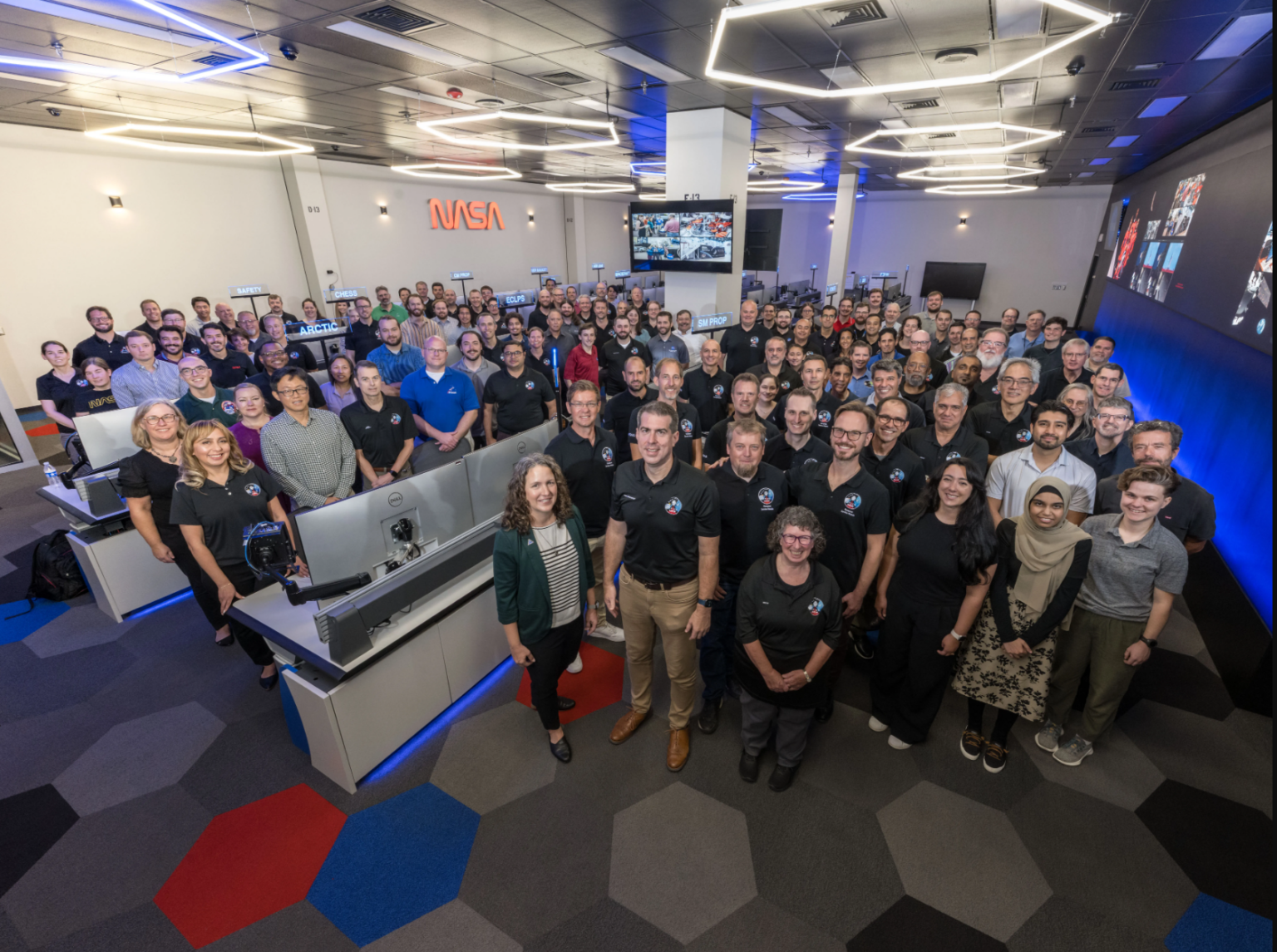
The first people to travel towards the Moon in over half a century are currently on their lunar journey. Supporting them around the clock, behind the scenes, are European teams in mission control centres around the world. In this edition of European eyes on Artemis, we meet part of the team stationed in the Mission Evaluation Room at NASA’s Johnson Space Center in Houston.
Inside the MER
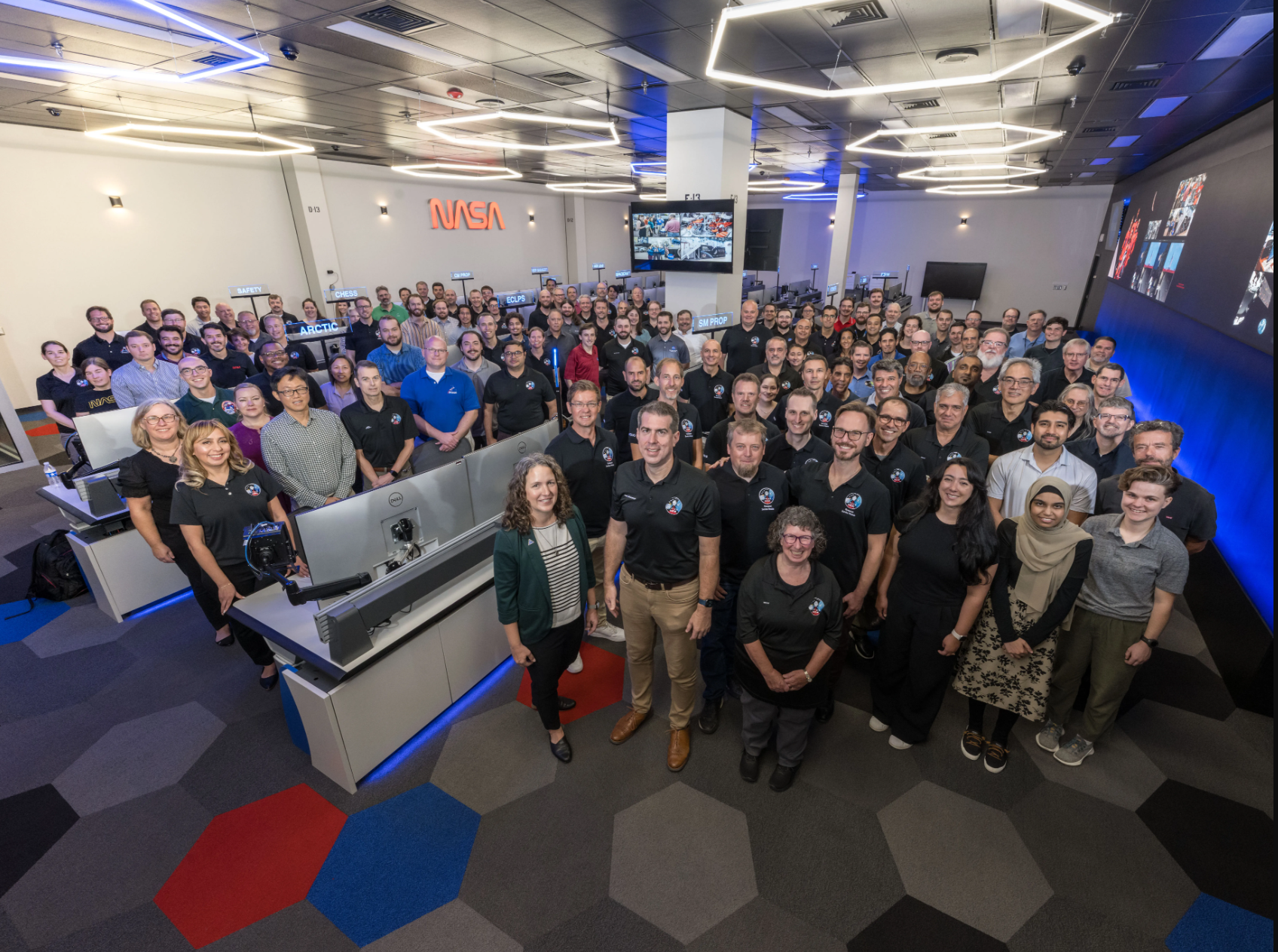
The Orion Mission Evaluation Room team gathers for a group photo in the new evaluation room at NASA’s Johnson Space Center in Houston on 18 August 2025.
NASA-J. Valcarcel
Just next door to the famous Apollo flight control room in Houston sits the Mission Evaluation Room, or MER as its residents call it. While flight controllers operate the spacecraft and send commands, the MER is where engineers monitor its performance in detail, analyse data and advise on decisions. Since two days before launch, the room has been buzzing with more than 200 specialists on three shifts from NASA, Lockheed Martin, ESA and Airbus, each focused on a specific subsystem of Orion.
Europe has a strong presence here. “The MER in Houston has 24 consoles and Europeans are on six of them – a quarter of the room. It’s a real sign of trust in our expertise,” says Tobias Langener, ESA’s European Service Module (ESM) propulsion lead.
“During Artemis I, the combined team saw the added value of having a European team in Houston, and NASA suggested that for Artemis II our presence should be expanded,” explains Luca Fossati, ESA’s ESM mission and flight operations system engineer.
Now, ESM has a dedicated console – a clear recognition that Europe is contributing not only hardware, but operational expertise throughout the flight.
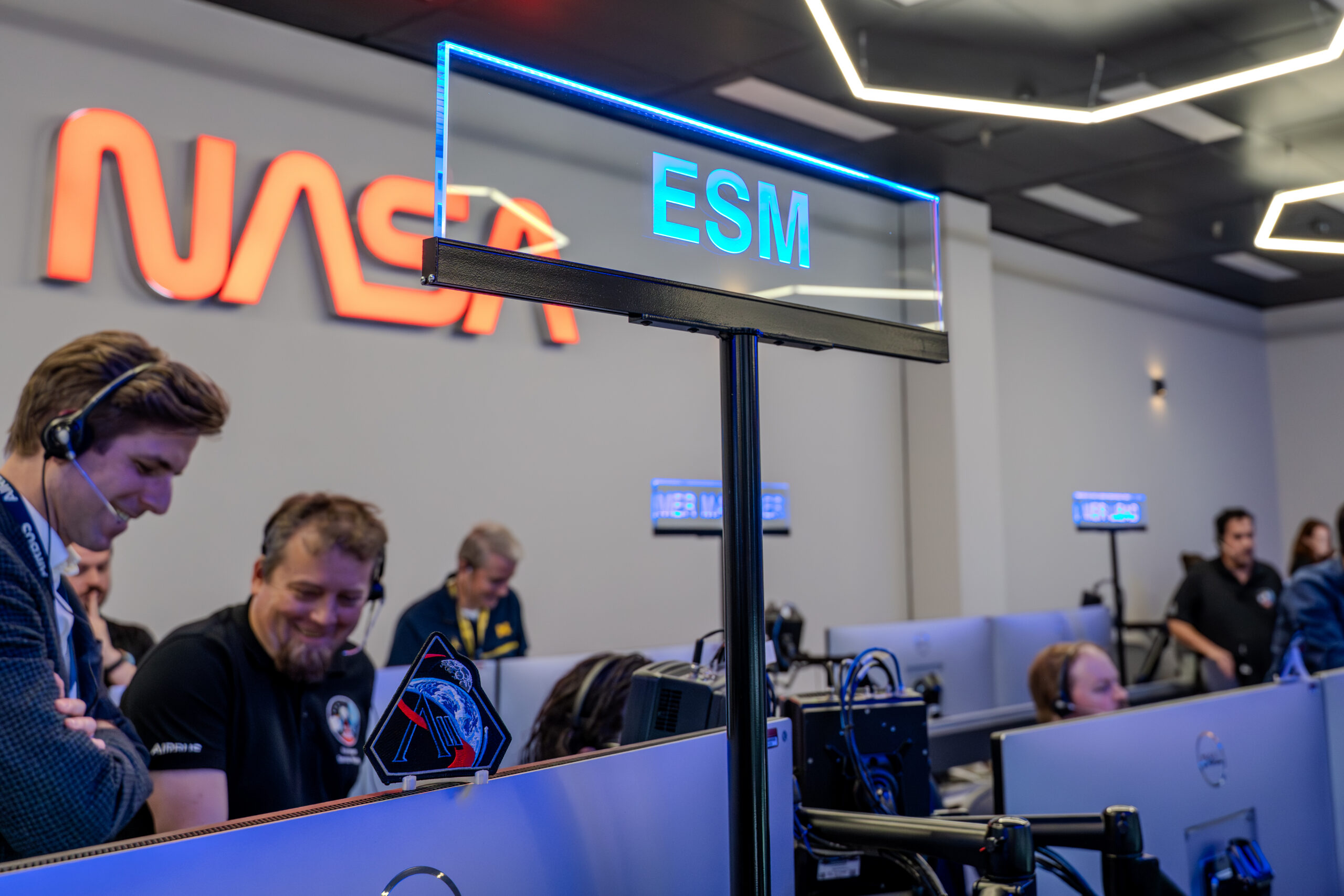
The ESM spacecraft console in the Mission Evaluation Room at NASA’s Johnson Space Center.
Credit: ESA-M. Cowan
On console
The European Service Module provides propulsion, electrical power, thermal control and life-support consumables to Orion and its four astronauts. With 33 engines of different sizes, it performs major manoeuvres in space, including the critical trans-lunar injection burn that sent the crew on their way to the Moon on flight day 2 of the mission.
“Propulsion is the biggest subsystem of ESM, so we have many people to support,” says Tobias. “We are two in Houston and five in the Netherlands, providing 24/7 coverage throughout the mission.”
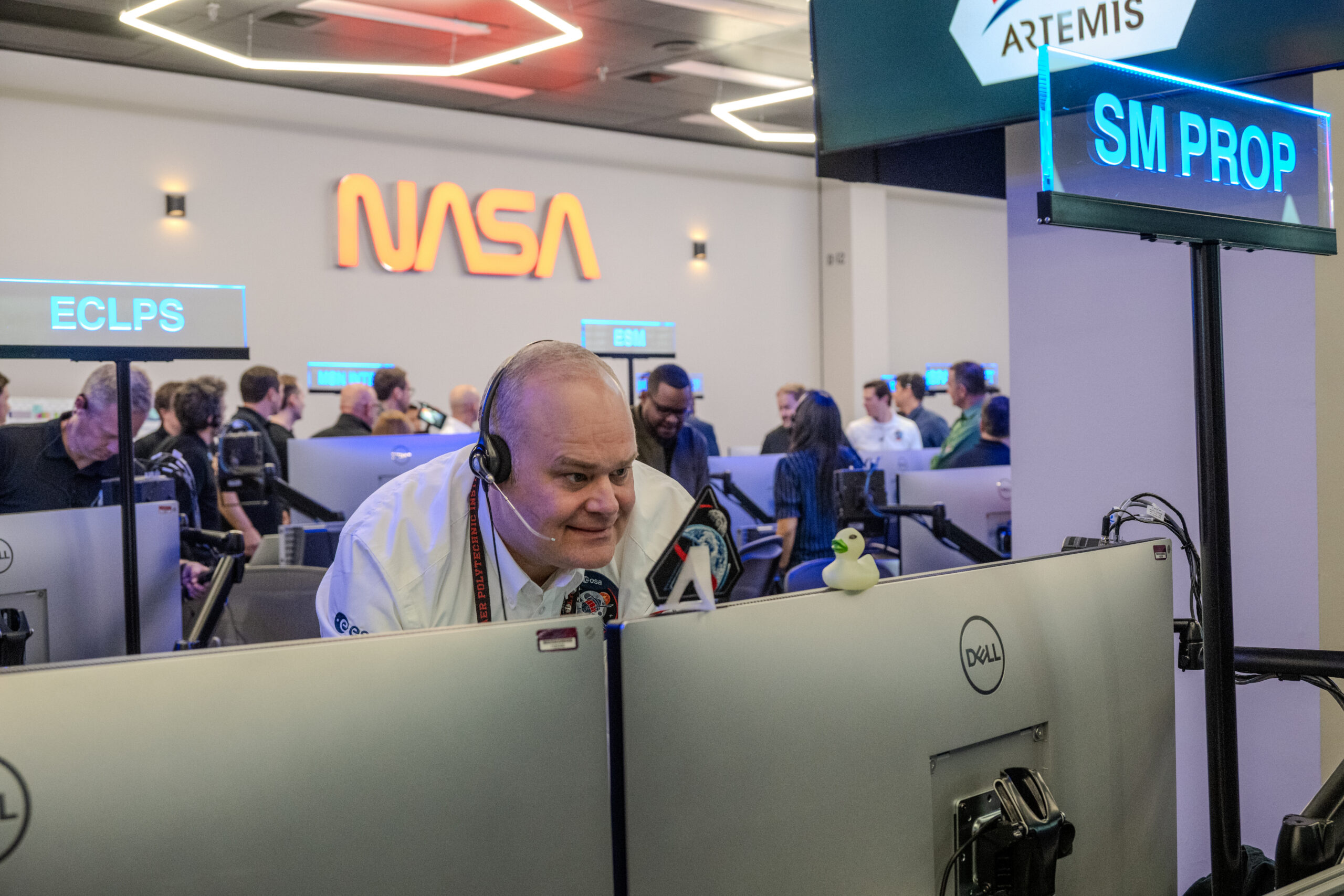
Tobias Langener in the Mission Evaluation Room at NASA’s Johnson Space Center during Artemis II.
Credit: ESA-M. Cowan
Luca works on the dedicated ESM spacecraft console in Houston, which consists of six European experts. “Our role is to keep the overall picture, coordinate with other consoles and support key decisions, for example the go for trans-lunar injection, or in case of any anomaly.”
Shifts on console last almost 10 hours, with detailed handovers to maintain continuity. Even off-shift, engineers remain on call and in close contact with colleagues in Europe across time zones.
At ESA’s ESTEC technical centre in the Netherlands, a parallel support room known as Eagle allows engineers to follow the mission from Europe and stay in touch with European suppliers, while still working on other activities.
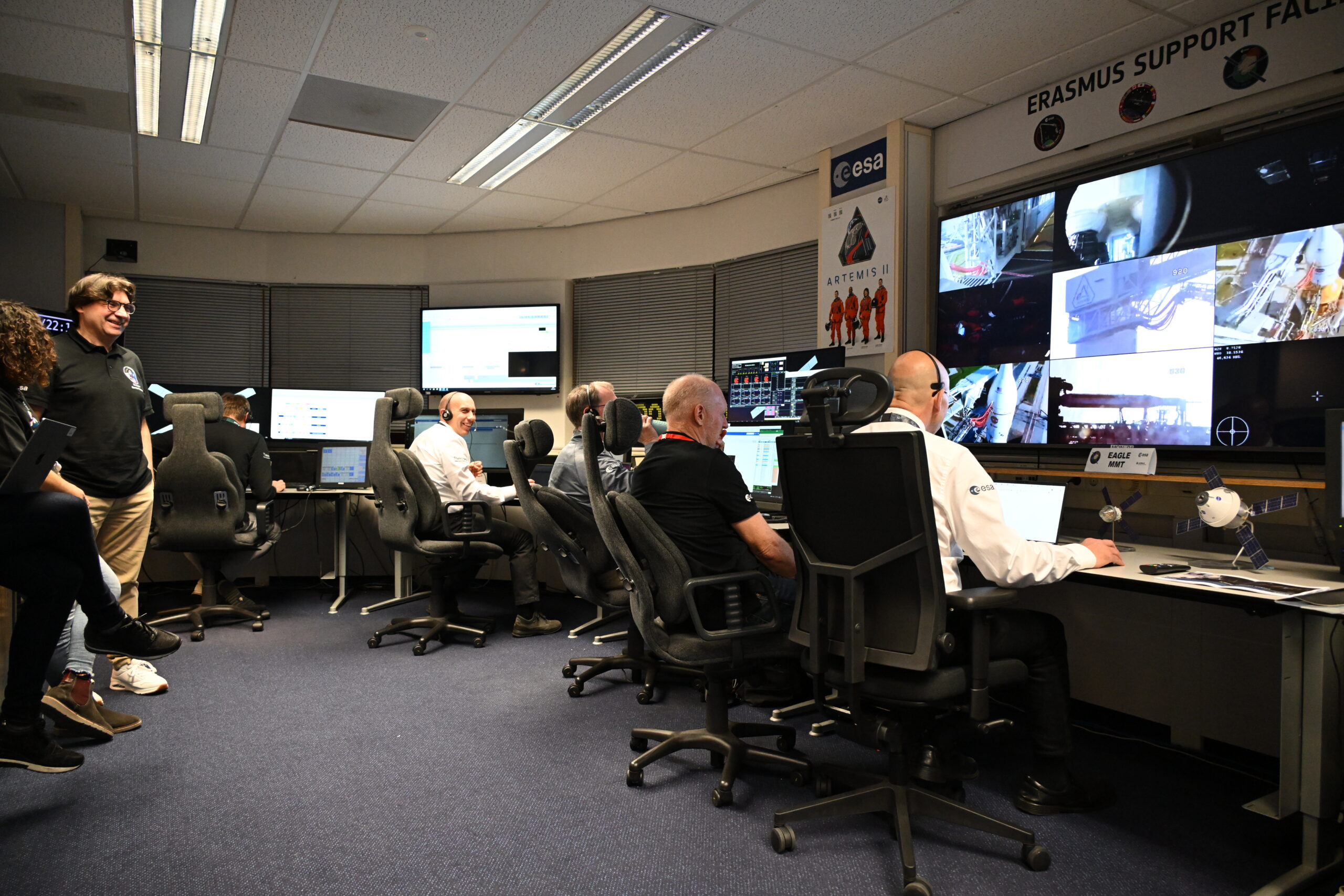
European engineers in the Orion mission evaluation room at ESA’s technical site in the Netherlands, also known as the Eagle room, during the Artemis II mission.
Credit: ESA-A. Conigli
“Part of our team continues working on the third, fourth and fifth ESMs,” Luca notes. “Our work doesn’t stop with the launch!”
Monitoring and anticipating
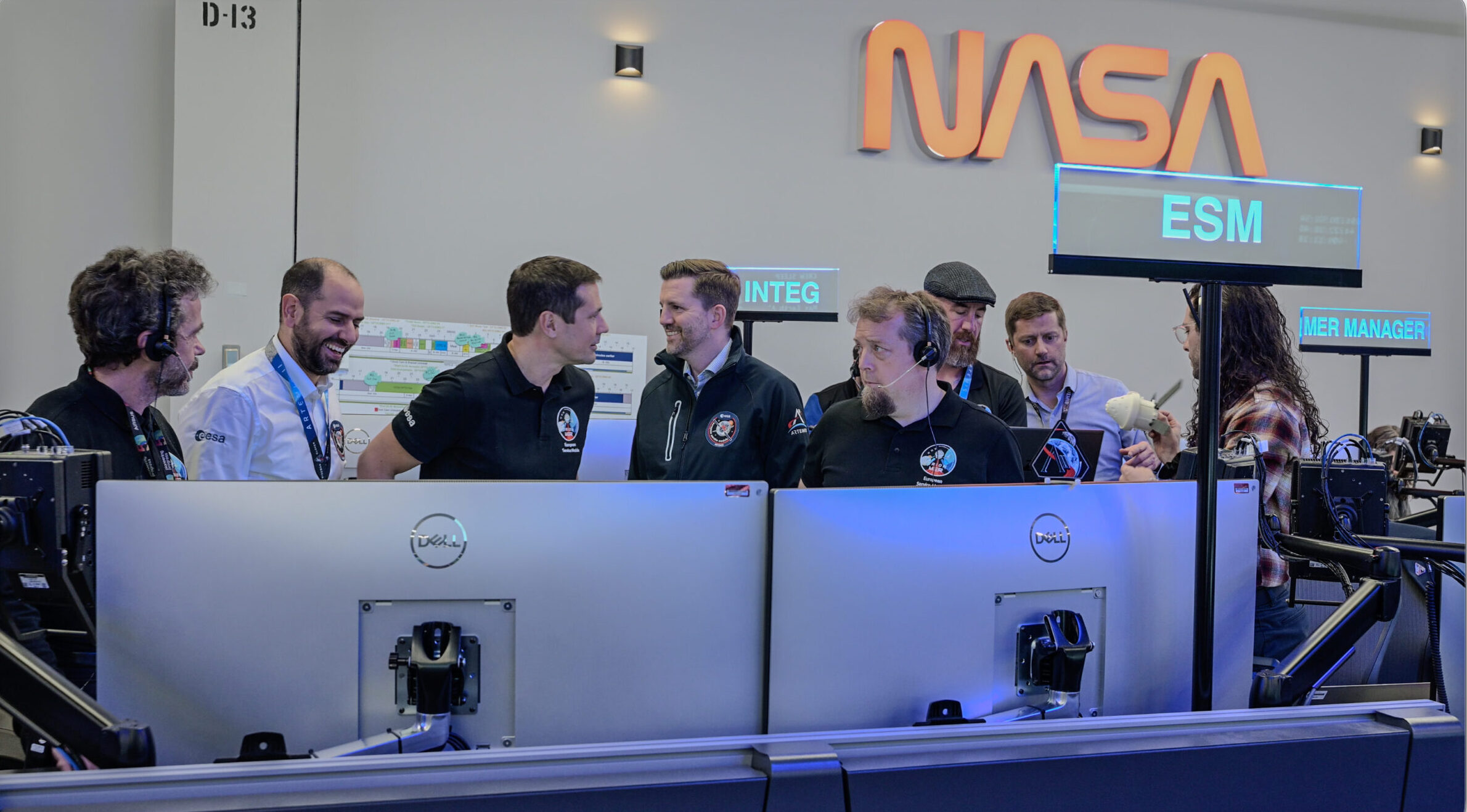
Conversations at the ESM spacecraft console in the Mission Evaluation Room during Artemis II.
Credit: ESA-M. Cowan
From their consoles, the European teams receive a continuous stream of telemetry from Orion: pressures, temperatures, voltages, fuel and consumable levels and more.
“We monitor that everything stays in the green, especially during dynamic phases such as engine burns,” Tobias explains. “We continuously check all parameters to make sure everything is going well.”
The MER works in close coordination with the flight control room next door, but with different roles. Flight controllers focus on operating the spacecraft in real time, whereas the MER team provides deep technical analysis and long-term perspective.
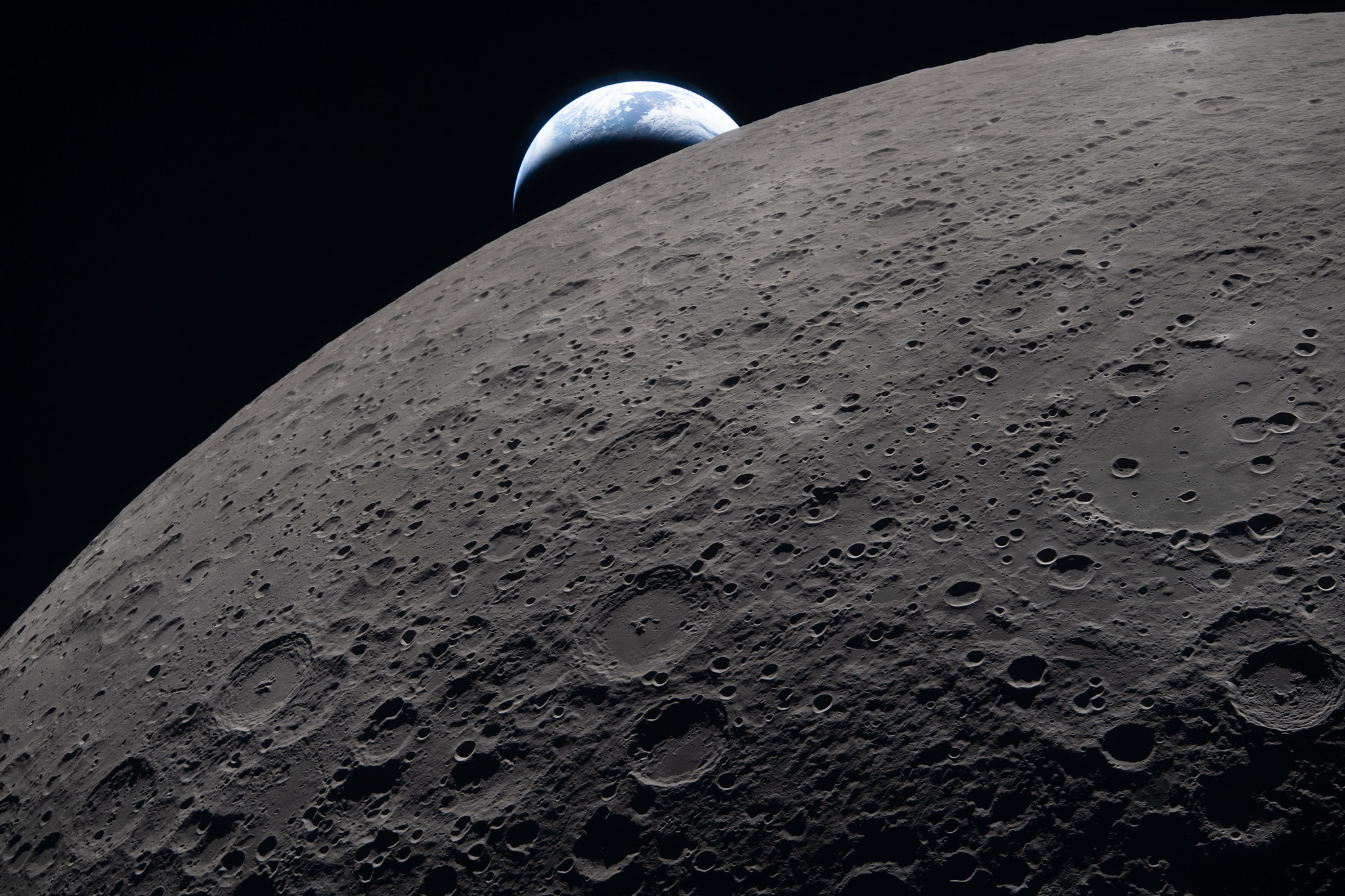
The lunar surface fills the frame in sharp detail, as seen during the Artemis II lunar flyby, while a distant Earth sets in the background. This image was captured at 6:41 p.m. EDT, on April 6, 2026, just three minutes before the Orion spacecraft and its crew went behind the Moon and lost contact with Earth for 40 minutes before emerging on the other side.
Credit: NASA
“The flight controllers know best how to operate the vehicle,” says Tobias. “But in the MER we have the detailed expertise on each subsystem, so we can analyse any small, or big, anomalies that hopefully won’t happen.”
For Luca, the difference lies in anticipation, and ensuring Houston doesn’t hear those famous words again. “Our job in MER is not only to monitor, but also to anticipate,” he says. “If we see something that isn’t behaving exactly as it should – even if it’s not yet an anomaly – we try to prevent it. Our goal is to look ahead and avoid problems before they happen.”
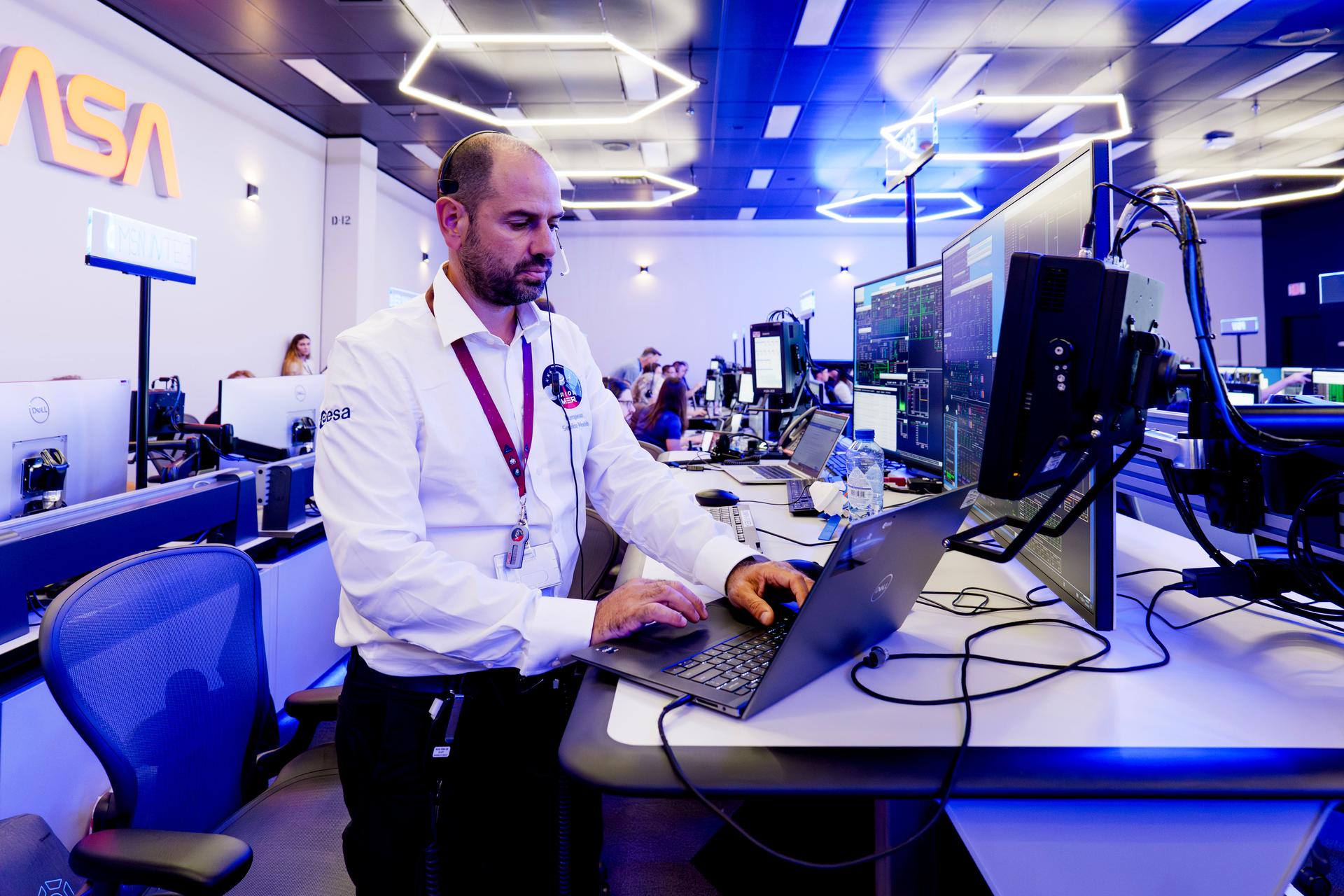
Luca Fossati, ESM mission and flight operations system engineer at ESA, in the Mission Evaluation Room at NASA’s Johnson Space Center in Houston.
Credit: NASA-R. Sinyak
Experience and responsibility
Many members of the ESM team have been working on the programme since its early days in 2012. They supported the development of the module, its assembly and testing, and its first flight during Artemis I.
“Some of us have been around since the beginning of ESM,” shares Tobias. “We’ve gone through the whole development cycle. Most of us also supported Artemis I, so we bring that experience to NASA.”
That experience builds confidence. “In a way, we are more relaxed than for Artemis I because we saw that ESM performed very well,” he adds.
But this mission carries a different weight.
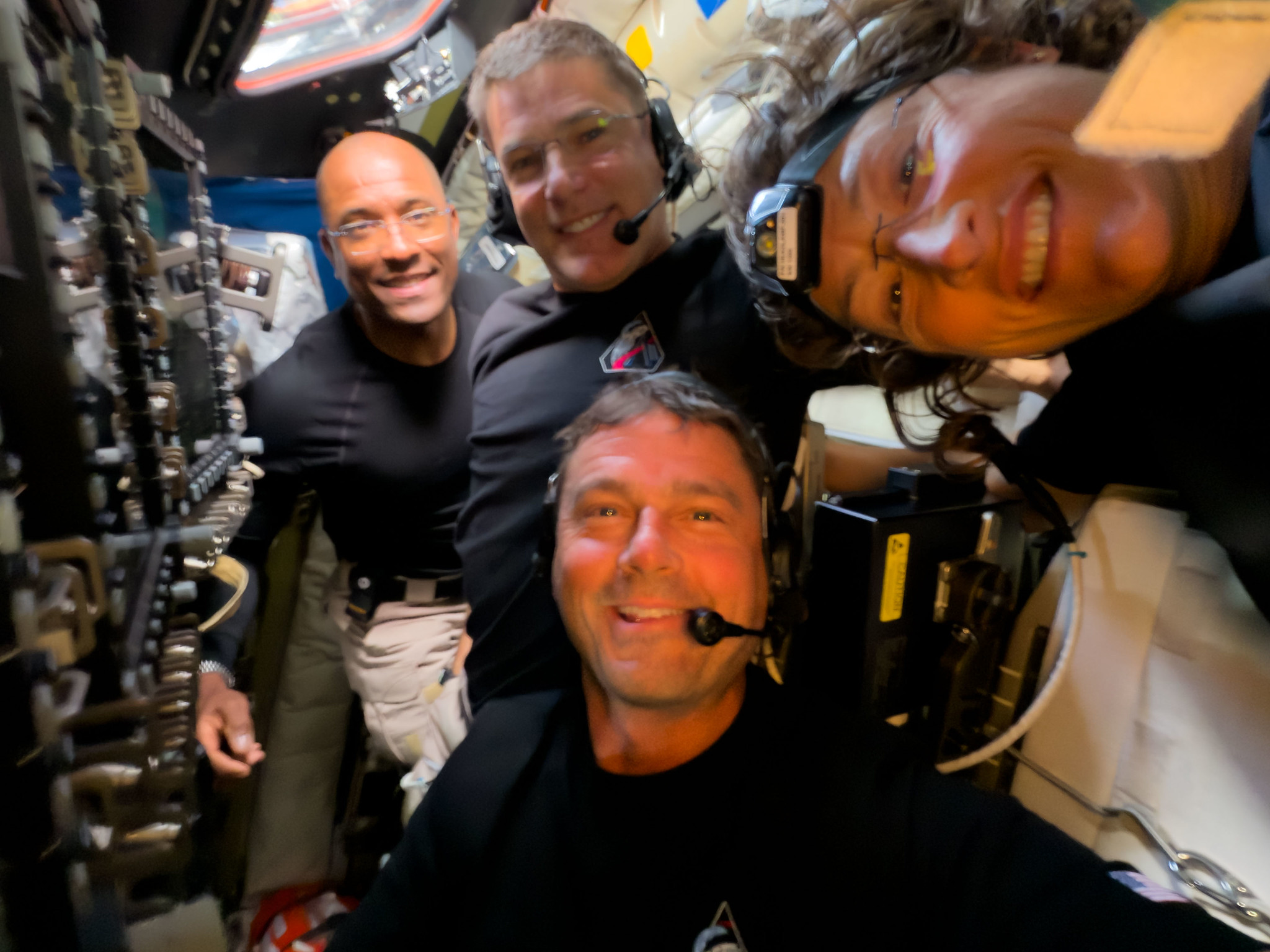
The Artemis II crew in their Orion spacecraft.
Credit: NASA
“For Artemis I we were flying a machine and optimising it,” Luca says. “Now there are human lives on board. It makes you think twice – whatever decisions we take, we have to remember that four people are up there and their lives partially depend on us.”
Some of the most intense moments of the mission have already passed: the first eight minutes of ascent as Orion rode its rocket into space, the checkout of the life support systems in Earth orbit and the trans-lunar injection burn around a day later that committed the astronauts to their lunar trajectory.
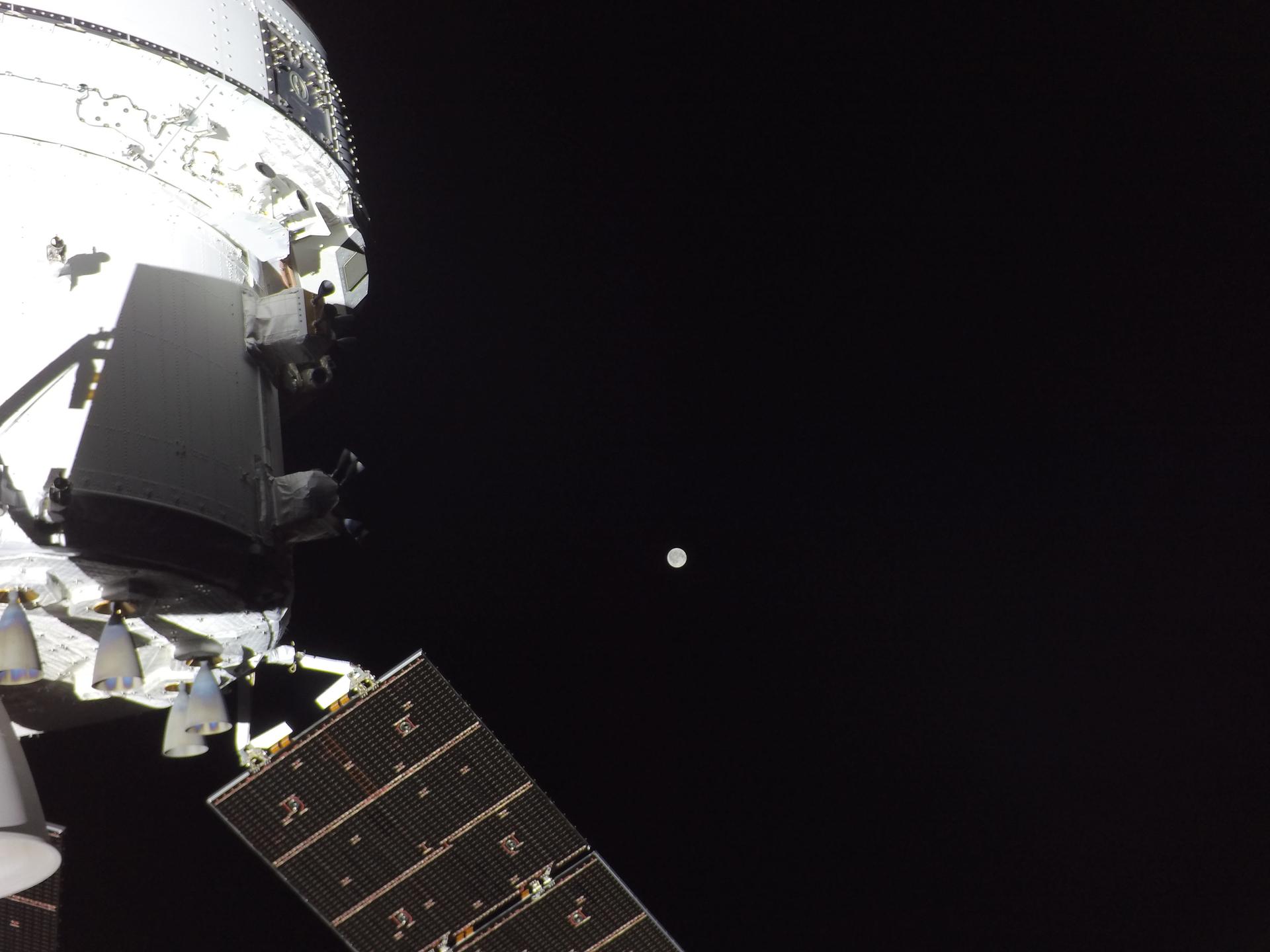
The Artemis II crew is en route to the Moon on the second flight day of the mission. This photo shows the Orion spacecraft with the Moon in the distance, as captured by a camera on the tip of one of its solar array wings.
Another milestone came shortly after reaching orbit, when the crew manually piloted Orion for the first time in space, practising rendezvous and docking manoeuvres that will be used in future Artemis missions.
“It’s the first time someone has piloted Orion in space – that’s something very special,” shares Luca.
“It’s a very exciting moment – for us and for the astronauts. Just three hours after launch, they took the joystick and manually controlled the spacecraft,” says Tobias.
Now, eight days into the mission, Orion has performed its lunar flyby and the crew is on their journey home; in just a few days, they will reach Earth. Before they re-enter our atmosphere, ESM will separate from the crew module and burn up safely in the atmosphere, its job complete. Then, the crew will splashdown safely in the Pacific Ocean.
Until that moment, across the world, ESA and European industry keeps a watchful eye on the spacecraft and its crew, ensuring that this historic journey safely completes its path around the Moon and back home.
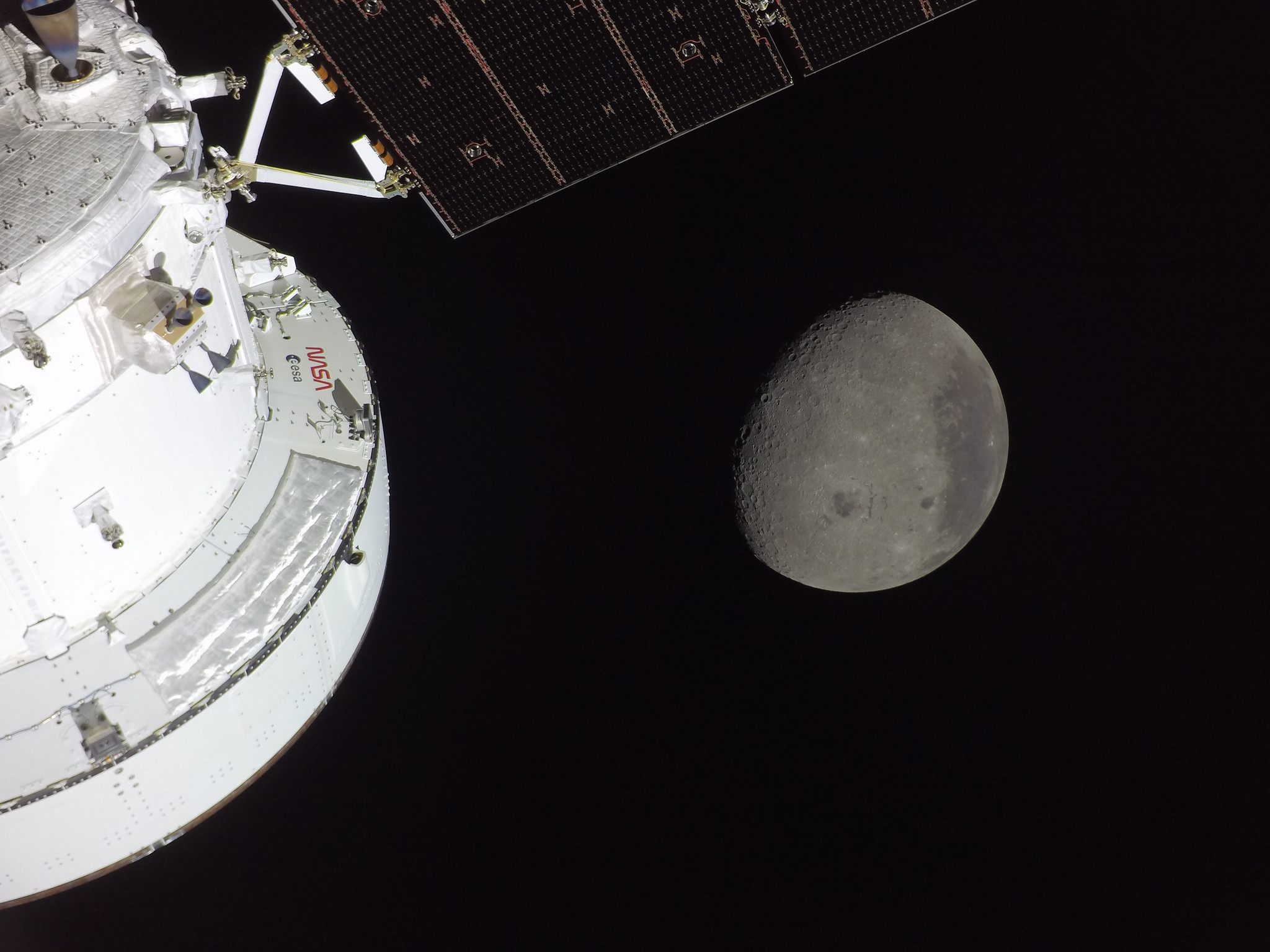
Orion approaching the lunar flyby on flight day 6 of the Artemis II mission. The sunlight shines on ESA and NASA logos on the Crew Module Adapter between the crew module and the European Service Module.
Credit: NASA