
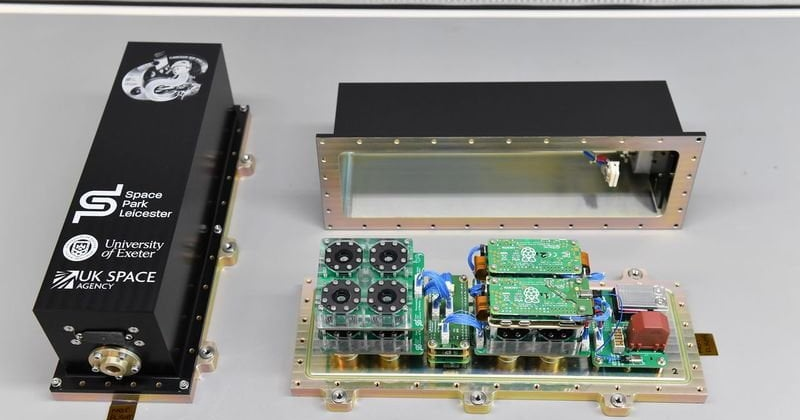

(University of Exeter via SWNS)
By Talker
By Lauren Beavis
Microscopic worms are being launched into space this week in a bid to unlock the “secrets of long-duration space travel.”
British scientists are preparing to launch a crew of microscopic worms – each one millimetre in size – to the International Space Station in a “pioneering” experiment that could help support our ambitions to reach the Moon and beyond.
The project, a miniature space laboratory designed to study how biological organisms respond to the extreme conditions faced by astronauts, is scheduled to launch on 10 April from a cargo vehicle from the Kennedy Space Center in Florida.
The mini lab will be mounted on the outside of the ISS by a robotic arm so that researchers can conduct tests on dozens of microscopic worms, called C. elegans nematode worms.
Scientists will be able to control the equipment remotely from Earth.
Led by the University of Exeter, engineered and built by the University of Leicester at Space Park Leicester, and funded by the UK Space Agency, British scientists believe the project could help provide new insights into how biological systems change in space and how astronauts can stay fit and healthy while travelling to and from the moon.
Scientists also hope the project will help provide more information into long-term stays following NASA’s plans to build a base there.
Space Minister Liz Lloyd said: “It might sound surprising, but these tiny worms could play a big role in the future of human spaceflight.
“This remarkable mission – backed by government funding – shows the ingenuity and ambition of UK space science, using a small experiment to tackle one of the biggest challenges of longâduration space travel: protecting human health.
“As we prepare for a new era of exploration, including future missions to the Moon, research like this will help astronauts stay healthy and return home safely.
“It’s a great example of how we’re driving innovation to grow the economy and keep the UK at the forefront of future technologies.”
Experts say the mission addresses the harmful effects of extended space travel on human health – a critical challenge in humanity’s ambitions to explore the Moon and other planets.
Microgravity can cause bone and muscle loss, fluid shift and vision problems, while radiation exposure can lead to genetic damage and increased cancer risk.
Dr. Tim Etheridge, from the University of Exeter, said: “NASA’s Artemis programme marks a new era of human exploration, with astronauts set to live and work on the Moon for extended periods for the first time.
(University of Exeter via SWNS)
“To do that safely, we need to understand how the body responds to the extreme conditions of deep space.
“By studying how these worms survive and adapt in space, we can begin to identify the biological mechanisms that will ultimately help protect astronauts during long-duration missions – and bring us one step closer to humans living on the Moon.”
The Petri Pod – which will contain the worms – is a self-contained experiment housed in a unit measuring approximately 10x10x30cm and weighing around 3kg.
It contains 12 experimental chambers – and each chamber provides a miniaturised ‘life support’ environment, by maintaining temperature, pressure and a trapped volume of air for organisms to breathe when exposed to the vacuum of space.
The specimens receive food and water through an agar carrier.
Initially, the experiment will spend time inside the ISS before being deployed outside on an experimental platform, exposing it to the vacuum and radiation of space along with microgravity for up to 15 weeks.
During the mission, researchers will monitor the worms’ health using fluorescent glowing signals and white light optics, captured via photographic stills and time-lapse video captured with miniature cameras.
The system will collect data on temperature, pressure and accumulated radiation dose, with information relayed to Earth.
Professor Mark Sims, project manager for the Fluorescent Deep Space Petri-Pods project at Leicester, said he was “excited” about the potential this experiment will have on the future of space travel.
He added: “FDSPP is Leicester’s first major microgravity life sciences project, and it has been both an interesting and challenging instrument to design and build.
“The project builds upon previous work with Tim Etheridge and the University of Exeter.
“Having now delivered the experiment to Voyager Space Technologies, who provide the interface to NASA and its flight on the International Space Station, the project team at Leicester look forward to seeing the first images from orbit.
“We hope this will contribute to our understanding of the microgravity environment, and we’re excited about the potential to further develop the instrument concept in the future.”
The experiment follows the launch of NASA’s Artemis II mission to send four astronauts on a 10âday journey around the Moon and back ahead of a future mission to return astronauts to the lunar surface for the first time since 1972.