
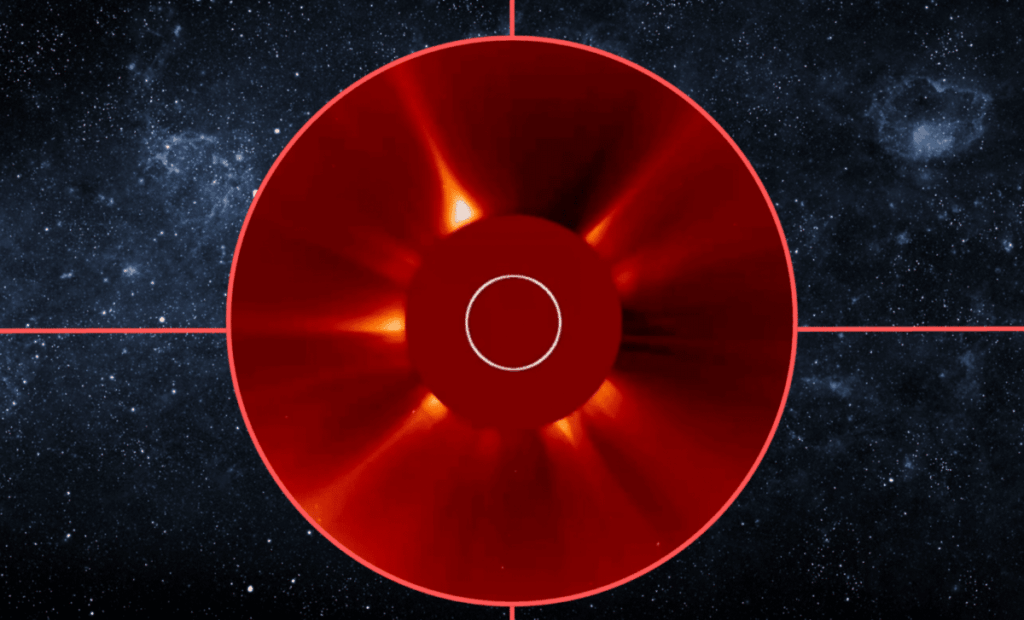
Comet MAPS, the much-anticipated “Great Easter Comet”, was completely destroyed in a cataclysmic fragmentation just hours before it was set to pass its closest point to the Sun. What was expected to be a dazzling light show in the evening sky instead ended in the obliteration of the comet, wiping away hopes for a spectacular display.
The Rise and Fall of Comet MAPS
Comet MAPS was discovered early in the year, and from the moment it was identified, it captured the attention of skywatchers around the world. Initially thought to be a much larger celestial body, the comet was hailed as a potential bright star in the evening sky, poised to put on a show. However, as observations continued, it became clear that Comet MAPS was far smaller than anticipated.
According to Space.com, the comet, a member of the Kreutz family of sungrazers, was already on a fateful path toward the Sun. These comets are notorious for their close passes, often within just a few hundred thousand miles of the Sun’s surface. This makes them a rare and fascinating object of study, as their proximity to the Sun provides valuable insights into the harsh conditions these comets endure. But Comet MAPS’ fate was sealed long before it even reached its closest approach, called perihelion.
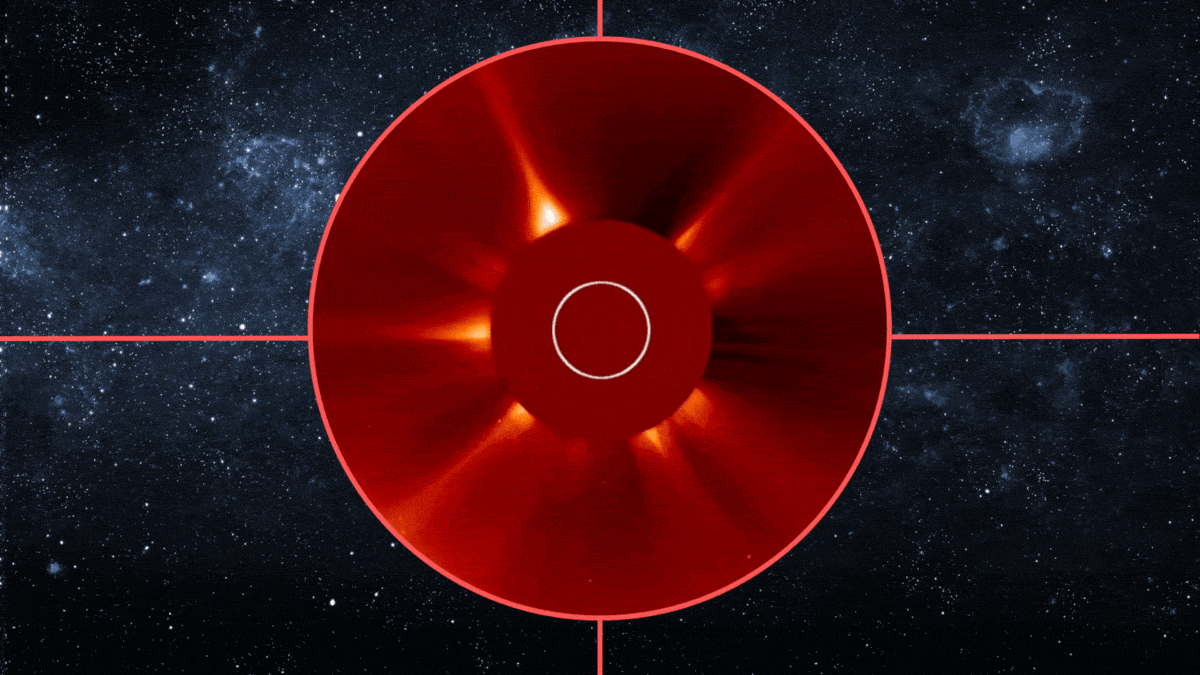 A dramatic breakup near the sun erased hopes of a bright comet lighting up the evening sky this week.
Image credit: ESA/NASA/SOHO
Why Did Comet MAPS Shatter?
As the comet hurtled toward the Sun, it faced extreme and unforgiving conditions. In the cold depths of the solar system, Comet MAPS had spent centuries far from the Sun’s heat. The nucleus of the comet was likely in a state of deep freeze, with temperatures approaching absolute zero. But as it neared the Sun, the comet was subjected to an intense and rapid increase in temperature.
In a phenomenon comparable to pouring hot tea into a freezing cold glass, the thermal stress on the comet’s nucleus was extreme. The outer surface of the comet began to heat up to over 3,000°F (5,000°C), while the interior remained frigidly cold. This sudden temperature disparity, combined with the intense gravitational forces exerted by the Sun, led to a catastrophic breakup.
The comet, which had been observed to brighten rapidly as it neared perihelion, eventually disintegrated. Imagery from NASA’s Solar and Heliospheric Observatory (SOHO) showed the comet’s fragmented remains, which quickly dissipated into a cloud of dust. By the time the comet passed closest to the Sun, there was nothing left but debris.
Observations and the Disappointment of Skywatchers
Astronomers and skywatchers had eagerly awaited the comet’s close encounter with the Sun. Hopes were high for a bright and beautiful spectacle in the western evening sky. However, as the comet passed behind the occulting disk of the SOHO satellite, which blocks out the Sun’s light, there was nothing to see.
By the time the comet reappeared in the satellite’s imagery, it was already too late. Instead of a bright tail or a shining nucleus, what remained was a hazy, cloud-like blob of debris. The skywatching community, who had been hoping for a rare and spectacular event, was left disappointed. What had promised to be a stunning celestial show turned out to be a cloud of dust, forever erasing any hopes of seeing a comet like MAPS shine in the evening sky.
A Unique Contribution to Our Understanding of Comets
Despite the unfortunate demise of Comet MAPS, its short-lived journey provided astronomers with valuable data. The comet’s disintegration near the Sun highlighted the extreme conditions these objects face when approaching one of the hottest and most powerful forces in the solar system.
Additionally, the comet’s small size, measuring only about 0.2 miles (0.4 kilometers) in diameter, sheds light on the nature of Kreutz sungrazers, which often break off from larger parent comets that passed close to the Sun long ago. The fragmentation of MAPS further deepens our understanding of these fascinating comets and their violent end at the hands of solar forces.
The Legacy of Comet MAPS: A Brief But Significant Life
Comet MAPS’ brief journey serves as a reminder of the unpredictable nature of space. While it was discovered with high hopes for a dazzling display, its sudden and violent end is a testament to the challenges and hazards faced by comets as they venture too close to the Sun. Despite its destruction, Comet MAPS will remain in the history books as a symbol of the wonders and unpredictability of our solar system.
The data gathered from this event will no doubt fuel further research into the behavior of sungrazing comets and their role in our understanding of the solar system’s evolution. Though Comet MAPS will no longer brighten the night sky, its legacy will continue to inform future studies of the cosmos.