
Applications
08/04/2026
23 views
0 likes
An important milestone has been reached in developing the upcoming Copernicus Radar Observing System for Europe in L-band satellite, known as ROSE-L. Engineers have tested the deployment of a structural model of its huge radar antenna – a key step towards preparing this new satellite for launch and its mission to monitor Earth’s land, oceans and ice from orbit.
Once operational, ROSE-L will return high-resolution radar images independent of weather or daylight. These data will underpin a wide range of applications, including soil moisture and crop monitoring, forest mapping, maritime surveillance, and the detection of both natural disasters and human-driven hazards.
One of the six Copernicus Expansion missions, ROSE-L, whose development is led by Thales Alenia Space as the mission’s prime contractor, will help strengthen Europe’s Earth-observation capabilities, complementing existing missions such as Sentinel-1 while expanding monitoring services for land management, food security, emergency response, and climate science.
Copernicus Sentinel Expansion Missions
At the heart of the mission lies an engineering achievement of extraordinary scale: a synthetic aperture radar (SAR) antenna spanning 40 square metres – roughly the footprint of a small studio apartment.
Because such a structure cannot fit inside a rocket fairing in its deployed form, engineers designed it as five separate panels, each measuring 3.6 × 2.2 metres. The central panel is fixed to the satellite, while the remaining four panels form two foldable wings that stow compactly during launch.
Once in orbit, specially designed hold‑down and release mechanisms, together with precision hinge‑line deployment systems, will unfold the stowed wings into a perfectly aligned, planar antenna surface. Each panel is built from lightweight carbon‑fibre face sheets bonded to an aluminium honeycomb core – combining strength with minimal weight.
Deploying the antenna in orbit will be a single, irreversible operation carried out shortly after the satellite has separated from the rocket – meaning it must work flawlessly the first time.
But verifying such a delicate operation on Earth presents its own difficulties.
Although the radar antenna wing is thin and fragile, it is large – comparable in area to four table-tennis tables – and it weighs around 240 kilogrammes.
Gravity complicates testing because the structure must move as if it were weightless.
ROSE-L radar deployment test
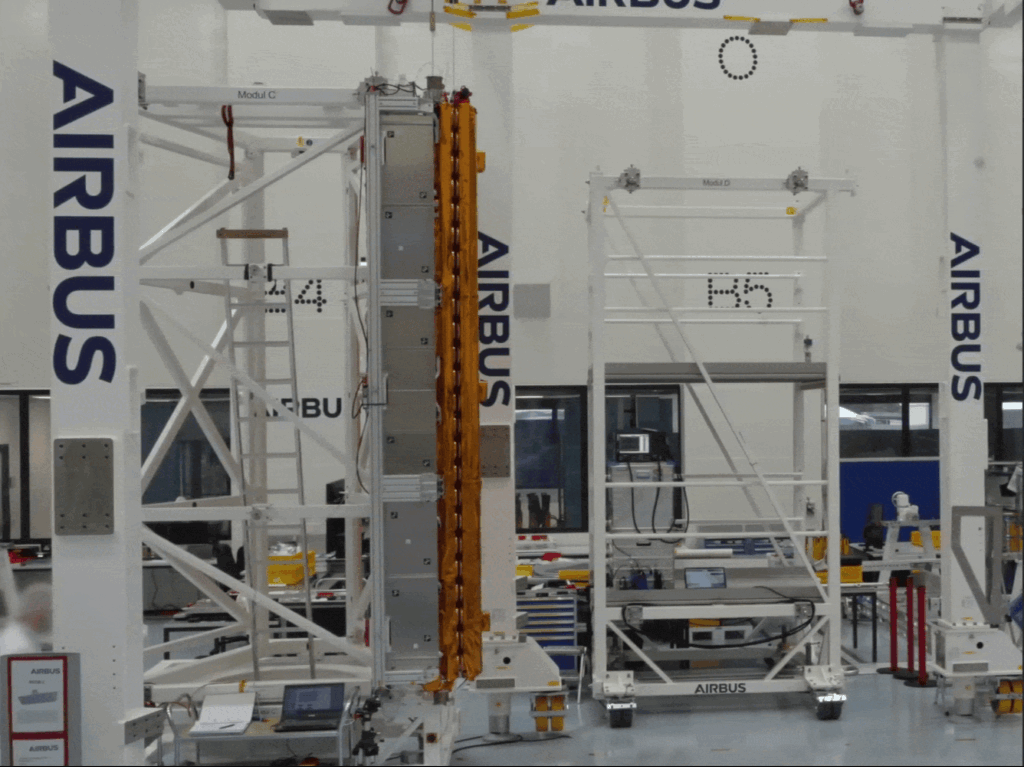
To overcome this, engineers developed a towering ‘antenna deployment device’ – an 8.2-metre-high, 7-tonne system designed to ‘simulate’ zero-gravity for a single antenna wing. The device supports the wing and allows it to unfold smoothly without friction or external assistance.
Engineers at Airbus Defence and Space’ facilities in Friedrichshafen, Germany, recently carefully prepared the structural model of the SAR wing with this deployment device for testing, with a special rig acting as mock-up for the satellite and central panel.
The SAR antenna unfolded exactly as planned.
In just over two minutes, the inner panel of the wing reached its final locking position. Then at eight minutes and 30 seconds, the outer panel completed its rotation, leaving the entire wing fully extended in its final planar configuration.
Remarkably, the entire sequence was fully passive – powered solely by spring-driven mechanisms rather than motors, which have been used for example on the antenna panels of the Sentinel-1 mission.
The passive solution allows to save both weight as well as complexity as there are no additional control electronics needed.
ROSE-L radar wing deployment test success
The successful first deployment validates the antenna’s mechanical design and provides strong confidence as teams continue manufacturing the flight hardware and prepare for final ground and in-orbit deployments.
Gianluigi Di Cosimo, ESA’s Project Manager for ROSE-L, said, “We are extremely happy to have passed this important milestone, which was an extremely delicate operation. Validating the deployment of such a large and complex radar antenna on the ground confirms the robustness of the design and brings the mission one step closer to delivering continuous, high-resolution radar observations for environmental monitoring and hazard management.”
New radar mission for Europe
The ROSE-L project brings together major European space industry partners and agencies.
Thales Alenia Space Italy serves as ESA’s prime contractor for ROSE-L, responsible for overall satellite development, system integration, verification and launch support. Airbus Defence and Space GmbH leads the design, development and testing of the L-band synthetic aperture radar, including both its electronics and the giant deployable antenna.
Like