
The most massive black holes in the universe are no longer growing the way they once did. A large-scale study now points to a simple explanation.
For years, astronomers observed that supermassive black holes, despite their enormous gravitational pull, have been growing more slowly since the universe’s most active period of star formation, known as cosmic noon. The reason behind this slowdown remained unclear, raising questions about whether fewer were active or whether their feeding mechanisms had changed.
Their growth is closely linked to the formation of stars and the structure of their host galaxies, especially in dense central regions known as galactic bulges. Untangling their history helps clarify how the universe reached its current state.
A Vast Survey of 8,000 Active Black Holes
The new study relies on an extensive dataset, combining observations of 1.3 million galaxies and around 8,000 actively feeding black holes. Based on a research avaliable on The Astrophysical Journal, the study drew from nine extragalactic surveys arranged in a “wedding cake” structure, blending wide, shallow observations with deeper, narrow ones.
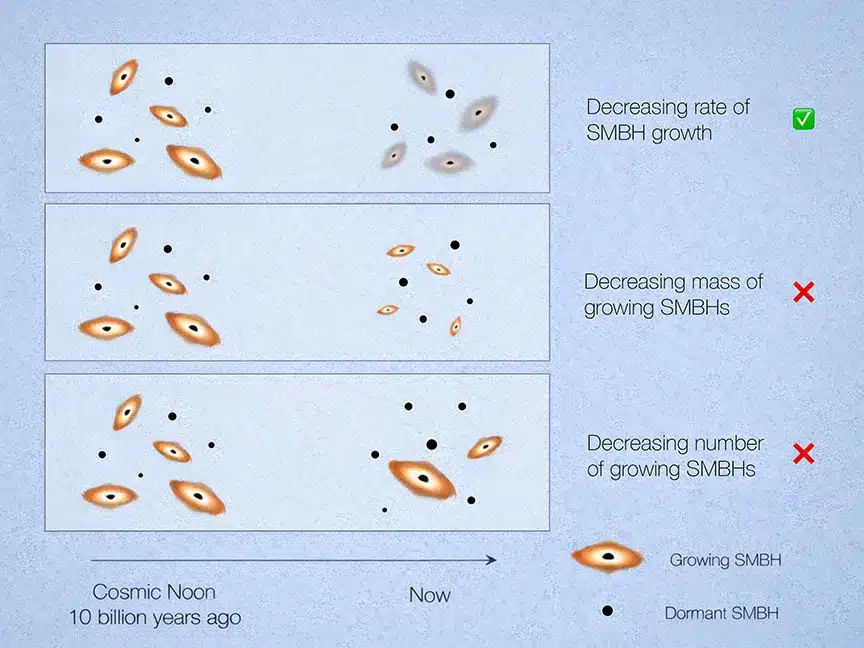 Conceptual diagram exploring why black holes grow more slowly today than in the early universe. Credit: Penn State/Z. Yu
These data were collected using leading X-ray observatories, including Chandra, XMM-Newton, and eROSITA. X-rays are especially useful because they are produced as matter spirals into Gravitational singularities. As lead author Zhibo Yu explained:
“X-ray light is arguably the best tracer of black hole growth,” he said, “It is ubiquitously produced by growing supermassive black holes and has high contrast compared to the background star light. It also has high-penetrating power — that’s why it’s commonly used in medical imaging — so that it is less affected by the obscuring gas and dust in the galaxy.”
A Clear Answer To A Cosmic Puzzle
The study tested several competing explanations: whether modern cosmic voids are smaller, less numerous, or simply feeding less efficiently. According to Fan Zou, co-author of the study, the answer is now clear:
“We knew black holes were growing more slowly, but not why — and it turned out to be that individual black holes are consuming material much less rapidly, rather than there simply being fewer growing black holes or smaller ones.”
This decline is tied directly to the availability of cold gas, the primary fuel for cosmic void growth. The supply of this gas has steadily decreased since cosmic noon, leaving black holes with less material to accrete. The slowdown is not subtle. Growth rates have dropped by a factor of 22 over the past 10 billion years, as reported by Live Science.
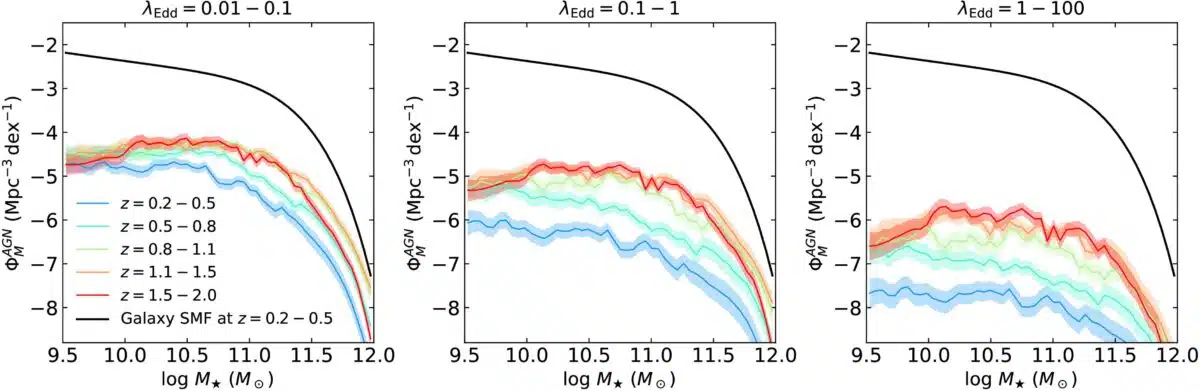 How black holes grow over time: this chart shows that the biggest ones are becoming less active as the universe ages. Credit: The Astrophysical Journal
The End Of An Era For Cosmic Giants
The findings suggest that most cosmic giants had already reached near-final stages of development billions of years ago. As explained in the study, the overall population of these objects was largely established around 7 billion years ago, with little change expected moving forward.
This paints a picture of a universe that has moved past its most active phase. The once “hungry” black holes that dominated early cosmic history are now evolving in a quieter environment, limited by shrinking reserves of gas. As Zou noted, scientists do not expect many of these giants to significantly grow in the future.