
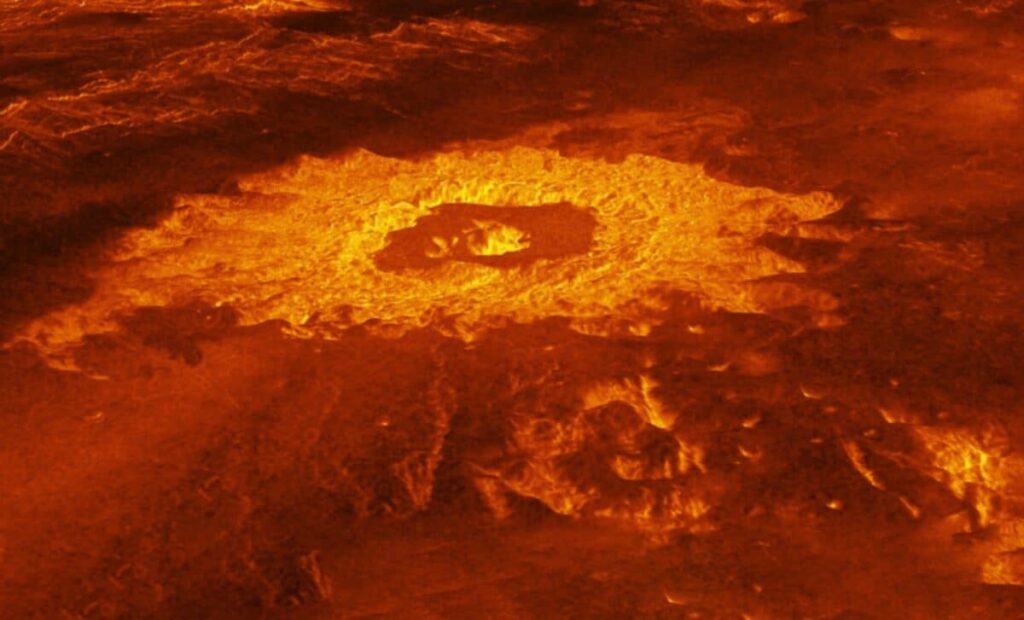
A research team from the University of Trento has found the first direct radar evidence of a lava tube on Venus, identifying a subsurface conduit roughly a kilometer wide beneath the shield volcano Nyx Mons. The finding, published in Nature Communications in February 2026, is based on reanalysis of radar images collected by NASA’s Magellan spacecraft in the early 1990s.
The structure is far larger than any comparable feature on Earth. The estimated conduit width averages about 937 meters, the roof thickness is at least 150 meters, and the empty void inside reaches approximately 375 meters in height. For comparison, the Corona lava tube system in Lanzarote, Spain, one of Earth’s longest, reaches widths of roughly 28 meters.
What the Radar Images Showed
NASA’s Magellan mapped Venus using Synthetic Aperture Radar between 1990 and 1992, the only practical tool for seeing through the planet’s dense cloud cover. The Trento team applied a detection method originally developed for identifying lava tubes on Earth and the Moon, looking for a specific radar signature near surface collapse pits.
One pit, labeled “pit A,” on the western flank of Nyx Mons produced a radar return that stood out from the others in the dataset. Most pits produce a straightforward shadow and a bright edge return consistent with steep walls. Pit A showed an asymmetric bright streak extending well beyond the pit rim, a pattern observed only when radar waves enter a skylight, travel along an underground tunnel, and scatter back toward the spacecraft.
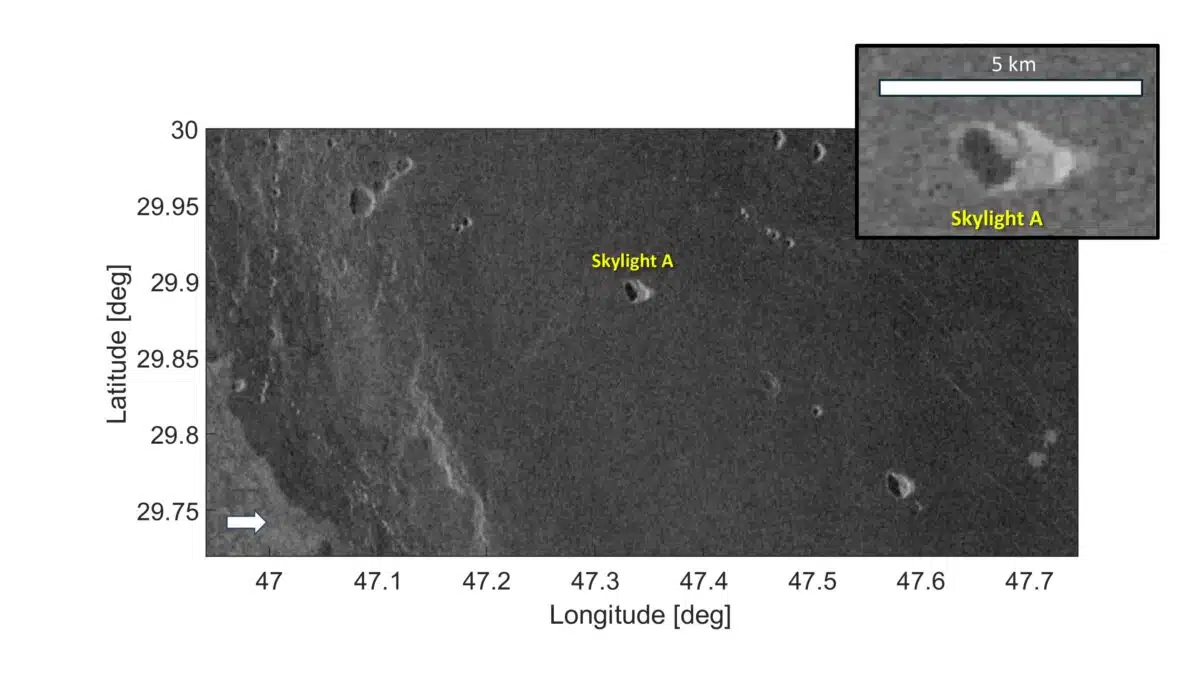 Magellan radar image of Venus displaying several pit chains and the identified “skylight”, marked as A, that are thought to show where underground lava tubes have fallen in. Credit: Carrer et al. / Nature Communications 2026
That signature, the researchers write, is consistent with a collapsed section of a lava tube roof, creating an opening into a still-intact conduit below.
The Scale of the Structure
The skylight itself measures approximately 1,545 by 1,070 meters. The radar signal traced the conduit for at least 300 meters from the opening before extinguishing, and the collapse depth is estimated at around 450 meters.
By following the chain of collapse pits along the surface and accounting for the downhill slope of the surrounding terrain, the team estimated the full tube system likely extends at least 45 kilometers beneath Nyx Mons. A 13-kilometer segment between two pits in the chain shows no surface collapse at all, suggesting that section of the tunnel remains fully intact from above.
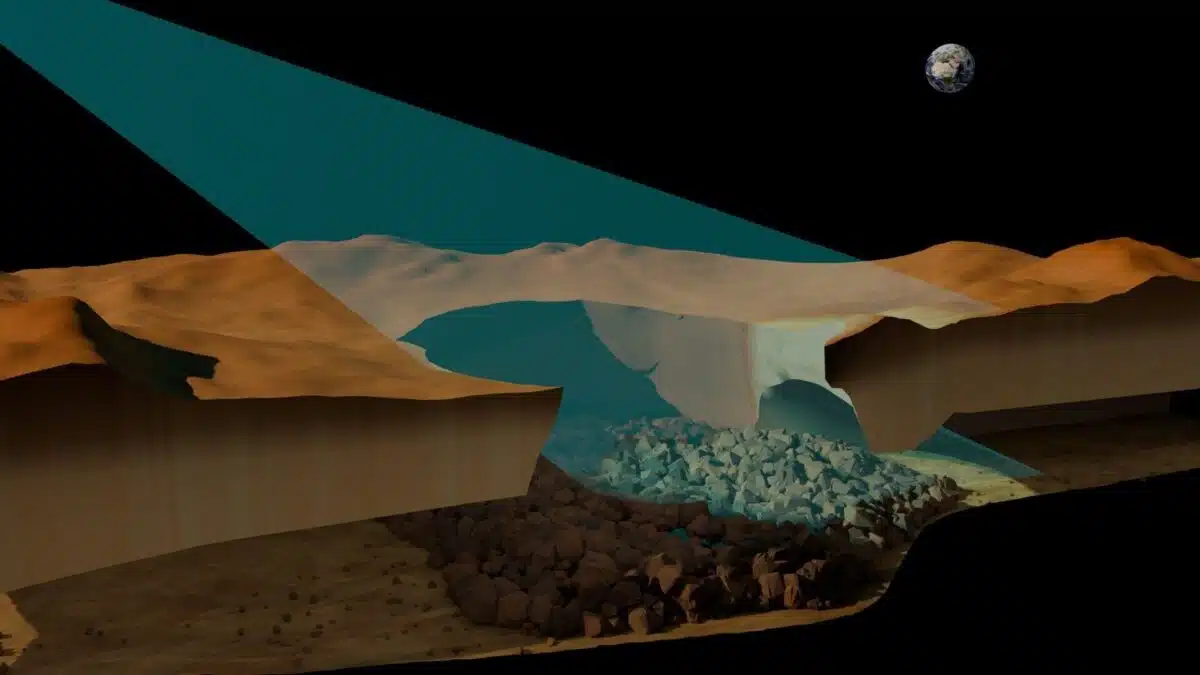 A lateral cross-sectional view illustrating the detected cave beneath the surface of Venus. Credit: RSLab, University of Trento
The tube’s dimensions are consistent with what has been found on the Moon, where low gravity also favors the formation of large lava structures. On Earth, stronger gravity and faster surface cooling produce far smaller tunnels.
Why Venus May Build Such Large Tubes
The physical conditions on Venus appear to favor the formation of unusually large lava tubes. The planet’s lower gravity and thicker atmosphere would cause a solidified crust to form quickly over a moving lava flow, insulating the molten rock beneath and allowing it to travel long distances while remaining liquid. That process, known as overcrusting, is the same mechanism that produces lava tubes on Earth and the Moon, but the Venusian environment appears to scale it up considerably.
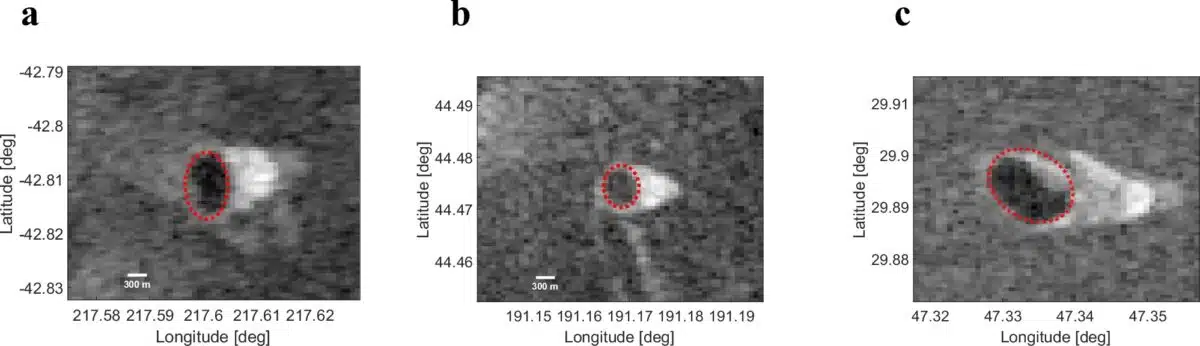 Comparison of Magellan SAR radar responses from different pits. a) A pit near Idunn Mons. b) A pit in Ganiki Planitia and c) the candidate skylight denoted A near Nyx Mons. Credit: Carrer et al. / Nature Communications 2026
Venus also has surface lava channels that are larger and longer than those seen on any other planet, which supports the idea that its volcanic plumbing operates at a different magnitude. Nyx Mons sits within a region already documented for an unusually high density of collapse pit chains, all of which may represent the surface signatures of a much more extensive underground network.
Ruling Out Other Explanations
The researchers considered several alternative explanations for pit A’s unusual radar response, including tectonic voids, volcanic vents, impact craters, and collapse features linked to underground magmatic dykes. Each alternative produced a distinguishable radar signature in terrestrial analog datasets.
A dyke-related collapse showed no evidence of horizontal continuation beyond the pit. Volcanic vents and impact craters both generated different backscattering patterns around the feature. The team also confirmed that surface roughness near pit A could not account for the bright radar anomaly.
The closest match came from a known collapsed lava tube entrance in the Corona system on Lanzarote, called Jameo Agujerado, where the same well-defined shadow and asymmetric bright return were observed. That terrestrial analog was used to validate the interpretation of the Venusian data.
What Future Missions Could Resolve
The Magellan radar operated at a pixel resolution of 75 meters, which the researchers acknowledge may have caused smaller skylights elsewhere on Venus to go undetected. The finding suggests the planet could contain many more lava tubes that have not yet appeared in existing data.
Two upcoming missions are expected to investigate. NASA’s VERITAS (Venus Emissivity, Radio Science, InSAR, Topography, and Spectroscopy) and the European Space Agency’s EnVision will both carry radar systems with resolutions down to roughly 15 to 30 meters. EnVision will also carry a subsurface radar sounder designed to penetrate several hundred meters into the Venusian surface, placing it at exactly the depth needed to detect intact tunnels like the one identified near Nyx Mons.
VERITAS is currently planned to launch no earlier than 2031.