

Published on
07/04/2026 at 21:31
Updated on
07/04/2026 at 21:32
The end of the era of galactic banquets and the dormancy of active nuclei. The scarcity of gas and stellar dust in the centers of galaxies is transforming ancient greedy giants into silent and less energetic structures.
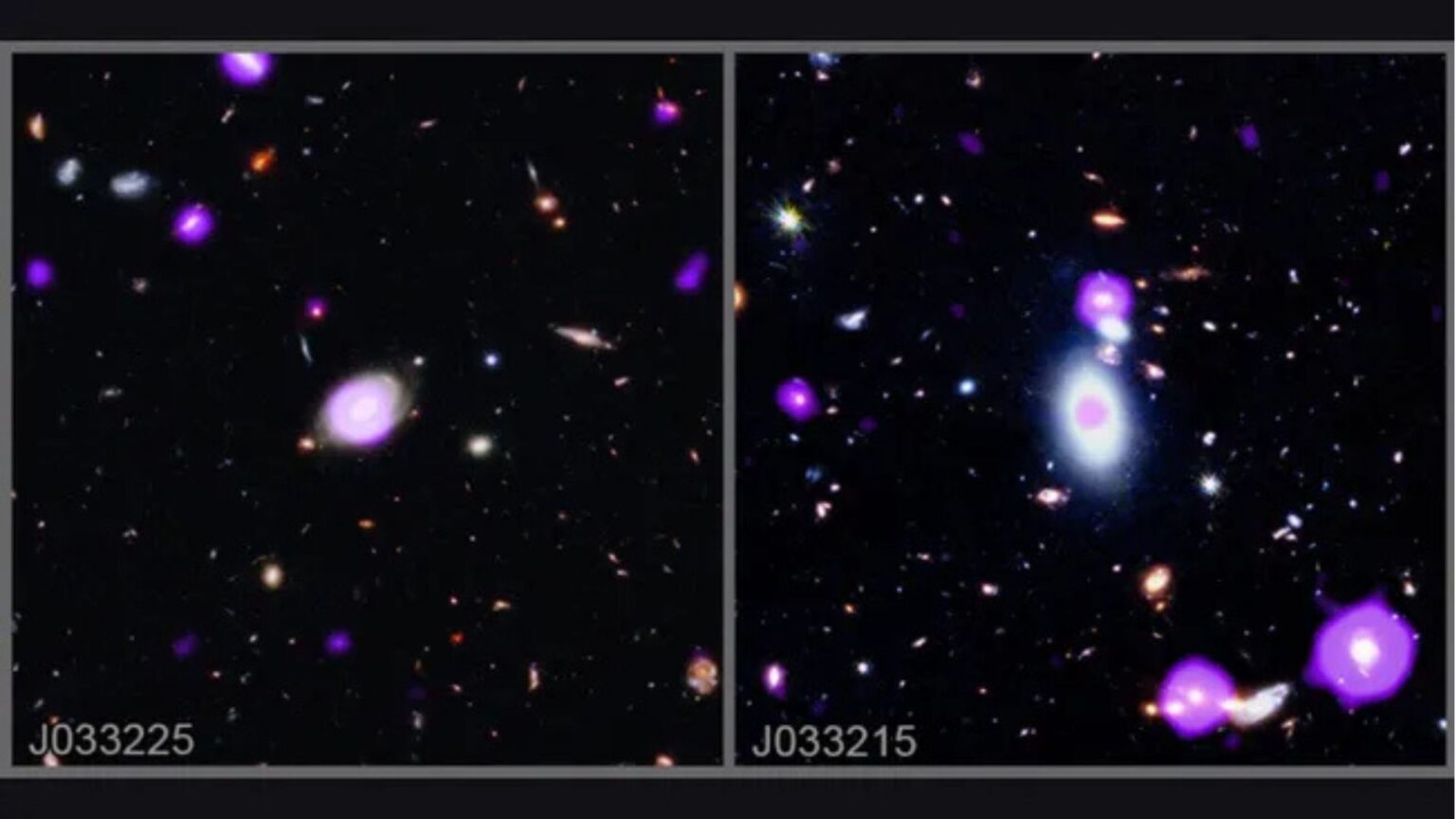
An extensive astronomical survey involving approximately 8,000 celestial objects revealed that the hungriest black holes in the cosmos are facing a severe shortage of matter to consume.
The study, which analyzed the behavior of these gravitational giants over billions of years, indicates a drastic change in the diet of the so-called “cosmic monsters.”
The research points out that the phase of frantic growth, characteristic of the early periods of the universe, is giving way to an era of relative inactivity for the largest galactic nuclei.
The decline of the cosmic banquet on a large scale
The collected data shows that the rate of gas and stellar dust ingestion by the hungriest black holes has dropped considerably compared to the distant past.
In the early history of the universe, these structures were fed by a constant flow of galactic material, allowing them to shine brightly as quasars.
Currently, the lack of available “food” in the immediate vicinity of these nuclei causes them to enter a state of dormancy, emitting much less radiation than in previous eras.
The statistical analysis of the 8,000 observed specimens suggests that the host galaxies are becoming less efficient at delivering matter to their centers.
Cold gas, essential to sustain the voracity of these objects, is being consumed by star formation or expelled by powerful galactic winds before reaching the event horizon.
This resource depletion process is a widespread phenomenon affecting the populations of supermassive black holes in various regions of the observable universe.
The evolution of cosmic monsters and their galaxies
The research highlights that the life cycle of the hungriest black holes is closely linked to the evolution of the galaxies that host them.
As a galaxy ages, it tends to stabilize its structure, reducing the collisions and interactions that previously pushed large amounts of matter to the center.
This gravitational isolation is the main reason why large cosmic banquets are becoming rare events in the modern universe, transforming ancient active giants into silent entities.
Astronomers have observed that even black holes that still exhibit some level of activity do so in a much more intermittent manner.
Meals now consist of leftovers from stars that come too close or small wandering clouds of gas, instead of the continuous flow of the past.
This change in behavior provides valuable clues about how the energy released by these objects has influenced the formation of large-scale structures in the cosmos over time.
Prospects for the future of astronomical monitoring
The survey of the 8,000 objects reinforces the need for new technologies to observe the hungriest black holes that are entering a phase of “fasting.”
Identifying these monsters in a state of low activity requires more sensitive telescopes capable of detecting more subtle thermal and gravitational signatures.
The study concludes that we are witnessing a historic transition in the dynamics of the universe, where the most powerful engines of nature are losing their primordial fuel.
The findings pave the way to understand whether this lack of food is a permanent state or just a pause in very long activity cycles.
Understanding the hunger of these black holes allows scientists to predict the ultimate fate of galaxies, including our own Milky Way.
The end of the era of great banquets signals a more mature universe, where the violence of accretion processes gives way to a cosmic calm that is expected to last for many trillions of years.
Click here to access the study.