
Agency
07/04/2026
15 views
0 likes
After more than a year of design, testing and development, dozens of European university students gathered in March to enact the final stage of their experimental projects in the REXUS 35 and 36 campaign. For two weeks, these students utilised the Esrange Space Center in northern Sweden to prepare and launch their various experiments on sounding rockets.
Turning ideas into space experiments
During the REXUS/BEXUS (Rocket/Balloon EXperiments for University Students) programme’s initial phase, the selected teams defined scientific objectives, designed systems capable of performing reliably in flight, and emulated the development process of professional space missions. This process challenges students, as Lorenzo, a member of the VIPER experiment team, says, “every step demands persistence, creativity, and teamwork”.
Through design reviews, safety assessments, technical tests and the crucial guidance of experts, these experiments were shaped into working flight hardware. These months of preparation were pivotal to the campaign’s success. “Throughout this journey, the guidance and support of the REXUS/BEXUS programme experts and our mentor proved invaluable, helping us overcome technical obstacles and refine our approach,” continues Lorenzo. “Their experience and collaboration were essential in turning an ambitious idea into a successful experiment.”
Inside the launch campaign
Students watching the launch of REXUS 36 in March 2026
Students, engineers and specialists were brought together in a real operational space mission. The campaign begins as experiments are unpacked, inspected, and eventually integrated into the rocket structure. Once again, the interfaces are verified, telemetry is checked and countdown procedures are rehearsed. Technical challenges are expected and solving them under time pressure is a highly valued learning experience.
“Upon arriving at ESRANGE, we knew we had a few stressful days ahead of us,” says Markus, a member of the APEX experiment team. “Within just a few long days, however, we managed to achieve most of our goals and became flight-ready only three days after arrival.”
Countdown
As launch day approaches, excitement and tension intensify. Teams gather on their ground stations, from where they can monitor their experiments. Finally, after a countdown of almost 3 hours, students see their experiments launch. “The launch moment was just extraordinary,” says Patrick, a member of the HARTS experiment team. ”Seeing everything come together and finally watching the launch after all the work we put in was a really special moment. The goosebumps just from a short few second liftoff is something to remember.”
Everything happens very quickly. Experiments collect and transmit data for a few minutes, before they land back on earth under a parachute. Soon after touchdown, a recovery crew goes out to bring the experiments back to the launch site.
REXUS 35
The REXUS 35 flight launched on 10 March 2026, carrying four experiments up to an apogee of 75.5 km. These experiments included:
APEX (Auroral Polarization EXplorer) from the University of Technology Graz, Austria. APEX measures auroral polarization from above the atmosphere to map the 3D origins of auroral emissions and improve understanding of magnetosphere–solar wind interactions.
HARTS (Hybrid Atmospheric Re-entry Thermal Shield) from the Technical University of Košice, Slovakia. HARTS develops and tests a hybrid re-entry heatshield that combines active helium cooling with passive protection, using a freefalling demonstrator to measure aerothermodynamic performance and validate a reusable, low-cost thermal shield concept.
MARTINI (Material Analysis of Resin Testing In Null-Gravity Interactions) from the Technical University of Braunschweig, Germany. MARTINI studies how photopolymer resins mix and cure in microgravity to support future in-space additive manufacturing, providing data needed to design effective resin processing systems for space applications.
TRACER (TRAnspiration Cooling Experiment Revisited) from the Rhenish-Westphalian Technical University, Aachen, Germany. TRACER tests transpiration cooling heatshield concepts directly on the REXUS rocket using multiple cooling media, comparing their performance with an uncooled surface to assess feasibility for reusable thermal protection systems.
REXUS 36
For REXUS 36, launch was a short two days later, 12 March 2026, carrying another four experiments to an apogee of 79.3 km. These experiments involved:
MEEGA (Make Enceladus Experiment Go Again) from the Aachen University of Applied Sciences, Germany. MEEGA recreates Enceladus-like plumes by accelerating water vapour through a nozzle on a REXUS rocket, and it documents pressure, temperature, and flow visuals to improve understanding of plume physics and validate technologies for future missions.
THRIVE (Tissue Healing Research for In-Flight Viability Experiment) from theTechnical University of Applied Sciences Würzburg-Schweinfurt, Germany. THRIVE investigates how high acceleration, vibration, microgravity, and cosmic radiation affect components of the StellarHeal stem‑cell‑based wound healing method during a REXUS launch, using a life support system that keeps samples viable and records all stresses. The results provide the foundation for applying StellarHeal in future human spaceflight.
VIPER (Vibro-mechanical and Inertial Positioning Experiment on Rocket) from the University La Sapienza, Italy. VIPER carries out three experiments on a REXUS rocket: it monitors changes in launcher structural dynamics during flight, tests vibration reduction solutions for payloads such as CubeSats, and validates a distributed inertial navigation system that improves position estimation in dynamic conditions.
GOOSE (Germanium Orbital Optical Semiconductor Experiment) from the Technical University of Munich, Germany. GOOSE develops a new type of optical furnace along with the first autonomous controller for the microgravity float zone process. These will then be used to float zone a germanium sample under microgravity, where the sample can be compared with a crystal grown under normal gravity.
After the launch
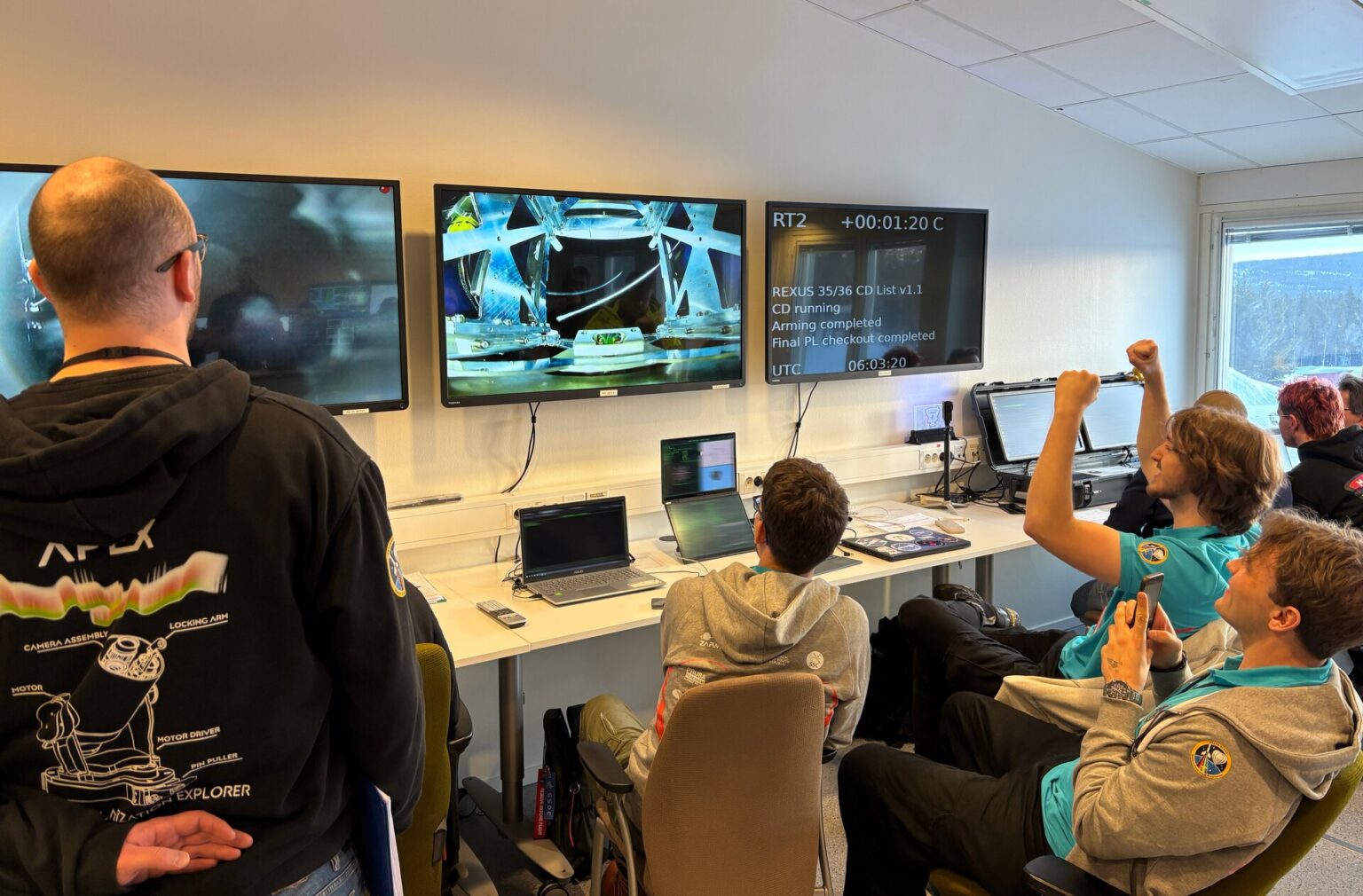
Students at their ground stations during the REXUS 35/36 launch campaign in March 2026
Once the rocket payload is recovered, the focus shifts from launch operations to scientific analysis. The data recorded during the flight is processed by the teams, at which point, the performance of their systems is assessed, and the results of their experiments are evaluated.
Preliminary results are shared after the launch, at the campaign post-flight meeting, while detailed analysis will continue at the students’ universities. As Lorenzo states, this experience is “not an endpoint, but the beginning of a new phase.”
Training the next generation of space engineers
For many participants, the REXUS/BEXUS programme is their first step into the space sector. It is an opportunity which not only improves participants’ engineering and research skills, but develops teamwork, project management and operational capabilities. These experiences are pivotal for preparing students to step into the role of the space sector’s next generation, directly contributing to ESA Strategy 2040.
About the REXUS/BEXUS programme
The REXUS/BEXUS programme is realised under a bilateral Agency Agreement between the German Space Agency at DLR (German Aerospace Center) and the Swedish National Space Agency (SNSA). The Swedish share of the payload has been made available to students from other European countries through a collaboration with the European Space Agency (ESA). EuroLaunch, a cooperation between SSC Space and the Mobile Rocket Base (MORABA) of DLR, is responsible for the campaign management and operations of the launch vehicles. Experts from DLR, SSC Space, ZARM and ESA provide technical support to the student teams throughout the project. REXUS and BEXUS are launched from SSC Space, Esrange Space Center in northern Sweden.
Like