
Back to Article List
This brighter-than-expected comet is visible in the early-morning hours near the Great Square of Pegasus.
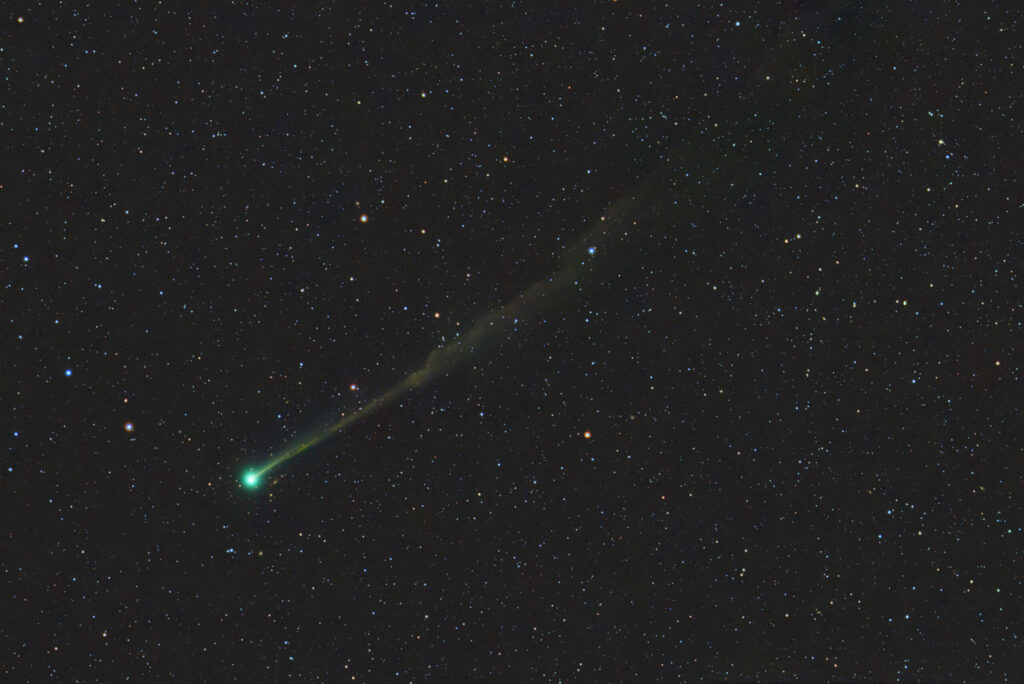
On March 26, Comet C/2025 R3 Panstarrs glowed around 8th magnitude and showed off a lovely long tail, within which several disconnection events are visible. Credit: Chris Schur
Looking for a sky event this week? Check out our full Sky This Week column.
April 6: The Moon passes Antares
Recently reported around 6th magnitude, this comet should be within the range of most amateur scopes. It’s expected to brighten at least two more magnitudes this month, although comets don’t always do as astronomers predict.
Rising around 3:40 A.M. local daylight time, give PanSTARRS an hour or so to climb above the horizon before searching it out. Around 4:45 A.M. local daylight time, it’s reached an altitude of 10° in the eastern sky. It lies close to the western side of the Great Square of Pegasus, between the stars Alpha (α) and Beta (β) Pegasi, also known as Markab and Scheat, respectively. From Markab, which is lower in the sky than Scheat, shift your scope 5° north-northwest to land on the comet.
Even as this comet brightens, it will become less visible as it sinks quickly toward the horizon each night. As we near the end of the month, it will no longer be visible in the Northern Hemisphere, instead gracing only Southern Hemisphere skies.
Sunrise: 6:34 A.M.
Sunset: 7:31 P.M.
Moonrise: 12:35 A.M.
Moonset: 9:21 A.M.
Moon Phase: Waning gibbous (69%)
*Times for sunrise, sunset, moonrise, and moonset are given in local time from 40° N 90° W. The Moon’s illumination is given at 10 P.M. local time from the same location.