
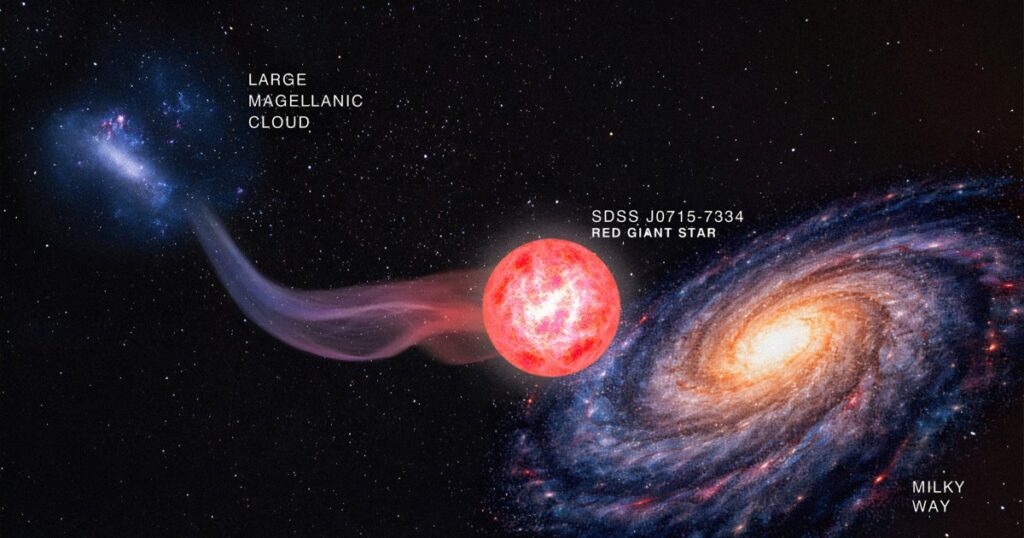
Long ago, far beyond our deepest views of the cosmos, star formed in the Universe for the very first time. It’s not a complete surprise that we haven’t spotted them yet; made almost entirely of hydrogen and helium alone, they were extremely massive and short-lived compared to the stars we see today. However, once those first stars die, their ejecta — depending on your perspective — either “enrich” or “pollute” the interstellar medium around them, meaning that the next generation of stars to form, and all generations thereafter, will be substantially different from that first generation.
However, unlike the first generation of stars, all subsequent generations should have the capability of producing small, red, low-mass stars that burn through their fuel quite slowly: so slowly that even a star formed back at the beginning of the Universe should still be alive today. Of course, galaxies are messy places, and a far greater number of stars have formed since those early times, making the task of finding such a relic more challenging than even the classic needle-in-a-haystack problem.
Remarkably, by examining stars in a satellite galaxy of the Milky Way, the Large Magellanic Cloud, astronomers have just revealed the most pristine individual star ever discovered: a true candidate for a bona fide second-generation star. Here’s the science behind it, and what its discovery could mean for our understanding of the Universe.
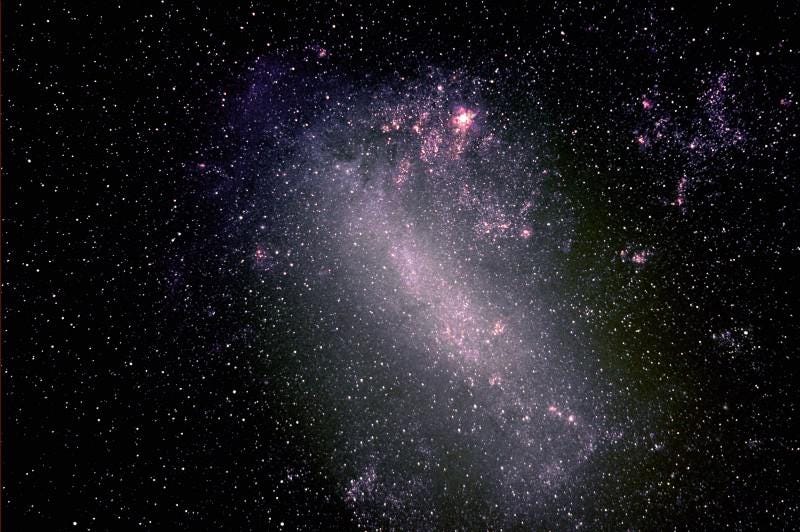
The Large Magellanic Cloud is home to the closest supernova of the last century, having occurred in 1987. The pink regions here are not artificial, but are signals of ionized hydrogen and active star formation, likely triggered by gravitational interactions and tidal forces primarily due to the Milky Way’s influence. The pink regions specifically arise when electrons fall back onto ionized hydrogen nuclei, and transition from the n=3 to the n=2 energy level, producing photons of precisely 656.3 nm.
Credit: Jesús Peláez Aguado
It’s important to start on solid footing, and that footing involves the stars we know, observe, and measure today: both in our galaxy and in neighboring galaxies, as far away as our telescopes are capable of resolving them. In general, the stars we know of are divided into two populations, creatively named Population I and Population II stars (in order of discovery).
Population I stars: these are stars like the Sun, with lots of heavy elements inside of them and a strong potential for planets, including rocky planets, found orbiting them. They can only be formed after several generations of stars have lived, died, and enriched the material that goes into creating these stars.
Population II stars: these stars are much less enriched in heavier elements than our Sun, sometimes with as little as a fraction-of-a-percent of the elements like oxygen, carbon, iron, etc., that our Sun possesses. These stars can form after only a small amount of enrichment from prior generations of stars occurs, possibly as few as even one earlier generation. These rarely, or possibly even never, have rocky planets around them.
In theory, there are also Population III stars, which would be representative of the very first time a cloud of atom-based material forms stars: made of material left over from the Big Bang alone. Despite many (including some ongoing) claims to have spotted them, they remain purely in the realm of theory: expected, but not yet discovered.
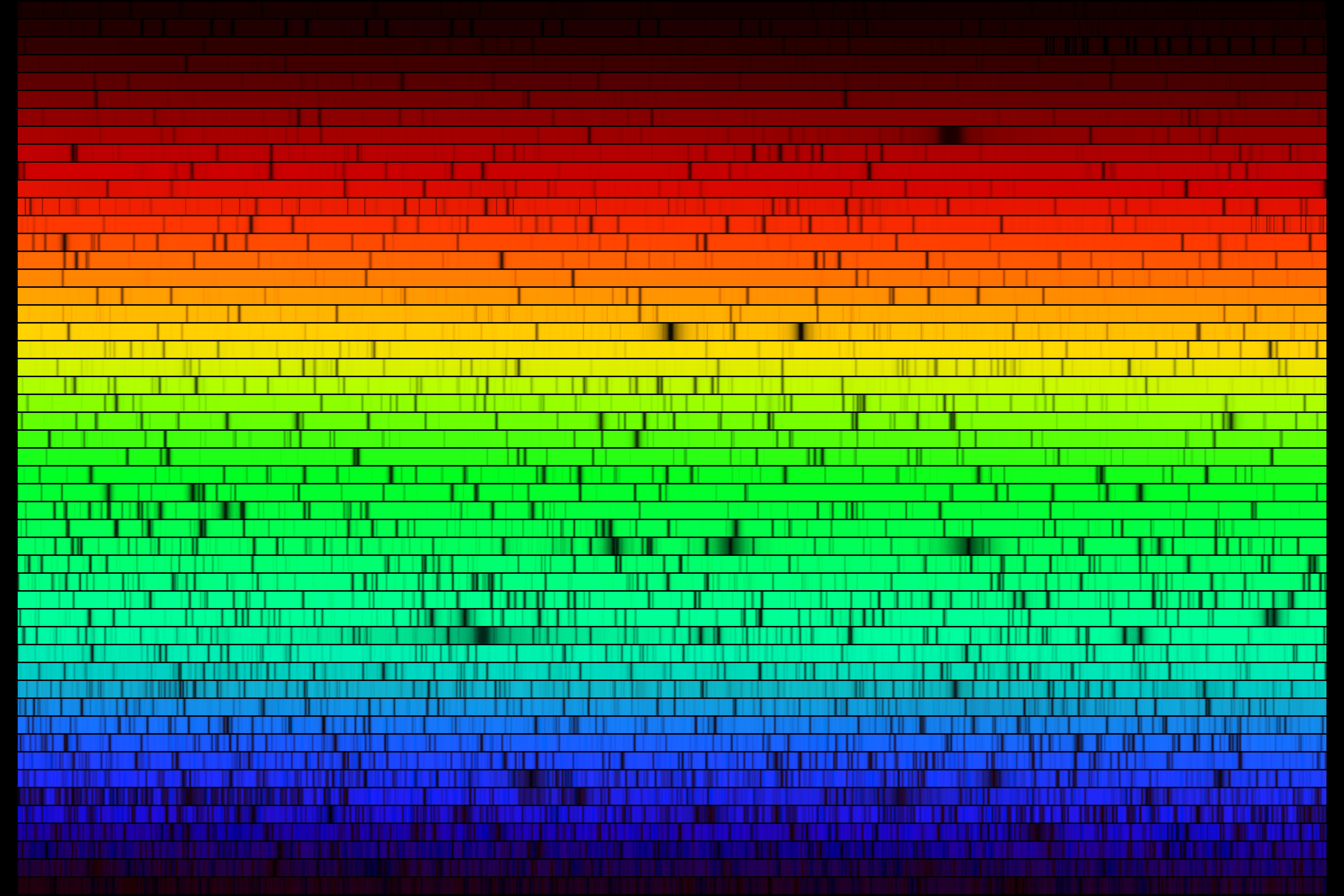
The visible light spectrum of the Sun, which helps us understand not only its temperature and ionization, but the abundances of the elements present. The long, thick lines are hydrogen and helium, but every other line is from a heavy element that must have been created in a previous-generation star, rather than the hot Big Bang.
Credit: N.A.Sharp, NOAO/NSO/Kitt Peak FTS/AURA/NSF
While it takes an enormous amount of effort and observational dedication to discover whether a star has planets or not orbiting around it, it’s relatively easy to measure the heavy elements content of a star: what astronomers call its metallicity. To an astronomers, the word “metal” means something very different from its conventional use. While some astronomical metals are indeed metallic — lithium, iron, nickel, and copper among them — a metal is simply any element of the periodic table that isn’t hydrogen or helium. If you take all of your heavier elements that are present in a star and sum them up, and compare them to the overall amount of hydrogen and helium in that star, that’s the astronomical definition of metallicity.
However, not all elements in all stars are created equally, or in equal amounts. We know that:
elements come from many different sources, like supernovae, kilonovae, giant stars, and tidal disruption events,
that even individual events, such as supernovae, often produce asymmetric ejecta, enriching regions found in different directions with different abundance ratios of elements,
and that when stars form, they do so in large batches at once, likely implying that any individual region would likely be enriched by multiple stars that have lived-and-died, not just by one individual star.
We have to keep all of this in mind whenever we look at any star, and inquire about, “where did it come from?”
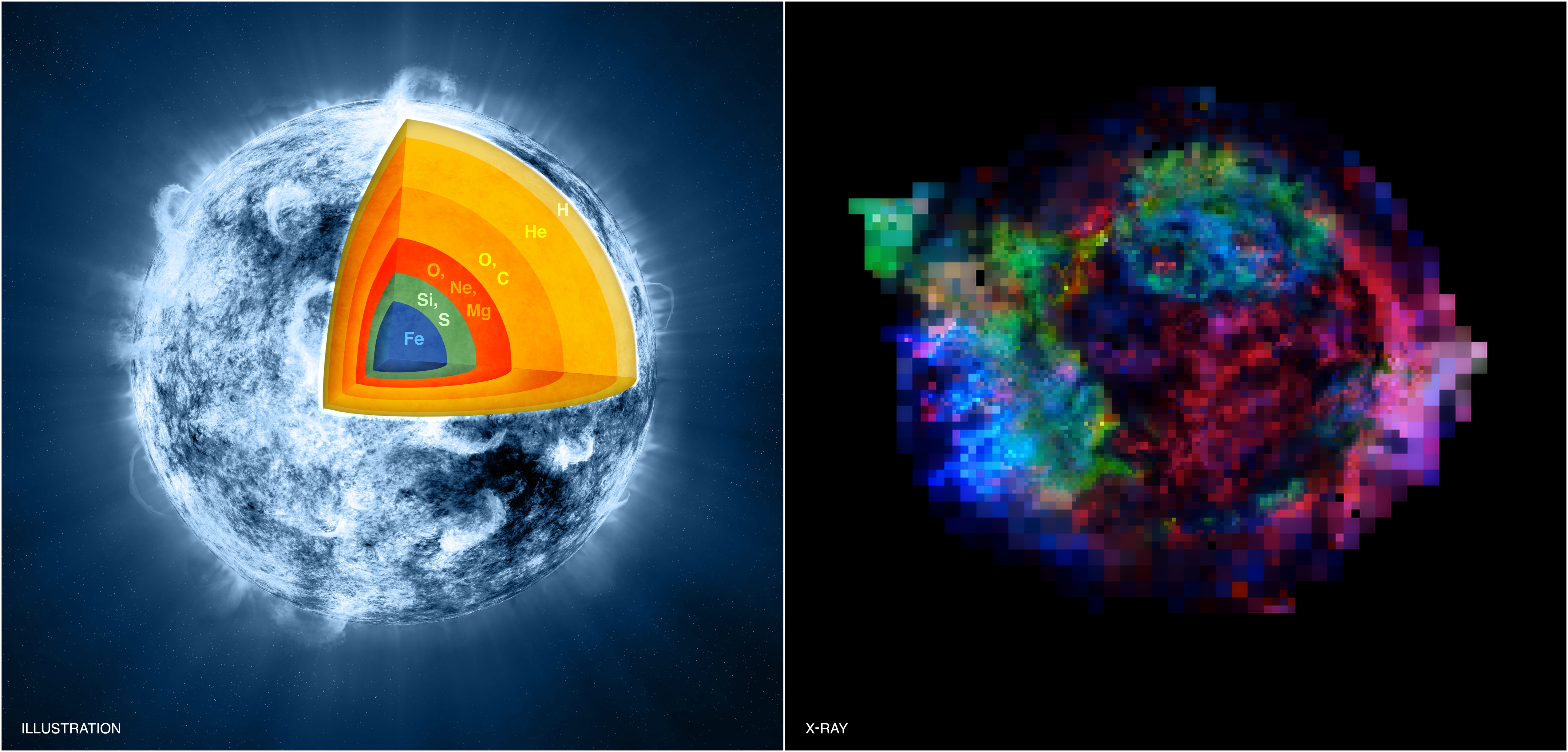
Artist’s illustration (left) of the interior of a massive star in the final stages, pre-supernova, of silicon-burning. (Silicon-burning is where iron, nickel, and cobalt form in the core.) A Chandra image (right) of the Cassiopeia A supernova remnant today shows elements like iron (blue), sulfur (green), and magnesium (red). Ejected stellar material can glow due to heat in the infrared for tens of thousands of years, and the ejecta from supernovae can be asymmetric and can have segregated elements within it, as shown here. In the right environment, this asymmetric material can be unevenly incorporated into future generations of stars.
Credits: NASA/CXC/M.Weiss (illustration, left) NASA/CXC/GSFC/U. Hwang & J. Laming (image, right)
We understand the stars that form nearby very well: we see them forming in large and small populations, with a wide variety of metallicities to them. However, most of the new stars that are being formed are Population I stars: not entirely surprising given the advanced age of our 13.8 billion year old Universe, and our (astronomically) metal-rich environment here in the Milky Way. There are exceptions, of course, from individual metal-poor stars to populations of stars in very low-metallicity neighborhoods, but when we see stars forming in general, they generally occur in modern, heavily-enriched environments.
However, when we try and understand the first generation of stars, we fully expect the situation would’ve been very different. Whenever stars form, they:
arise from a cloud of neutral atoms,
that cools radiatively and contracts,
fragmenting into many different clumps,
where those clumps cool and collapse under their own gravity,
where their cores heat up,
and eventually reach the conditions necessary to ignite nuclear fusion inside of them,
which officially triggers the birth of a full-fledged star. However, the “thing” that happens that allows clouds of gas to cool radiatively is that heavy elements and molecules do the radiating. In a Population I or even a Population II star, that’s fine: there are plenty. But early on, for the first generation of stars, that would have been quite difficult with hydrogen and helium alone.
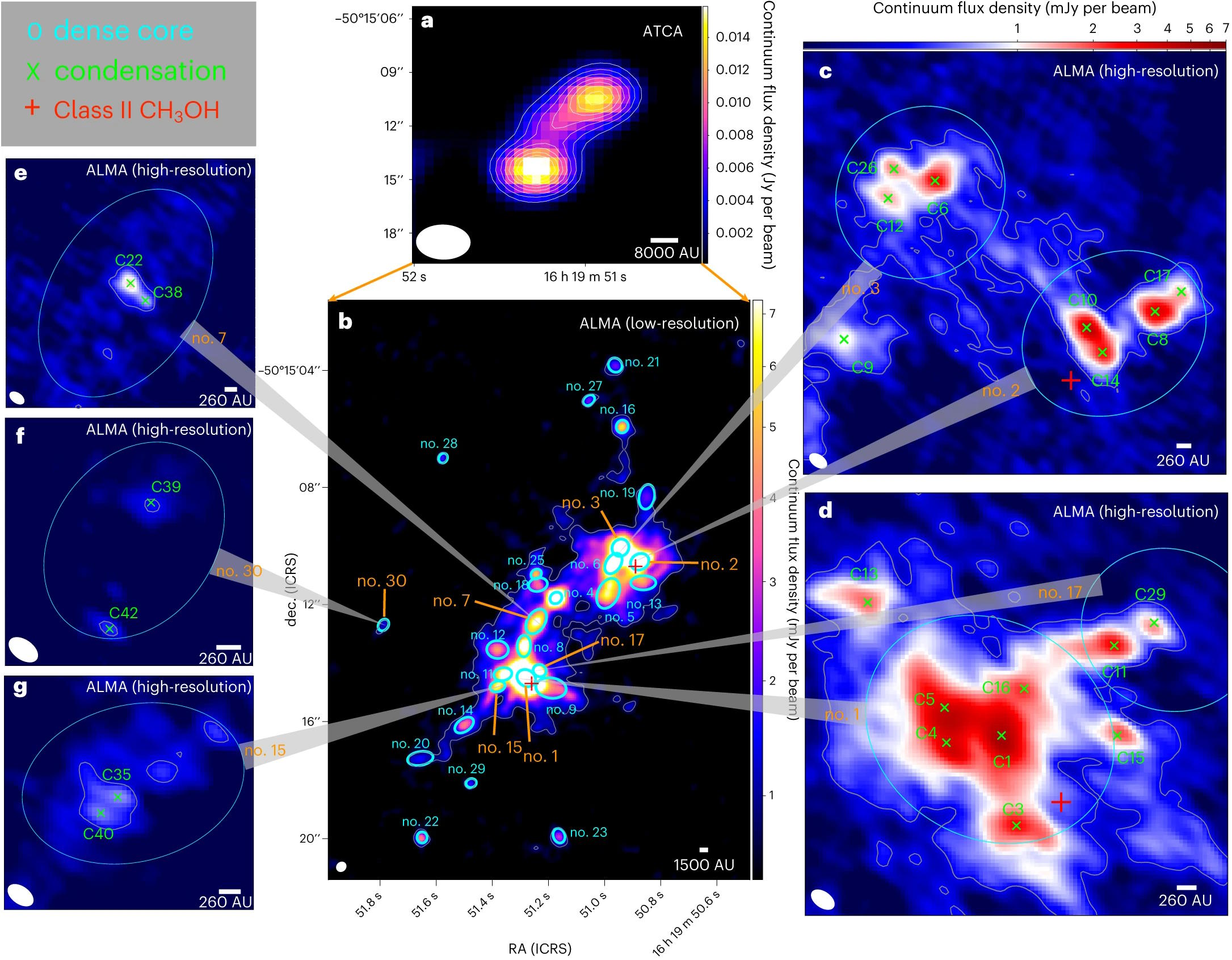
The dense cores of protostar cluster G333.23–0.06, as identified by ALMA, show strong evidence for large levels of multiplicity within these cores. Binary cores are common, and groups of multiple binaries, forming quaternary systems, are also quite common. Triplet and quintuplet systems are also found inside, while, for these high-mass clumps, singlet stars turn out to be quite rare. It is expected that the stars forming in nebulae all throughout the Universe, including in the Eagle Nebula, have similar clumpy, fragmented properties.
Credit: S. Li et al., Nature Astronomy, 2024
Today, based on observations, we can conclude that the average mass of a new star that forms is only about 40% of the Sun’s mass. Moreover, 95% of all stars that form are less massive than our Sun is (at once solar mass), whereas only a tiny fraction — fewer than 1% of all stars — are born massive enough to die in a core collapse supernova. However, for the first generation of stars, that set of pristine Population III stars, simulations and models indicate that the average mass of a new star was 10 solar masses, and that the majority of Population III stars lived for just a few million years before dying in a core-collapse supernova.
In other words, whenever you form stars for the first time, they burn bright and fast, die early, and enrich the interstellar medium rapidly. You should only have a very small window of time to observe them before more evolved Population II stars arise alongside them. And, because they lacked the ability to cool in the early phase where they formed, there ought not be any low-mass Population III stars remaining; they all died long ago.
The key, then, to finding the legacies of these pristine stars are twofold:
to look nearby, and take a spectrum of a star to find the most metal-poor star possible,
or to look in the distant Universe, early on, beyond where individual stars are resolvable, and to measure the dust and spectral contents of collections of stars in galaxies, and measure how poor their metallicities are.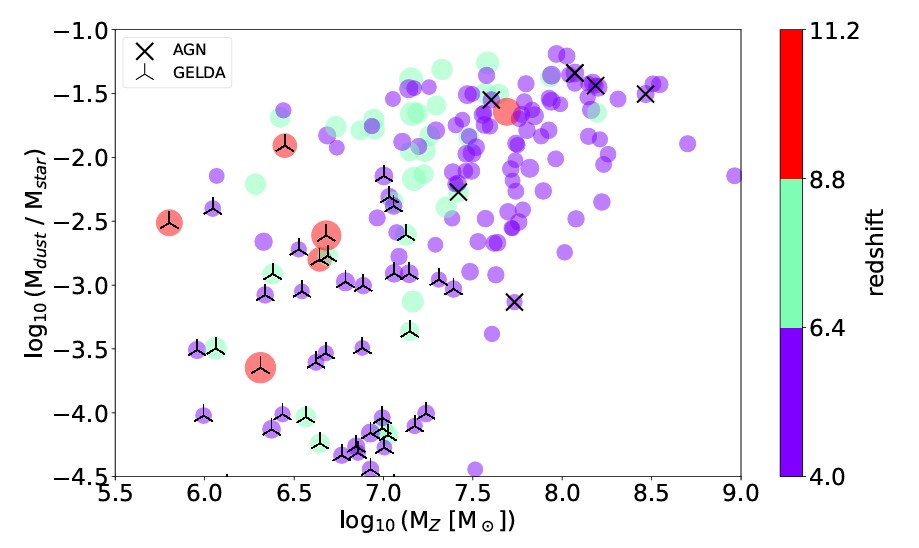
This plot shows galaxies from the first ~1.5 billion years of cosmic history, color-coded by redshift and plotted by their metallicity (x-axis) as a function of the dust-to-stellar mass ratios (y-axis) found within them. The majority of low-metallicity galaxies are also dust-poor and are known as GELDAs, dominating the very early Universe, while later-time, more dust-rich galaxies are much more enriched in heavy elements.
Credit: D. Burgarella et al., Astronomy & Astrophysics accepted/arXiv:2504.13118v2, 2025
The above graph is what we’ve learned by looking at distant galaxies here in the JWST era: galaxies from the first 1.5 billion years of cosmic history. On the y-axis is dust content (dust requires the existence of stars, as a prerequisite, in order to be produced), while on the x-axis is metallicity itself. The Sun’s metallicity, for reference, is generally talked about as “solar metallicity,” where metallicities of other stars are often compared to solar metallicity. The Sun, with an overall metallicity of 8.6 on this scale (using the Sun’s oxygen abundance, for reference), is nearly three orders of magnitude more abundant in terms of metals than the most metal-poor ancient galaxy shown on the graph above, with the left-most galaxy having about 0.15% of the heavy element content of the Sun.
This teaches us an important piece of information: how far away we are from finding a source in the ancient Universe that’s truly pristine, or metal free. We can estimate metallicity by using a single element, such as oxygen, carbon, or iron, but that runs the risk of biasing us. After all, we’ve already talked about how different histories for the prior generations of stars, or even different directions with respect to the same star, can wind up with different ratios of elements. That’s why it’s important to measure the Sun, our reference point, for a wide variety of elemental signals, and then to compare a variety of signals with any star whose metallicity (and other composition-related properties) we seek to know.
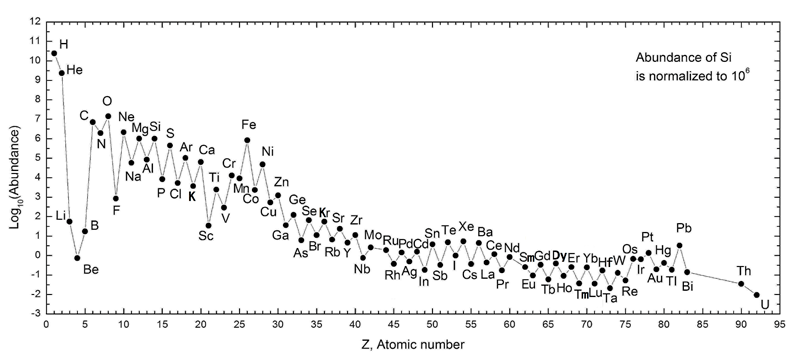
The relative abundances of elements in the Solar System has been measured overall, with hydrogen and helium the most abundant elements, followed by oxygen, carbon, and numerous other elements. However, the compositions of the densest bodies, like the terrestrial planets, are skewed to be a vastly different subset of these elements. Overall, some ~90% of the atoms in the Universe, by number (but only ~70-72%, by mass), are still hydrogen, even after 13+ billion years of star-formation.
Credit: 28bytes/English Wikipedia
Above, you can see the heavy element abundance for the Solar System: dominated by the Sun. While hydrogen (73.5%) and helium (25%) are still the most abundant elements of all, making up over 98% of the Sun’s mass, there’s:
oxygen (0.77%),
carbon (0.4%),
iron (0.14%),
neon (0.12%),
nitrogen (0.09%),
and silicon (0.07%),
after that. The roughly 1.5% of the Sun that’s in the form of heavy elements comes from 9.2 billion years of cosmic history — of star-formation, stellar death, stellar cataclysms, and of continued enrichment of the interstellar medium — that led to our Sun and Solar System being born with the composition that it initially had.
So we have to be careful, when we’re comparing stars that are very different from the Sun with the Sun itself, that we don’t just look at one single element and say, “oh, this is the most pristine star we’ve ever found.” No; we need to look at multiple elements, as there are many stars with a low iron abundance but a high carbon abundance, for instance, and we don’t want to be fooled by them.
In 2011, a star in the Milky Way’s halo known as J1029+1729 was discovered and analyzed, having just 0.01% of the total heavy elements found in the Sun. But now, a new star from the Large Magellanic Cloud, SDSS J0715-7334 was identified and had a high-resolution follow-up conducted on it, and a new paper published in early April in Nature Astronomy confirms it as the most pristine star ever yet identified.
![Scatter plot of [C/H] vs. [Fe/H] for various stars, including astronomers' most pristine star, with colored symbols for different objects and a highlighted red band at D_trans = -3.5.](https://www.ufofeed.com/wp-content/uploads/2026/04/abundance.jpg)
This graph shows the iron abundance (x-axis) and the carbon abundance (y-axis) of many different low-metallicity stars. While there are many iron-deficient stars shown on the left of the graph, they almost all have substantial carbon abundances, suggesting that they aren’t extremely metal-poor overall, just in one particular element. For contrast, J1029+1729 and J0715-7334 are both severely iron and carbon deficient, making them the two most metal-poor stars known today.
Credit: A.P. Ji et al., Nature Astronomy, 2026
Based on orbital data, the scientists studying this star were able to conclude that it originates from the halo of the Large Magellanic Cloud, where stars in the halo (instead of towards the central bulge or in the disk) of a galaxy are usually the most metal-poor ones of all.
What’s interesting about this star is that it isn’t a low-mass dwarf star, like you might expect, but rather an evolved red giant star: a star not so different than our Sun, just a little bit lower in mass and more evolved (as it’s likely much older), and hence bright, cool, and easier to observe and obtain detailed properties of than a normal Sun-like star, and much easier than a red dwarf star.
Based on data from the Magellan telescope with the Magellan Inamori Kyocera Echelle (MIKE) instrument, the team was able to obtain a spectrum for the star, showing clear absorption line signatures associated with aluminum, hydrogen, iron, magnesium, and even a molecule with calcium bonded to hydrogen. No carbon was detected, but an upper limit on the amount of carbon was placed and found to be very tightly constrained. Overall, the observations teach us that this star, known as J0715-7334, is the most pristine, metal-poor star known overall, with just 0.005% of the heavy element content of the Sun.
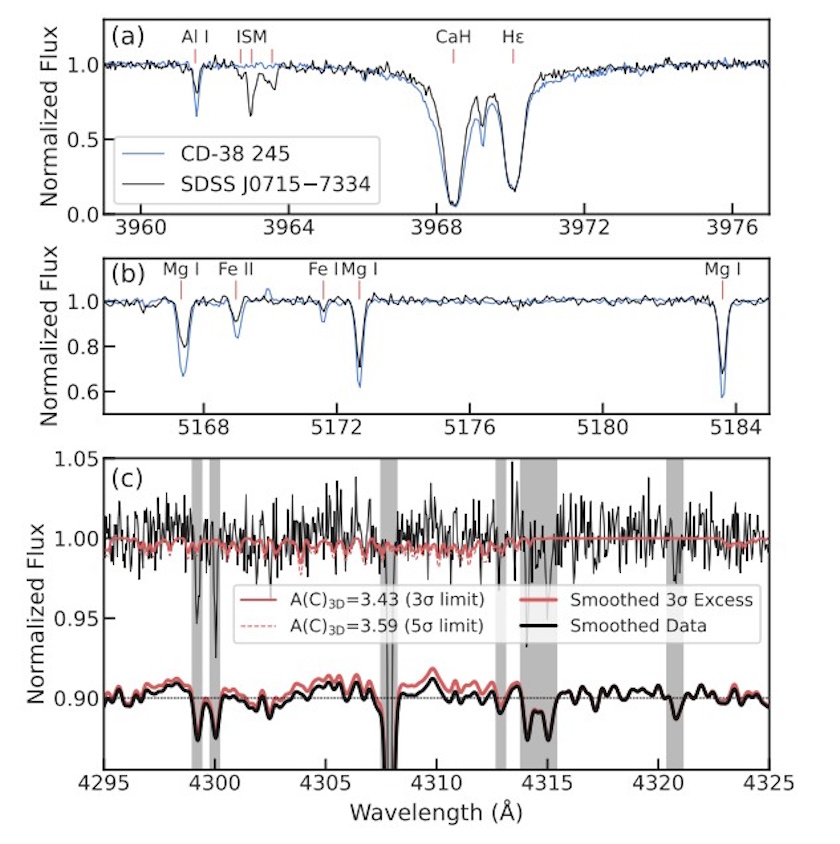
This graph shows the MIKE instrument’s spectrum for the star SDSS J0715-7334, along with another metal-poor star, CD-38 245, for reference. Note the shallow but substantial absorption signatures for J0715-7334, showcasing its extraordinary metal-poor nature, and the lack of a carbon detection in panel c, placing strong constraints on the overall carbon abundance of the star.
Credit: A.P. Ji et al., Nature Astronomy, 2026
Observing a star like this doesn’t just bring us one incremental step closer to the discovery of a star that’s truly pristine, although it does indeed do precisely that. In addition, it helps us address one of the key questions affecting everyone who’s interested in understanding how stars grow up in our Universe: what is it, precisely, about chemical enrichment that transforms an initial (Population III) set of high-mass, short-lived stars into one where most of the stars that form are low-mass and long-lived?
In other words, how does an enriched population of gas form stars in a fundamentally different fashion than a pristine population of gas, with practically nothing other than hydrogen and helium?
The leading thought is that something about heavy elements is particularly more efficient at cooling than a pristine population of hydrogen and helium alone. For the first stars, cooling is thought to primarily occur through hydrogen gas (H2) and helium hydride (HeH+) radiating heat away: a very inefficient process, but one that can explain the suspected high masses of these first stars. For slightly enriched populations, the two main ideas are fine-structure cooling (through carbon and oxygen lines) or thermal cooling via dust. The discovery of J0715-7334 effectively rules out the fine-structure cooling scenario (as there’s too little carbon and oxygen to make it work), and tells us that dust cooling is likely the culprit here.
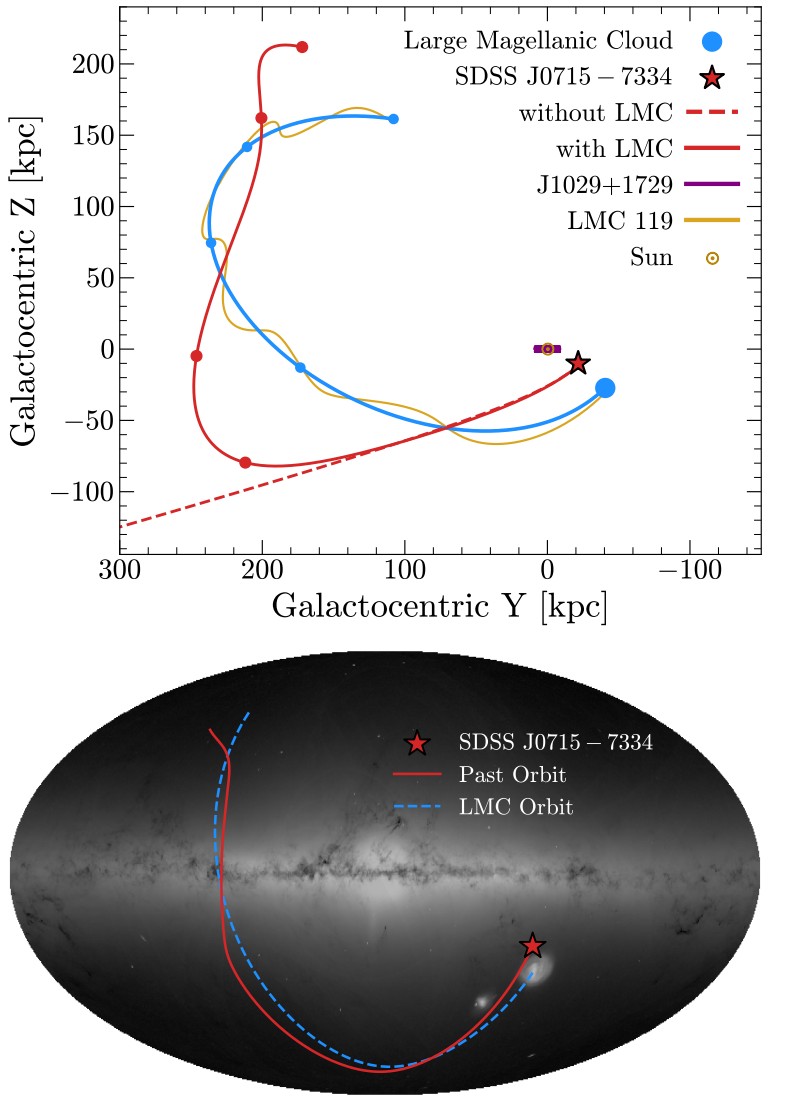
This figure shows the past orbit of the star J0715-7334 in galactic coordinates over the past 4 billion years, where the LMC and the star in question are shown relative to the Milky Way in the bottom panel, relative to all the Milky Way stars presently observed by Gaia. The star, from a kinematic reconstruction, appears to be from the outer halo of the LMC, not from the Milky Way itself.
Credit: A.P. Ji et al., Nature Astronomy, 2026
What’s interesting is that “dust cooling” requires an abundance of heavy elements of at least 0.001% of the Sun’s abundance in order for that to be sufficiently effective; if we ever find a Population II star with a lower overall metallicity, we will have no way, using conventional physics, to explain its existence. Another interesting thing about this star — although it is a bold and dangerous extrapolation to make — is that one can compute, from stellar nucleosynthesis models, “what kind of pristine star’s supernova could explain this star’s heavy element abundances,” and the answer is a Population III star of approximately 30 solar masses and a high explosion energy.
As the authors point out, finding a star this metal-poor shows us just how far away we are from truly finding a population of pristine stars (i.e., “the first stars”) using JWST to probe the distant Universe. As they state unequivocally:
“The launch of the James Webb Space Telescope has led to a flurry of discoveries of extremely metal-poor high-redshift galaxies… These are undoubtedly exciting objects, but the metallicity constraints remain an order of magnitude away from legitimate claims of detecting Population III stars… at least 10 times better signal-to-noise ratios are needed in order to show that these high-redshift galaxies are not Population II galaxies composed of stars like J0715−7334. The search for Population III stars continues.”
Remember this the next time you read claims along the lines of astronomers thinking they’ve spotted the first stars. The instrumentation capabilities simply aren’t there, and this new star, the most pristine one ever found, shows us just how far we have to go in the journey towards definitively finding them.