
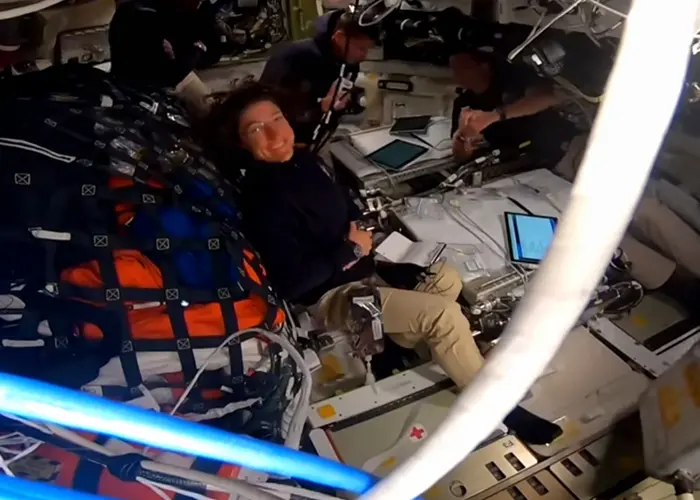
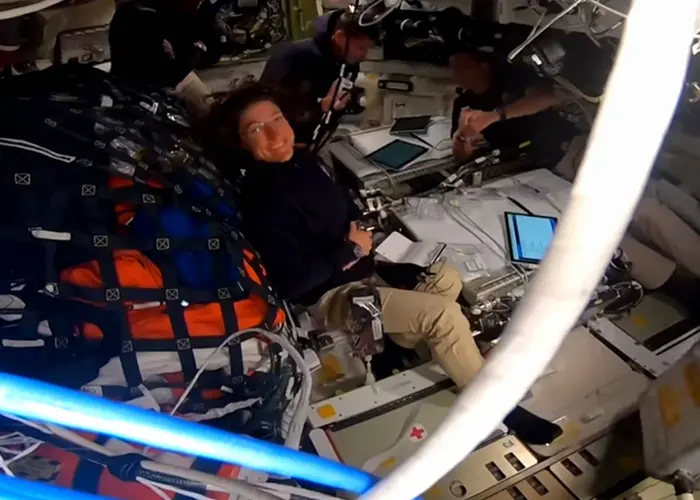
NASA says the four-person Artemis II crew has surpassed the Apollo 13-era record for the farthest distance humans have travelled from Earth, marking a milestone for the agency’s first crewed mission under its Artemis program.
According to NASA, astronauts Reid Wiseman, Victor Glover and Christina Koch, along with Canadian Space Agency astronaut Jeremy Hansen, passed the previous record at 12:56 p.m. CDT on Monday, April 6, when the Orion spacecraft reached 248,655 miles from Earth. NASA said Orion is expected to reach about 252,760 miles at its farthest point before turning back toward Earth.
The record matters beyond symbolism, as Artemis II is designed as a test flight to validate the performance of the Orion spacecraft and NASA’s deep-space operations, including navigation, communications and imaging activities that will be used to plan later lunar missions.
NASA said the mission began with an April 1 launch from Kennedy Space Center in Florida on a Space Launch System (SLS) rocket, followed by a series of engine burns to depart Earth orbit and set course for the Moon.
In a statement included in the agency’s release, Dr. Lori Glaze, acting associate administrator for NASA’s Exploration Systems Development Mission Directorate, said: “At NASA, we dare to reach higher, explore farther, and achieve the impossible. That’s embodied perfectly by our Artemis II astronauts – Reid, Victor, Christina, and Jeremy. They are charting new frontiers for all humanity.”
After the record was reached, Hansen delivered remarks from the spacecraft, saying: “From the cabin of Integrity here, as we surpass the furthest distance humans have ever traveled from planet Earth, we do so in honoring the extraordinary efforts and feats of our predecessors in human space exploration… But we most importantly choose this moment to challenge this generation and the next to make sure this record is not long-lived.”
NASA said the crew has continued to collect imagery of the Moon during the outbound leg of the mission and will later pass within about 4,070 miles of the lunar surface at closest approach. The agency also expects a communications blackout of about 40 minutes during a planned period when the spacecraft passes behind the Moon and signals are blocked, before Orion re-establishes contact through NASA’s Deep Space Network with flight controllers in Houston.
NASA said the crew suggested naming two lunar craters during the flight, with proposals to be formally submitted after the mission to the International Astronomical Union, which oversees naming of celestial bodies and surface features.
The agency said Artemis II is more than halfway through its mission, with splashdown scheduled off the coast of San Diego at approximately 8:07 p.m. EDT (5:07 p.m. PDT) on Friday, April 10, followed by recovery operations and post-flight medical evaluations aboard the USS John P. Murtha.
NASA said data collected from the test flight—including photos, video, telemetry and communications—will be used to inform future Artemis missions and support longer-term plans for lunar exploration.
More information: https://www.nasa.gov/artemis-ii